

Navigating the path to legal status in this Central American nation can seem complex. A common route for foreign nationals involves a significant financial commitment. Many believe recent regulatory updates closed a key avenue—this guide corrects that record.
We focus specifically on the Inversionista, or Investor, residency category. It is distinct from other temporary options like Pensionado. The law permits qualifying by investing in various assets, including shares in an active local corporation.
A widespread misconception is that Law 9996 eliminated this corporate investment pathway. It did not. The foundational immigration law still supports this route for those investing at least US$150,000.
We provide transparent, realistic guidance. This process requires thorough documentation and ongoing corporate compliance. There are no shortcuts or guaranteed approvals.
Starting your document preparation from home—before arrival—can significantly streamline your timeline. This article offers a step-by-step overview of the entire process, from eligibility to maintaining your status.
Our role is to be your knowledgeable guide through this intricate legal landscape. For personalized advice beyond this resource, our team is ready to assist.
Introduction: Why Choose Investor Residency in Costa Rica?
The appeal of establishing legal residence here extends beyond scenic beauty to tangible legal and financial benefits. This nation is celebrated for its enduring political stability and democratic traditions, creating a secure environment for your capital.
We explain the unique advantages of the Inversionista program. It offers a territorial tax system—you’re typically taxed only on local income. Qualifying investment income can be exempt, a significant benefit for portfolio holders.
It’s crucial to distinguish between holding a temporary residence permit and becoming a tax resident—the latter requires 183+ days physically in the country per year. Also, note that temporary Digital Nomad visas do not provide the same long-term legal status or pathway to citizenship.
This residency is granted initially for two years and is renewable. It provides access to the public healthcare system and embodies the “Pura Vida” lifestyle. After seven continuous years, you become eligible to apply for citizenship. This pathway requires significant commitment and patience with administrative timelines.
Understanding Investor Residency Requirements in Costa Rica
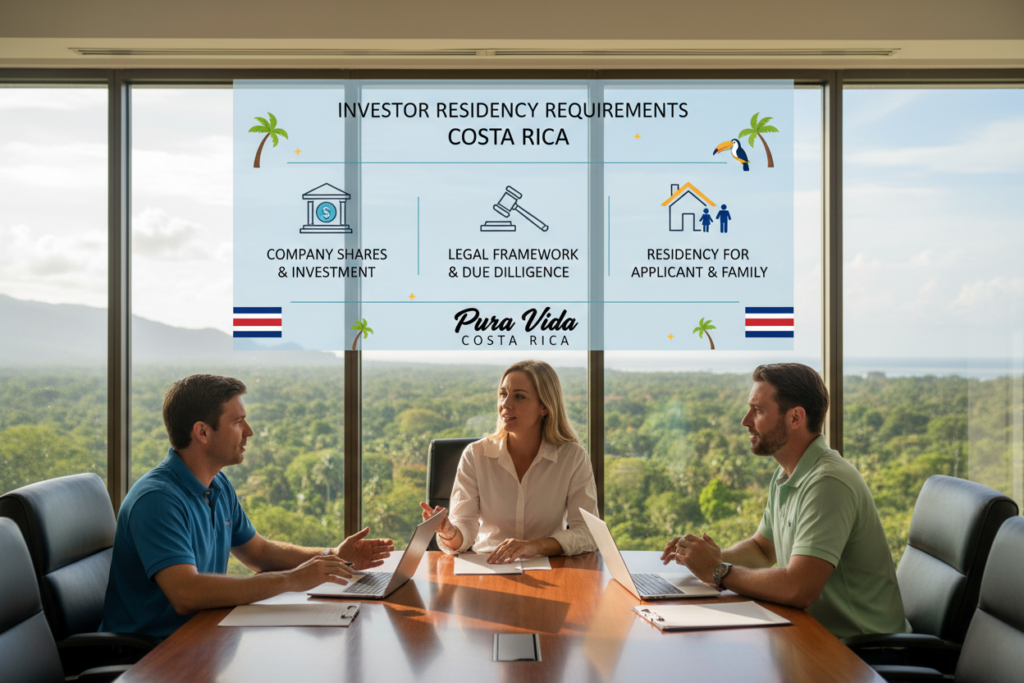
Costa Rican immigration law defines three primary pathways for temporary residency, each with distinct financial thresholds. Understanding these official categories is the first step.
Eligibility Criteria and Spanish Categories
The law establishes clear categories. The Pensionado (Pensioner) category requires a guaranteed lifetime pension of at least USD $1,000 monthly.
The Rentista (Person of Independent Means) category demands proof of stable income—USD $2,500 per month for two years. The Inversionista (Investor) category is our focus.
Investment and Income Thresholds
For the Inversionista category, you must invest a minimum of USD $150,000. Qualifying assets include real estate, corporate shares, or productive projects.
A critical rule: if using real estate, the property must be in your personal name. An active local corporation’s shares provide a separate, valid pathway.
Beyond capital, applicants need a clean criminal record and must show financial self-sufficiency. The investment must be maintained continuously to renew your status every two years.
These are non-negotiable statutory requirements. Meeting them opens a potential pathway to Costa Rican citizenship after years of continuous legal residence.
Costa Rica Investor Residency Through Company Shares
Article 7(B) of the national immigration decree formally recognizes corporate share ownership as a valid investment for residency purposes. This legal provision allows foreign nationals to qualify by holding equity in an active local business entity.
A common misconception is that newer regulations closed this pathway. They reorganized categories and increased scrutiny but did not repeal the authorization for this type of capital commitment.
Most locally registered entities start with a minimal stated capital. To meet the requirement, the corporation’s official records must be amended to reflect a capital stock of at least US$150,000.
The entity must be registered as an active taxpayer with the national revenue service. It must file monthly VAT returns and an annual income tax declaration, even with no activity.
These ongoing filings typically require a local certified public accountant. Applicants also need a recent notarial certificate of share capital and a CPA letter confirming the investment value.
This route suits those who already own a business or hold property within a corporate structure for liability reasons. We note it offers flexibility but imposes recurring administrative duties that a direct personal investment does not.
Step-by-Step Guidance for a Successful Application
The key to a smooth immigration journey lies in organizing your documents well in advance. We provide a clear roadmap for the entire application process. Starting your preparation from home is the most effective strategy.
Document Preparation: Apostilles, Translations, and More
Your first task is gathering core paperwork. This includes your valid passport, birth certificate, and if applicable, a marriage certificate. Each document from abroad needs an apostille for official recognition.
Next, every paper must be translated into Spanish by a certified professional. You will also need a recent police clearance certificate. Remember, children under 12 are exempt from this last requirement.
Include two passport photos and a formal request letter in Spanish. A US$250 government deposit completes the initial package. Proof of consular registration is another mandatory step.
Managing Timelines and Avoiding Common Mistakes
Realistically, this process takes six to twelve months from submission. Delays often stem from simple oversights. A common error is submitting an expired police clearance.
Incorrect apostilles or poor-quality translations also cause setbacks. Ensure all your paperwork is current and perfectly prepared. We advise verifying every detail against official sources like migracion.go.cr.
By starting early, you can submit a complete application soon after arrival. This minimizes your waiting period in tourist status.
Structuring Your Investment: Direct Investment vs. Corporate Shares
Two primary frameworks exist for meeting the financial requirement: direct asset ownership or corporate equity. If you use real estate, the property must be titled in your personal name. The corporate shares pathway offers a different structure.
Advantages of Using an Active Costa Rican Corporation
Holding your commitment through a local company provides key benefits. You gain limited liability protection for your personal assets. This structure also simplifies estate planning and offers operational flexibility for running a business.
Necessary Legal and Document Updates
The corporation’s capital stock must be officially increased to at least US$150,000. This amendment is recorded in the Public Registry.
The entity must also be active with the national tax agency. It must file monthly VAT returns and an annual income tax declaration. A certified public accountant provides a letter confirming the investment value.
Increasing the stated capital does not trigger higher taxes. It’s a one-time legal update. The choice between direct and corporate investment is strategic, based on your goals for liability and administration.
Overcoming Common Application Mistakes
We consistently observe the same administrative oversights tripping up otherwise qualified applicants. These errors cause frustrating delays or even denials in the immigration process.
The most frequent issue is submitting expired or incorrectly apostilled documents. Police clearance certificates are a particular weak point—they must be recent and bear the proper Hague Convention stamp.
For those using a corporate structure, two critical gaps exist. First, the entity’s stated capital must be officially increased to meet the threshold. Second, the company must be registered as an active taxpayer with filed returns.
Translation quality and document timing are also vital. All foreign paperwork needs certified Spanish translations. Notarial certificates for share capital are only valid for 30 days from issuance.
Applicants must also maintain valid tourist status while their file is pending. Underestimating the ongoing costs for legal and accounting compliance is another common budgeting mistake.
Remember, even perfect documentation offers no guarantees. Approval rests with immigration authorities. Our guidance focuses on helping you avoid these common pitfalls.
Essential Documents to Prep Before Arrival
Success hinges on meticulous preparation, beginning with a complete set of legalized documents. We provide a clear pre-departure checklist. Gathering everything at home is the most effective way to accelerate your timeline.
Your core paperwork includes a valid passport with six months’ validity. You will need an apostilled birth certificate and a recent police clearance. If married, include an apostilled marriage certificate.
Proof of your financial commitment is mandatory. This means certified property deeds or corporate share certificates. All foreign-language papers require official Spanish translations.
Start this process three to six months before traveling. This lead time ensures documents remain valid. Arriving with a ready dossier lets you file your application within weeks.
Timelines and Milestones During the Immigration Process
Understanding the sequence of events in your immigration journey helps manage expectations and plan effectively. We outline realistic phases from filing to final approval.
The pre-arrival phase involves gathering, apostilling, and translating documents. If managed proactively from home, this typically takes three to six months.
Upon arrival with a complete dossier, you can file your formal application within weeks. The initial review by authorities usually takes one to three months.
From submission to resolution, most applications take six to twelve months. Authorities may request additional information—prompt replies prevent delays.
After approval, you must enroll in the national healthcare system (CCSS), a process requiring one to two months. Your official DIMEX card follows shortly after.
The initial permit is valid for two years and is renewable. After seven continuous years of legal status, you become eligible to apply for citizenship.
These are typical timelines, not guarantees. We advise checking migracion.go.cr for the latest official processing times.
Special Considerations for Residency and Future Citizenship
Looking beyond the initial two-year permit, a common question arises about the possibility of obtaining a Costa Rican passport. The Inversionista category can serve as a pathway, but it’s crucial to understand the distinct steps.
First, you must maintain continuous legal status for seven years. This clock starts from your first approval. You must also enter the country at least once per calendar year to keep your residency active.
Residency grants you the right to live and work here. It does not provide voting rights or a local passport. Full citizenship is a separate, discretionary process after the seven-year period.
Additional requirements for naturalization include Spanish proficiency and cultural knowledge. Short-term visas, like the Digital Nomad program, do not count toward this timeline.
For those with long-term goals, formal residency categories are the only route. You can uncover detailed specifics on citizenship by for deeper planning. We provide guidance, but final approval rests with national authorities.
Starting Your Application from Home: Organize Your Documents Early
The most significant time-saver in the entire immigration procedure begins in your home country. We strongly advise starting your residency application long before you travel. This proactive approach slashes months off your total timeline and drastically reduces stress.
Applicants who organize everything domestically can often file within weeks of arrival. Those starting from scratch locally may wait an extra four to eight months. The difference is entirely in your preparation.
Begin by requesting certified copies of your birth certificate and a national police clearance. If married, get your marriage certificate too. These are your foundational papers.
Next, research how to get an apostille for each document from your country’s competent authority. Simultaneously, engage a certified Spanish translator. Having translations done early removes a major bottleneck later.
This methodical, project-based mindset is the hallmark of a successful candidate. You arrive ready to submit, not to scramble. It lets you focus on settling into your new life from day one.
Navigating Legal and Financial Obligations for a Smooth Process
We outline the key ongoing tasks required to keep your residency valid and in good standing. Your first step is opening a local bank account. This is necessary to pay the mandatory government deposit of US$250 and other fees.
Engaging a local attorney or notary is highly recommended. They authenticate documents and prepare the formal Spanish application letter. This professional guidance helps navigate procedural requirements.
After approval, enrollment in the CCSS social security system is mandatory. Monthly contributions are calculated based on your declared income or business activity. This funds your access to public healthcare.
If your pathway involves a corporation, strict tax compliance is essential. The entity must file monthly VAT returns and an annual income declaration. A local CPA typically manages these filings.
Maintaining this compliance is critical for renewal. Budget for ongoing CPA and legal fees alongside your initial investment. These are continuous responsibilities, not one-time hurdles.
Final Thoughts: Secure Your Costa Rican Future with Informed Decisions
Making an informed decision today can unlock a lifetime of benefits in this welcoming country. The investor pathway via corporate equity remains a valid legal option under current regulations.
It requires a minimum capital commitment of US$150,000 into an active local entity. This entity must maintain strict tax compliance and demonstrate genuine economic activity.
Successful applicants must prepare extensive documentation, including apostilled personal records and verified proof of investment. Realistic timelines range from six to twelve months for approval.
This status offers renewable two-year permits, access to healthcare, and a potential route to citizenship after seven years. It demands ongoing administrative diligence and annual visits.
We encourage you to start early and seek expert guidance. For personalized assistance, contact our team at info@crie.cr or WhatsApp +506 8706 3888.
We provide transparent, professional support grounded in the law, helping you navigate with confidence.
FAQ
What are the main visa categories for financial residency?
Can I really use my existing company shares for the investment requirement?
What documents are the most critical to prepare early?
How long does the entire application process typically take?
What common mistakes should I avoid during the application?
Does this residency lead directly to citizenship?
Do I need to open a local bank account?
What are my tax obligations after obtaining residency?
Article by Glenn Tellier (Founder of CRIE and Grupo Gap)
Don't wait, contact us right now!
Call or WhatsApp Costa Rica +506 8373 2085 or +506 8706 3888
Call USA/Canada +1 305-906-6784