
For an emergency in Costa Rica, call 911. Use it when urgent police, fire, rescue or medical help is needed. Do not delay an emergency call while searching for a local office number.
Essential contacts to save
| Service | Number | Purpose |
|---|---|---|
| Emergency response | 911 | Urgent police, fire, rescue and medical assistance |
| National Poison Control Centre | 800-4686-9422 | 800-INTOXICA: specialist advice about suspected poisoning, available 24 hours |
| OIJ confidential information line | 800-8000-645 | Anonymous information relevant to criminal investigations; not emergency dispatch |
| INS accident reporting | 800-800-8000 | Contact for an applicable INS motor-insurance claim; follow your own insurer’s procedure |
| U.S. Embassy, main line | +506 2519-2000 | Consular assistance for U.S. citizens |
| U.S. Embassy, after-hours emergency | +506 2220-3127 | Urgent consular assistance; not a replacement for 911 |
Numbers beginning 800 are presented for use within Costa Rica. Save your own embassy, insurer and accommodation contacts as well. If a call does not connect, ask someone nearby or your accommodation to help contact the appropriate service.
Police, fire and ambulance: start with 911
The Costa Rican Red Cross identifies 9-1-1 as the emergency number and distinguishes it from its administrative telephone. This guide uses 911 rather than unverified legacy short codes for separate services.
Tell the operator where the emergency is, what happened and how many people need help. Give the location you know immediately; do not postpone calling while trying to collect perfect coordinates. Follow the operator’s questions and instructions.
If you need English assistance, say so promptly. Preparing your accommodation’s address and useful landmarks in advance can help communication, especially in an unfamiliar area.
Giving your location the way Costa Rica works
This is where foreigners lose time. Costa Rican addresses are not street numbers, and the 9-1-1 service asks for the location as precisely as possible using province, cantón and district, supported by landmarks — streets and avenues, cardinal directions, and places anyone would know such as a shopping centre, park, church, school or hotel. “Two hundred metres south of the church” is a real address here and it is genuinely more useful to a dispatcher than a pin you are still trying to read off a map.
Learn the province, cantón and district of your own home before you need them, and of anywhere you spend time. Write them down where a guest or a cleaner could find them. This is a five-minute job that only matters once.
What the operator will ask
What is happening, and in what detail: descriptions of the people involved, vehicles, whether there are weapons, and how long ago it happened. Then where. Then who you are.
Your name and telephone number are requested but are not obligatory. They are asked for to confirm the call is genuine and so the operator can ring you back if the line drops — which is a good reason to give them even though you do not have to.
Four things worth knowing in advance
- The call is free. Calls to 9-1-1 cost nothing, and on a prepaid phone they do not reduce your balance no matter how long the call lasts. Never hesitate over the cost.
- Let the operator lead. They ask in a set order for a reason; answering the question asked gets help moving faster than explaining everything at once.
- Stay on the line until you are told you can hang up.
- Every call is recorded, for the caller’s protection, and the recordings are confidential.
Source: Sistema de Emergencias 9-1-1, guidance on using 9-1-1 and its frequently asked questions.
Poisoning or chemical exposure
The CCSS publishes 800-INTOXICA, 800-4686-9422, as the National Poison Control Centre’s 24-hour number. Call for specialist advice about suspected exposure. For an immediate medical emergency, call 911 rather than delaying urgent care.
When safe to do so, have the product name or container information available for the professional assisting you. Keep medicines and chemicals in their original containers and out of children’s reach, as CCSS advises.


OIJ tips and formal crime reports are different
The OIJ explains that 800-8000-645 is a confidential, free information line. It should not be described as the standard route for obtaining a formal criminal complaint or an emergency response.
For a formal denuncia, contact the appropriate OIJ office and ask about the reporting process. Keep the report or case reference for follow-up and any insurance claim. If danger is immediate, call 911 first.
After a traffic collision
If anyone is injured or there is immediate danger, call 911. Contact the insurer and, for a rental vehicle, the rental company promptly.
“Never move the vehicles, not even a little” is not a correct universal rule. The INS minor-accident procedure includes documenting the incident and moving vehicles to a safe area. Its Pacto Amistoso procedure also has specific eligibility conditions and instructions.
Those procedures do not cover every collision. Ask the insurer and competent authorities what applies, particularly if there are injuries, disagreement or other complications. Do not assume every vehicle is insured by INS or that the same claims procedure applies to every policy.
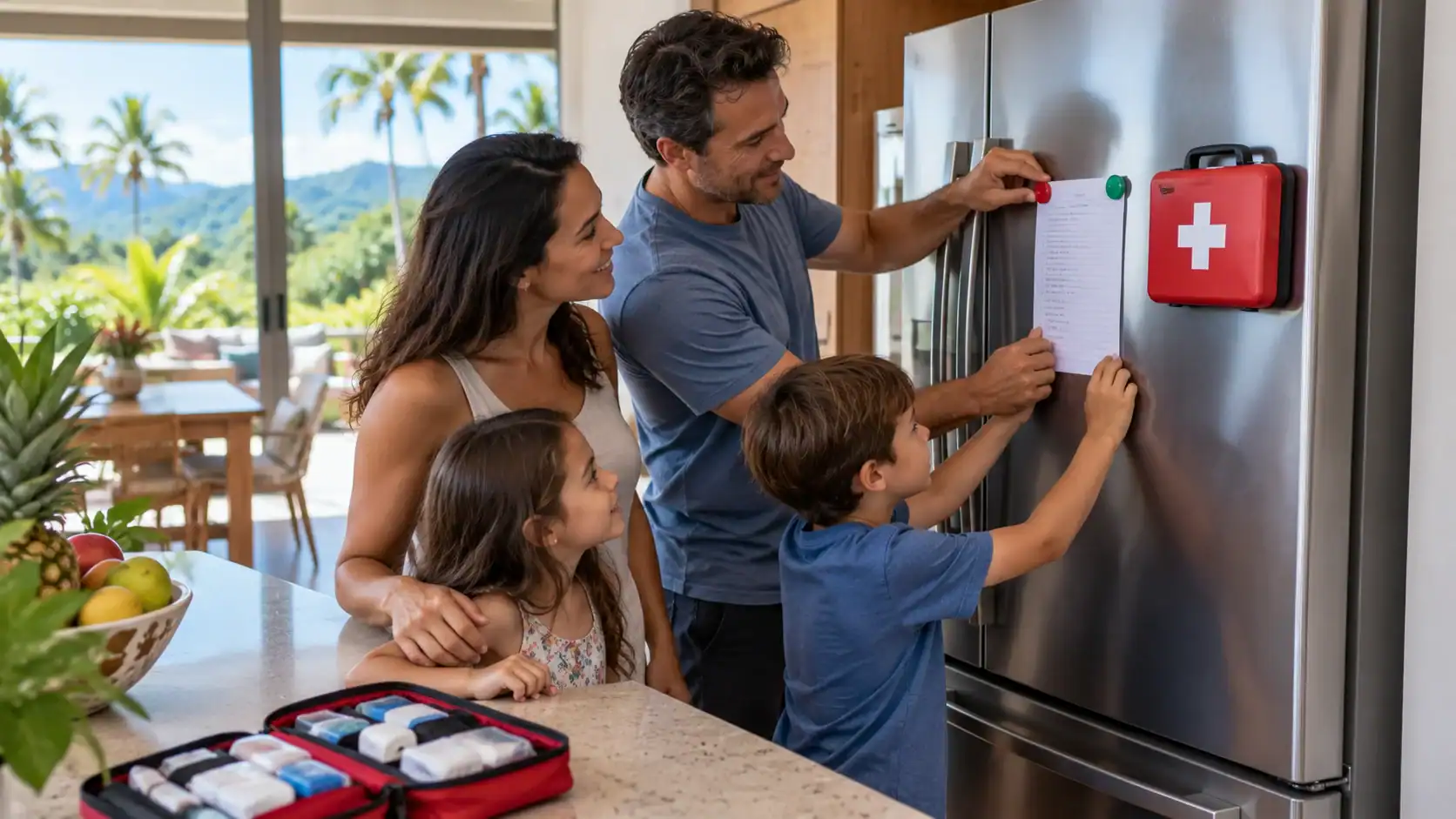
Prepare before you need help
- Save your accommodation’s address and nearby landmarks.
- Keep emergency contacts available offline.
- Record your insurer’s assistance number and policy details.
- Know where to find essential medical information.
- For emergencies, call 911 first.
Frequently Asked Questions
What is the emergency number in Costa Rica?
911. It covers police, fire, rescue and ambulance.
What is the police number in Costa Rica?
Call 911 for the police in an emergency. For an anonymous tip to the OIJ, the judicial investigation police, use 800-8000-645.
Is calling 911 free?
Yes. Calls to 9-1-1 are free, and on a prepaid phone they do not reduce your balance.
What should I say when I call?
What is happening, where it is (province, cantón, district and a landmark), and how many people need help. Then follow the operator’s questions and stay on the line.
What number do I call for poisoning?
The National Poison Control Centre, 800-INTOXICA (800-4686-9422), 24 hours. For an immediate medical emergency, call 911.
Sources: the official Red Cross, CCSS, OIJ, INS and U.S. Embassy information.
Thinking of moving to Costa Rica?
Get a free residency assessment. Tell Johanna, our immigration expert, about your situation, and she will tell you which residency fits you and what you need.
WhatsApp Johanna: +506 8373 2085Free assessment
Or email info@crie.cr