
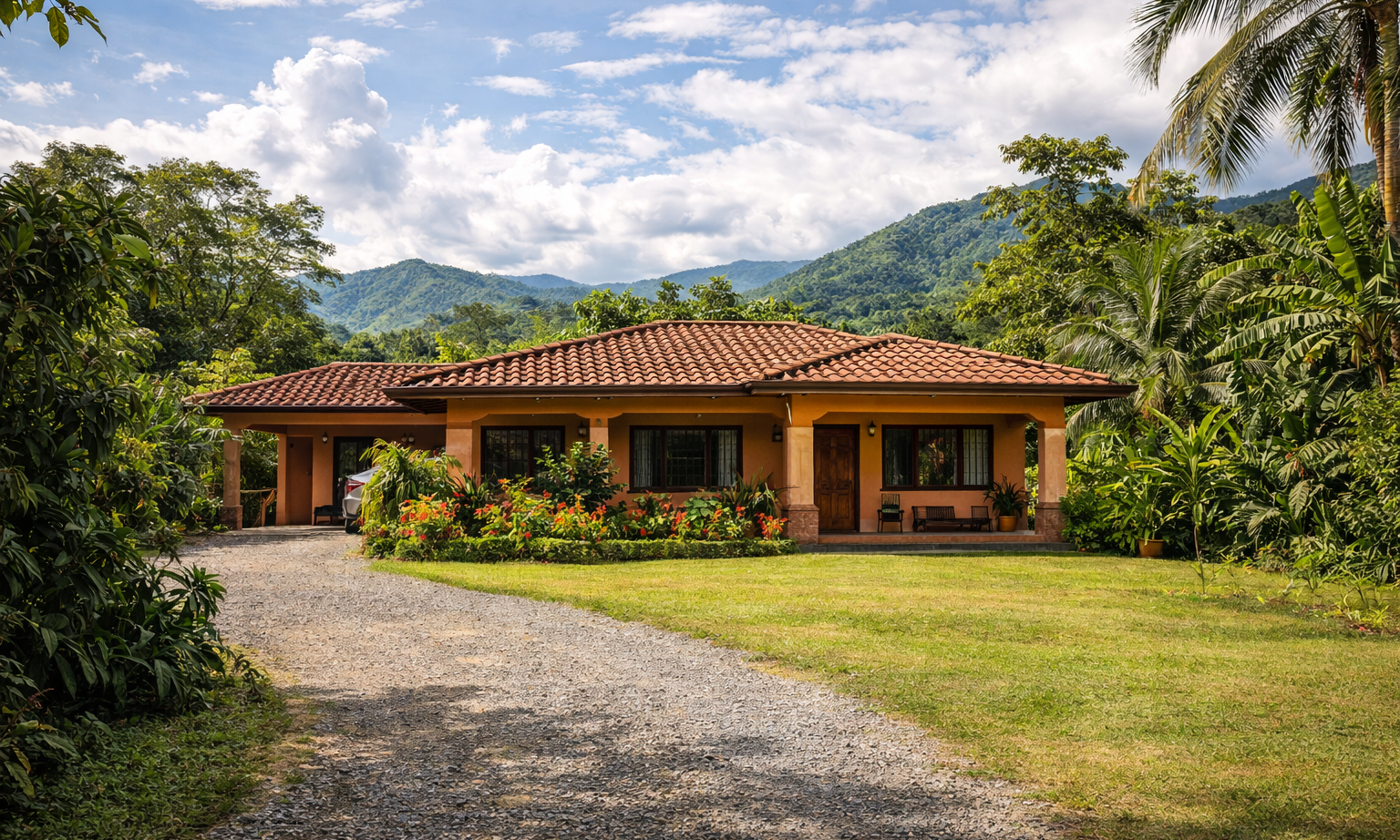
It is the first thing almost every new arrival notices, and it makes a bad first impression. Bars on the windows. Bars on the doors. Fences, gates, sometimes razor wire — on ordinary family houses, in ordinary neighbourhoods, in a country that markets itself as one of the safest and happiest in the region.
The natural conclusion is that Costa Rica must be far more dangerous than advertised. The data says otherwise, and the real explanation is more interesting.
What the crime figures actually show
In 2024 Costa Rica recorded roughly 5,000 residential burglaries — break-ins to an unoccupied home — and about 670 home robberies, meaning cases where the occupants were confronted.
Those are not small numbers. But look at the direction of travel: residential burglary has fallen by about 34% since 2019. Property crime overall rose only 4.7% across those five years — essentially flat — even while the country’s homicide rate rose sharply for reasons that have almost nothing to do with houses.
So the bars are not a response to a worsening burglary problem. They pre-date the current numbers by decades, and the thing they were built against has been getting less common, not more.
The explanation people miss: the windows are open
Here is what changes the picture.
In most of Costa Rica — certainly across the Central Valley, where the climate is famously mild — houses are ventilated by opening the windows. Not seasonally. All year, all day, and very often all night. Air conditioning is far from universal and, in the highlands, largely unnecessary.
A house whose windows stand open for twelve hours a day is a house that cannot rely on a closed window as a barrier. So the barrier is a grille — and it goes on the outside of the window frame, so the window itself can stay open behind it.
The bars are not there because the doors are inadequate. They are there so the windows never have to be shut.
Once you see that, the whole streetscape reads differently. Those houses are not fortified against a siege. They are ventilated buildings with the openings screened — which is also why the grilles are so often decorative, worked into curves and patterns rather than plain steel.
Opportunity, not violence
The second thing worth understanding is what kind of crime this is defending against.
The overwhelming majority of Costa Rican residential crime is opportunistic and non-confrontational. Of the roughly 5,000 burglaries in 2024, only about 670 involved confronting the occupants. The typical case is an empty house, a visible opportunity, and someone gone in minutes.
That is a completely different threat from the one the razor wire suggests to a nervous newcomer, and it responds to completely ordinary measures: a barrier, a light, a dog, a neighbour who notices.
It is also worth restating the wider picture from the national statistics. Costa Rica’s homicide problem is real and it is concentrated — around three quarters of killings are score-settling within criminal networks, and they cluster in specific districts and along the trafficking corridors. Household burglary is a separate phenomenon, and it is the one your windows are actually about.

Insurance is not the safety net it is at home
There is a second reason for the steel, and it is the one North Americans almost never think of, because at home it is invisible.
In Canada and the United States, household contents insurance is close to universal. It is bundled with a mortgage, renewed without thinking about it, and it quietly changes how people behave: a stolen television is an inconvenience and a claim form.
That is simply not the ordinary situation here. Plenty of Costa Rican households carry no contents cover at all, and among those who do, a theft claim is not the automatic reflex it is up north.
So the house itself has to be the protection. If nothing replaces what walks out of the door, you stop what walks out of the door. That is the whole logic, and once you see it the grilles stop looking like fear and start looking like sense.
It is also why this is not a new development or a response to some recent crime wave. Costa Ricans have built this way for generations. It is not a reaction to anything — it is simply how you lock up a house here, the way a deadbolt is how you lock up a house in Toronto.
The point is to be the harder house
Opportunistic theft goes where it is easy. Someone looking for an unlocked window is not going to spend twenty minutes cutting through a welded grille in a lit street while a dog barks — not when the house two doors down has neither.
That is the entire strategy, and it is why some households keep adding: more bars, better anchors, a gate on the terrace. They are not expecting a siege. They are making sure they are never the easiest house on the block.
It also explains why the level of hardware on a street tells you very little about how dangerous that street is.
The fire risk nobody warns you about
This is the most important section on this page, and it is the one that gets left out of every cheerful article about Costa Rican architecture.
If you have come from Canada or the United States, you are used to buildings designed around getting out. Windows that open wide enough to climb through. Doors that unlock from the inside with a thumb-turn, no key needed, because in an emergency nobody can find a key.
Costa Rican homes are commonly not built that way.
Two things combine, and each is manageable alone:
The windows are barred. A grille that is bolted or welded in place is not an escape route. In a house fire, the window you would instinctively go through is a wall.
And the doors are usually keyed on both sides. Not a thumb-turn on the inside — a keyhole, the same as the outside. Which means that when the house is locked and something goes wrong at three in the morning, you cannot leave without finding the key. In smoke, in the dark, with your family behind you.
Costa Rican families know this and organise around it. Newcomers frequently do not, because in the country they came from the door simply opens.
What to do about it
- Keep the door key in one fixed place, always, and make sure every adult knows where. Hanging by the door, out of reach from outside through a window or grille, but instantly findable in the dark. This single habit is the whole answer.
- Identify one window grille that opens — many are made with a hinged section and a padlock. Know which one, and keep that key with the door key.
- If nothing opens, change something. A hinged panel can be added to an existing grille by any local welder for very little. It is the cheapest safety improvement you will ever make to a house here.
- Have a smoke alarm. Time is the only thing that helps when the exits are slow.
- Talk it through with children the way you would a fire drill anywhere else — but including the specific step that is different here, which is the key.
None of this is an argument against the bars. It is an argument for knowing that the trade-off exists, because the house is telling you it was designed against burglary and it was not designed against fire.
What to look at when you rent or buy
- Is the grille solid, and is it anchored into the structure? A decorative frame screwed into render is decoration. Look at how it is fixed.
- Can it be opened from the inside without hunting for a key? For the reasons in the section above, this matters more than anything else on the list, and it is the question people forget to ask.
- Is there exterior lighting, and does it actually cover the approach? Lighting deters opportunists more reliably than steel.
- Who overlooks the property? In practice, neighbours are the best security a house has, which is one argument for a street over an isolated lot.
- Is there a dog? Unscientific, universally believed here, and probably correct.
The mistake newcomers make in both directions
Some arrive, see the bars, and conclude the country is dangerous. They spend more than they need to on security, choose a gated development they do not much like, and stay slightly frightened of a place that does not warrant it.
Others arrive from somewhere they never locked a door, decide the bars are paranoia, and leave a ground-floor window open onto a public street with a laptop visible from it. Costa Rica’s burglary problem is modest and falling, but it is not zero, and an obvious opportunity in any country will eventually be taken.
The local practice is the sensible middle: normal precautions, taken as a matter of routine, without anxiety. Bars on the openings, a light outside, a dog, and windows that stay open all year because the climate is one of the reasons you came.
The thing worth remembering
Visible security is not a reliable measure of danger. It is a measure of what a place has decided is worth doing about a problem — and it tends to lag decades behind the problem itself.
Costa Rica settled on grilles a long time ago, they became normal, they became decorative, and now they are simply how houses look. Meanwhile household burglary has fallen by a third in five years.
The bars will still be there long after the reason for them has changed. Most architecture is like that.
Working out where to live in Costa Rica?
Safety, like water quality and healthcare, varies far more between cantons than the national numbers suggest. It is worth reading the map before choosing an address — and worth not reading the ironwork as the map.
CRIE — Costa Rica Immigration Experts handles residency applications, renewals, permanent residency and citizenship.
See the types of residency in Costa Rica, or get in touch.
Crime figures are from the Observatorio de la Violencia of the Ministerio de Justicia y Paz and the Poder Judicial’s published analyses. General information only.
Article by Glenn Tellier (Founder of CRIE and Grupo Gap)
Don't wait, contact us right now!
Call or WhatsApp Costa Rica +506 8373 2085 or +506 8706 3888
Call USA/Canada +1 305-906-6784