
Securing residency in Costa Rica is a dream for many. The process, however, demands precision. A single oversight in your paperwork can lead to frustrating delays or even a rejected application.
The best defense against these setbacks begins at home. Meticulously preparing your documents before submission is the most effective strategy. Understanding common document-rejection-costa-rica scenarios helps you avoid them entirely.
We help navigate the complex immigration landscape of Costa Rica. Our team provides specialized guidance to ensure every piece of your application meets strict local standards. For a deeper look at common concerns, explore our frequently asked questions.
Partnering with experts gives you a clear roadmap. This proactive approach transforms a daunting process into a manageable journey. Your path to a new life starts with getting the details right from the very beginning.
Understanding the Costa Rica Residency Process (Residencia)
A common point of confusion is the Digital Nomad program versus formal residency. The Digital Nomad visa is a temporary permit. It does not grant residency status or count toward citizenship.
For long-term goals, you must pursue a formal residency application. The closest option for many is the Rentista category, based on stable income.
Eligibility for U.S. Citizens and Residency Categories
U.S. citizens typically qualify under categories like Pensionado, Rentista, or Inversionista. Each has specific financial thresholds you must prove.
Selecting the right category aligns your application with your life plans. For those with a Costa Rican parent, eligibility for residency as a child of a Costa Rican is a distinct path. We help you navigate these choices.
Overview of Application Steps and Document Requirements
The Costa Rican Immigration Department holds full legal discretion to approve or deny any file. This makes your initial preparation the most critical step.
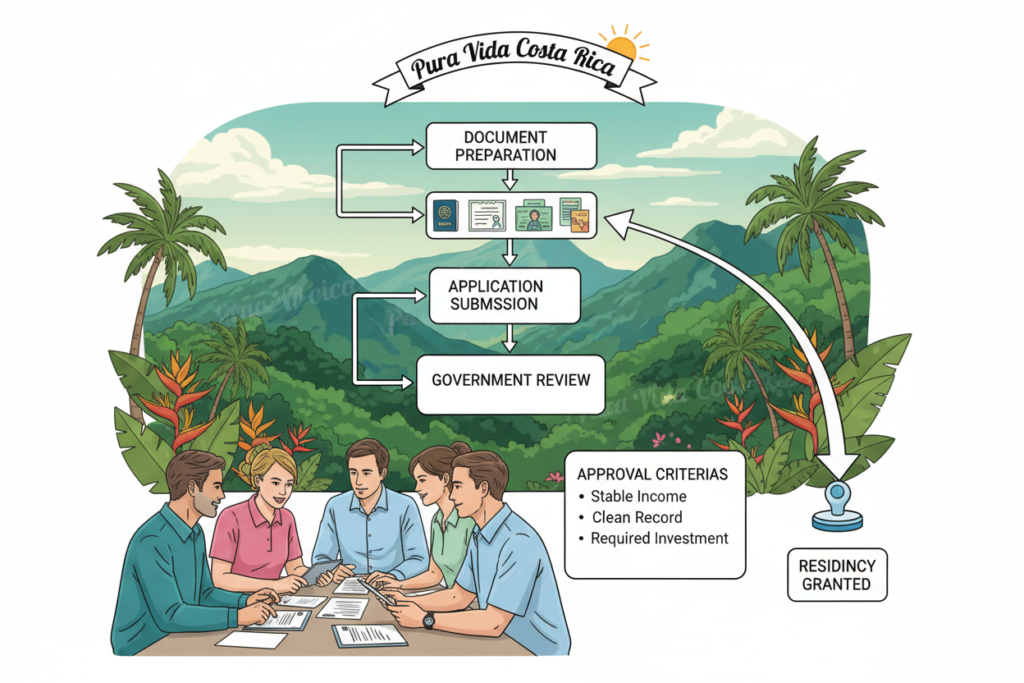
The process begins with gathering specific documents. These include apostilled birth certificates and background checks. Meeting every requirement forms the foundation of a successful residency application.
We ensure you understand each nuance. Our guidance provides a clear path through the formal immigration process from the very first step.
Key Reasons Behind document-rejection-costa-rica
Many applicants are surprised to learn that their entire case can be stalled by a single clerical error. The immigration office scrutinizes every detail, and even qualified individuals face setbacks due to avoidable paperwork issues.
Common Document Errors and Overlooked Requirements
A frequent cause for denial is simply failing to include all necessary documents. Authorities require a complete file, and an omission creates immediate delays.
Formatting is another critical area. Costa Rican officials often mandate specific layouts, notarization standards, or page counts. As Quatro Legal reported, many applications are rejected for minor technicalities—like a missing document that could have been submitted.
How Minor Technicalities Can Derail Your Application
Something as small as an outdated form or an unsigned page can trigger a rejection. The system treats these oversights as failures to meet core requirements.
It is essential to double-check every piece of your submission. We help clients identify these potential pitfalls early. Our review ensures your paperwork is robust and aligns perfectly with government standards, preventing unnecessary roadblocks.
Preparing Your Documentation at Home
The most effective preparation for your residency application begins long before you set foot in Costa Rica. We always advise clients to assemble their core paperwork from their home country. This proactive step is your best defense against procedural delays.
Gathering Essential Papers: Birth Certificates, Background Checks, and More
Start by collecting vital documents like birth certificates and marriage records. For U.S. citizens, an FBI Identity History Summary Check is a standard requirement. This background check proves you have a clean criminal history.
These documents form the non-negotiable foundation of your file. Having them ready early streamlines the entire process.
Apostilles and Certified Translations: What You Need to Know
Since Costa Rica is a member of the Hague Convention, U.S. citizens must obtain an apostille for each vital document. This special certification validates your paperwork for legal use abroad.
All documents must then be translated by a certified professional. Immigration authorities will only accept your application with this official Spanish translation. We guide you through each step to ensure your paperwork meets every local standard.
Step-by-Step Guidance to Avoid Common Mistakes
Think of your residency file as a living portfolio that requires careful assembly and secure maintenance. We provide a clear, step-by-step framework to navigate the entire immigration process. This methodical approach is designed to prevent the oversights that commonly derail applications.
The most critical phase begins before you relocate. Preparing your core documents in your home country is the single most effective step you can take. It streamlines your transition and forms a solid foundation for your case.
Pre-Arrival Document Prep and Secure Record-Keeping
An immigration officer will evaluate your file based solely on the documents presented at submission. Proper organization is therefore essential. We help you compile and order every required piece, ensuring nothing is missed.
Our team reviews each document for compliance with Costa Rican standards. This attention to detail allows you to submit your application with confidence. You know your file is accurate and complete.
Secure record-keeping has long-term value. You will need these original documents for various legal purposes throughout your life in Costa Rica. A well-organized portfolio protects your investment in the residency process from day one.
Thresholds and Requirements for Each Residency Category
Each residency category in Costa Rica comes with its own set of non-negotiable financial thresholds. Your eligibility hinges on proving you meet these specific benchmarks. The government requires clear documentation to verify your financial standing.
Pensionado (Pensionado): US$1,000+ per Month Pension Criteria
This status is for retirees with a guaranteed lifetime pension. You must provide official proof of a monthly income of at least US$1,000. This pension must be verifiable and permanent to satisfy the requirements.
Rentista (Rentista): US$2,500/Month Income for Two Years
The Rentista category is designed for individuals with stable, non-pension income. You need to demonstrate a guaranteed monthly income of US$2,500 for a minimum of two years. Bank deposits or investment income often serve as proof for this residency pathway.
Investor (Inversionista): US$150,000 Investment and Personal Property Requirement
This option requires a minimum investment of US$150,000 into approved assets, typically real estate. A critical rule: the property must be held in your personal name, not through a corporation. We help verify that your investment and ownership structure align perfectly with this rule.
Timelines and Process Expectations
Setting realistic timelines is a cornerstone of a smooth residency journey. Government processing times are not always predictable, making advance planning your best strategy.
Estimated Processing and Document Preparation Timeframes
Obtaining an apostille is a critical early step. State-level certification often takes 5 to 15 business days. Federal documents can require over five weeks.
The entire residency process can span several months. If an appeal is necessary, the Administrative Immigration Tribunal currently has a 10 to 12-month backlog for a resolution.
Starting your paperwork well in advance is essential. This prevents certification delays from derailing your submission date.
How to Manage Delays and Follow-Up with Authorities
We help you track the status of your application actively. This ensures you are prepared for any unexpected delays with government authorities.
Our team provides regular updates on your case. We navigate the complex regulations and follow-up steps required by the immigration office on your behalf.
By planning for these timeframes, you avoid stress. Partnering with experts for residency support services keeps your application on the right track.
Document Rejection: How to Respond and Reapply
When immigration authorities return your file, the key is to respond strategically rather than starting over completely. A denial clarifies the specific issues you must address. Your options typically involve appealing the decision or preparing a new, corrected application.
Identifying Mistakes and Corrective Measures
We begin by analyzing the official rejection notice in detail. This allows us to pinpoint the exact errors in your paperwork or process.
This analysis determines the best path forward. For some cases, a formal appeal to the government is the correct step. For others, a fresh submission is the faster route to residency status.
Preparing for a Swift Reapplication Without Starting from Scratch
You often do not need to regather every document. Valid core documents, like your apostilled birth certificate and local police background check, can typically be reused.
This reuse saves you significant time—often months. We guide you to focus efforts only on correcting the deficient items or information. This streamlined approach gets your case back on track efficiently.
Acting quickly is crucial after a setback. Contact us today via WhatsApp at +506 8706 3888 or email info@crie.cr for a direct review of your case. Our guidance transforms a rejection into a corrected, successful filing.
Final Thoughts on Streamlining Your Costa Rica Residency Journey
Navigating the final stages of your residency application requires a clear focus on the details that ensure approval. This journey is deeply rewarding, and it becomes straightforward with the right preparation and support.
Every correct step you take builds momentum. Obtaining an apostille, securing your background check, and verifying each document brings you closer to your goal. We provide the transparent information and expert guidance needed to navigate the immigration process confidently.
Your path to a new life starts with a single, informed decision. We are here to help you manage the details and submit a complete, successful case. Contact our team today to begin your streamlined residency journey.
FAQ
What are the most common reasons for residency document rejection?
The most frequent reasons involve paperwork that is incomplete, expired, or incorrectly certified. This includes documents like birth certificates without a recent apostille, background checks from the wrong jurisdiction, or financial proofs that don’t meet the exact monthly thresholds. Even small details, such as a missing stamp or a translation not done by a Costa Rican official, can cause a denial.
How long does the residency application process typically take?
You should plan for a lengthy process. After gathering all your documents—which can take several months for apostilles and certifications—the formal review by immigration authorities often takes an additional 6 to 12 months. Delays are common, so building extra time into your plans is a smart move. We help clients track their status and follow up to keep things moving.
What is the difference between the Pensionado and Rentista categories?
Both are popular paths, but their requirements differ. The Pensionado category requires a guaranteed lifetime pension of at least US
FAQ
What are the most common reasons for residency document rejection?
The most frequent reasons involve paperwork that is incomplete, expired, or incorrectly certified. This includes documents like birth certificates without a recent apostille, background checks from the wrong jurisdiction, or financial proofs that don’t meet the exact monthly thresholds. Even small details, such as a missing stamp or a translation not done by a Costa Rican official, can cause a denial.
How long does the residency application process typically take?
You should plan for a lengthy process. After gathering all your documents—which can take several months for apostilles and certifications—the formal review by immigration authorities often takes an additional 6 to 12 months. Delays are common, so building extra time into your plans is a smart move. We help clients track their status and follow up to keep things moving.
What is the difference between the Pensionado and Rentista categories?
Both are popular paths, but their requirements differ. The Pensionado category requires a guaranteed lifetime pension of at least US$1,000 per month. The Rentista category requires proof of a stable income of US$2,500 per month, guaranteed for at least two years from a qualified source. We can review your finances to determine which residency category you best qualify for.
Do all my documents from the U.S. need an apostille for Costa Rica?
Yes, nearly every crucial document does. Your birth certificate, marriage certificate (if applicable), and federal background check must bear an apostille from the Secretary of State or the U.S. Department of State. This certification verifies the document’s authenticity for use abroad. Without it, your application will not proceed.
What should I do if my residency application is rejected?
Don’t panic. A rejection usually specifies the reason. The key is to carefully identify the mistake—whether it’s a missing certification, insufficient funds, or an expired police record. Correct that specific issue. You can then re-submit the corrected paperwork without starting the entire process over, though it will add significant time. We assist clients in efficiently navigating this corrective step.
Can I use my property investment to qualify for residency?
Yes, through the Inversionista (Investor) category. This requires a minimum investment of US$150,000 in property, a business, or projects approved by the government. Importantly, you must also show a separate, stable income to support yourself. Simply owning a home does not automatically grant residency status; the investment must be formally registered and proven.
Why is the background check requirement so specific?
Costa Rican immigration requires a background check from every country you’ve lived in for more than six months in the last three years. This is a strict security measure. A report from only your home country is often insufficient. Failing to provide a complete criminal history from all required jurisdictions is a leading cause of document rejection and application delays.
,000 per month. The Rentista category requires proof of a stable income of US,500 per month, guaranteed for at least two years from a qualified source. We can review your finances to determine which residency category you best qualify for.
Do all my documents from the U.S. need an apostille for Costa Rica?
Yes, nearly every crucial document does. Your birth certificate, marriage certificate (if applicable), and federal background check must bear an apostille from the Secretary of State or the U.S. Department of State. This certification verifies the document’s authenticity for use abroad. Without it, your application will not proceed.
What should I do if my residency application is rejected?
Don’t panic. A rejection usually specifies the reason. The key is to carefully identify the mistake—whether it’s a missing certification, insufficient funds, or an expired police record. Correct that specific issue. You can then re-submit the corrected paperwork without starting the entire process over, though it will add significant time. We assist clients in efficiently navigating this corrective step.
Can I use my property investment to qualify for residency?
Yes, through the Inversionista (Investor) category. This requires a minimum investment of US0,000 in property, a business, or projects approved by the government. Importantly, you must also show a separate, stable income to support yourself. Simply owning a home does not automatically grant residency status; the investment must be formally registered and proven.
Why is the background check requirement so specific?
Costa Rican immigration requires a background check from every country you’ve lived in for more than six months in the last three years. This is a strict security measure. A report from only your home country is often insufficient. Failing to provide a complete criminal history from all required jurisdictions is a leading cause of document rejection and application delays.
Article by Glenn Tellier (Founder of CRIE and Grupo Gap)
Don't wait, contact us right now!
Call or WhatsApp Costa Rica +506 8373 2085 or +506 8706 3888
Call USA/Canada +1 305-906-6784