
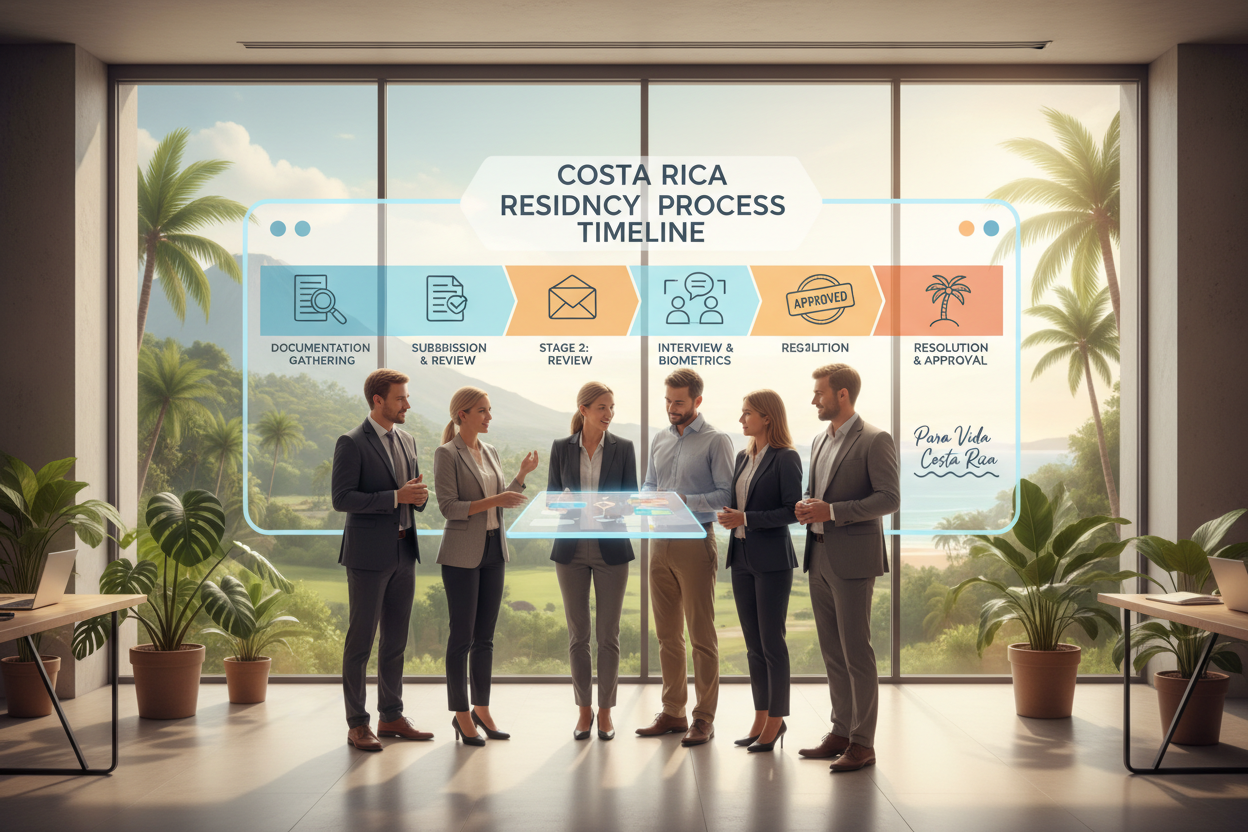
Nearly 70,000 Americans now call Costa Rica home. This beautiful country attracts people seeking a stable life in a tropical paradise. Moving here involves a key legal step: securing your residency status.
Understanding the timeline for this process is crucial for planning. The wait can vary from months to over a year. It depends heavily on your chosen category and how well you prepare your documents.
You’ll need to provide proof of a steady income, a valid passport, and other specific requirements. Your visa category—whether based on pension, investment, or other means—sets the rules. Knowing your work rights by residency category is also an important part of the puzzle.
At CRIE, we guide you through every step. We help manage the complex immigration process with professional care. Start early to avoid common delays. Contact us at info@crie.cr or WhatsApp +506 8706 3888 to discuss your goals.
Understanding Costa Rica Residency Options

Your financial situation determines which of Costa Rica’s main residency programs you may qualify for. The three primary categories are Pensionado, Rentista, and Inversionista. Each has specific financial thresholds and benefits.
Pensionado (Pensionado) Requirements and Benefits
This program is for retirees. You must prove a guaranteed lifetime pension of at least $1,000 per month. This steady income is the core requirement for this residency category.
It offers a straightforward path for those with a verified pension. The process hinges on providing authenticated bank documents as proof.
Rentista (Rentista) and Inversionista (Inversionista) Explained
The Rentista visa suits individuals with stable passive income. You must demonstrate $2,500 per month for two years from a reliable source. This is not from active employment.
The Inversionista category is for investors. It requires a minimum investment of $150,000 in the country. This can be in a local business, property, or other approved projects.
We help you assess which path aligns with your finances. Proper documentation of your income or investment is the critical first step.
Why Document Preparation from Home is Crucial

The most effective step toward securing your new life in Costa Rica begins long before you arrive—with careful document preparation at home. Getting your paperwork in order from the start prevents significant delays later. It creates a solid foundation for your entire immigration process.
Apostilles and Official Translations
Every foreign document must have an apostille to be valid here. This includes your birth certificate and criminal background check. Official translations into Spanish are also a strict requirement.
These translations must be done by a certified translator in Costa Rica. We help clients navigate these specific legal requirements to ensure everything is accepted.
Ensuring Consistency in Your Records
Consistency across all your records is critical. Names on your passport, birth certificate, and bank statements must match exactly. Any discrepancy can halt your application.
We provide a detailed checklist to manage this proof. Organizing everything before you leave is the best way to keep your residency process on track.
Eligibility and Qualification Requirements
The Pensionado, Rentista, and Inversionista programs each have a non-negotiable financial threshold. This acts as the first filter for your application. Understanding these core requirements is the foundational step in your journey.
Income Thresholds for Pensionado and Rentista
For the Pensionado category, you must prove a guaranteed lifetime pension of at least $1,000 per month. This proof of income often comes from Social Security or a similar retirement source.
The Rentista visa requires a different kind of financial proof. You need to demonstrate stable passive income of $2,500 per month. Authorities require evidence this income is secured for two years.
Investment Criteria for Inversionista
The Inversionista program is for those making a significant capital investment. The minimum requirement is $150,000 in a local business, real estate, or approved project.
A critical rule is that this investment must be registered in your personal name. This proves your direct economic contribution to the country.
We help verify your financial proof meets all government standards. Solid preparation here is key for a successful immigration interview and application process.
Step-by-Step Application Process in Costa Rica
Navigating the DGME’s requirements is a critical phase where preparation meets official action. This is the formal procedure to submit your file and begin the government review.
We guide you through each specific step to ensure a smooth submission.
Collecting and Authenticating Your Documents
Your complete dossier is essential. A key item is your criminal background check. It must be issued within the last six months to be valid.
All foreign documents require an apostille and official Spanish translation. Your birth certificate and passport copies must be pristine and consistent.
Scheduling Your DGME Appointment
You must book your appointment through the official website, migracion.go.cr. Do this well in advance, as slots can fill quickly.
At your meeting, you will submit your authenticated documents. This officially starts your residency application with the immigration authorities.
You will receive a receipt upon submission. This allows you to stay in the country legally if your tourist visa expires during the wait.
Our team prepares you for this appointment. We ensure every requirement is met for a confident and successful filing.
Understanding residency-approval-time-costa-rica: Key Timelines and Expectations
Once your application is submitted, the waiting period begins—a phase where patience and proper legal management are key. Government review times are not uniform.
Understanding these expectations helps you plan your life effectively while your file is processed.
Estimated Processing Times by Residency Category
Processing durations differ based on your visa category. We provide these ranges as realistic guides, not guarantees.
Pensionado applications typically take 8 to 12 months. Rentista files usually resolve in 6 to 10 months.
Inversionista cases often see the fastest timeline, generally between 4 and 8 months.
These are estimates. They can fluctuate with the current workload at the DGME immigration office.
Managing Your Legal Status During the Waiting Period
It is crucial to manage your legal status throughout this process. Keep your official submission receipt with you at all times.
This document is your proof of legal stay if your tourist visa expires. Do not leave the country without obtaining the proper exit permits first.
Our team provides ongoing support during this phase. We help ensure you remain compliant with all requirements while you wait for your final residency status.
Tips to Avoid Common Application Mistakes
The difference between a smooth process and a frustrating delay often lies in the details of your documents. We see many avoidable errors that can stall a residency application.
Preventing Document Errors and Inconsistencies
An expired criminal background check is a top cause for rejection. This document must be issued within the last six months.
Another frequent issue is name mismatches. Your passport and birth certificate must show identical information. Any variation can cause significant delays.
Common Missteps and How to Solve Them
Many applicants fail to provide sufficient proof of income for their chosen category. This is a critical financial requirement.
We recommend a professional review of your entire file. This ensures every apostille and translation is accurate and complete.
Solving these issues early saves you time and stress. It lets you focus on planning your new life in Costa Rica. Our team provides this comprehensive review to meet all immigration standards.
The Role of CAJA and Healthcare Enrollment
A key pillar of your new life in Costa Rica is enrolling in the national healthcare system, known as CAJA. This is not an optional benefit. It is a mandatory requirement tied directly to your legal residency status.
Mandatory Healthcare Requirements
Enrollment in CAJA is compulsory for all residency holders. It provides comprehensive medical coverage through local clinics and hospitals. Maintaining your active enrollment is a non-negotiable part of keeping your residency in good standing.
We guide you through the registration process at your assigned EBAIS clinic. This ensures you are fully compliant from the start.
Budgeting for Monthly CAJA Payments
Your monthly CAJA payments are calculated as a percentage of your declared income. This makes budgeting for this recurring cost a crucial step in your financial plan.
Understanding this commitment is essential for long-term stability. We help you prepare the correct documentation for this income-based assessment. Staying current with these payments fulfills a vital obligation of your residency in Costa Rica.
Budgeting for Your Costa Rica Residency Journey
Your residency budget should account for both one-time fees and recurring monthly expenses. This financial planning is a critical step beyond just meeting the basic income or investment requirements.
You must budget for government filing fees, professional attorney services, and the mandatory CAJA healthcare payments. These costs add up over the course of your application process.
For the Rentista visa category, you may need to maintain a specific deposit in a Costa Rican bank. This is part of proving your financial stability.
We also recommend setting aside funds for document preparation. Apostilles and official translations can cost several hundred dollars per year.
Planning for travel to San José for appointments is another necessary expense. A clear financial plan lets you focus on your new life without stress.
Our team provides a transparent overview of all typical costs. We help you create a realistic budget to successfully maintain your residency status in this beautiful country.
Importance of Legal Guidance and Professional Support
Securing your legal status in Costa Rica is a complex journey that benefits greatly from expert guidance. The immigration process involves intricate rules and precise documentation. Even a small mistake can lead to months of delay.
How an Experienced Attorney Can Help
A knowledgeable attorney is your best defense against common errors. They ensure your documents meet the latest government standards for your residency category. This professional support is crucial for a successful application.
Having an expert by your side at DGME appointments makes a significant difference. They can clarify requirements and navigate the process efficiently. This helps secure your legal status with confidence.
Selecting the Right Immigration Assistance
It is vital to verify the credentials of your immigration assistance provider. Look for a firm with proven experience in your specific visa category. This ensures they have the expertise to handle your case.
We position ourselves as your dedicated guide through every step. Our team provides transparent and reliable service. This allows you to focus on your transition to life in this beautiful country.
Temporary vs. Permanent Residency in Costa Rica
Your journey to becoming a permanent resident in Costa Rica typically unfolds in two distinct legal phases. Understanding this progression is fundamental for your long-term planning.
Most applicants begin with temporary residency. This status is usually valid for one to three years, depending on your specific visa category.
You must renew this temporary permit to maintain your legal standing. It acts as your official permission to live in the country during the initial period.
Transitioning from Temporary to Permanent Status
After maintaining your temporary residency for three consecutive years, you become eligible to apply for permanent residency. This is a significant legal milestone.
Transitioning to permanent status offers greater stability. It also comes with fewer ongoing administrative requirements for your stay.
We guide you through the renewal process for your temporary permit. Our support ensures you remain compliant while working toward your permanent status goal. This clear path is essential for building your future in Costa Rica.
Special Considerations: Digital Nomad Visa vs. True Residency
A common point of confusion for remote workers is the legal distinction between a Digital Nomad visa and true residency in Costa Rica. This temporary permit is popular but functions very differently from traditional categories.
Why the Digital Nomad Visa Doesn’t Count Toward Residency
The Digital Nomad visa is just a temporary permit. It allows you to live in the country for up to two years but does not count toward permanent residency or citizenship.
This visa offers benefits like tax exemptions. However, it does not grant the same rights as a true residency status in Costa Rica.
For a long-term future, we often recommend the Rentista residency as a more suitable alternative. It requires proof of stable passive income but provides a clear path to permanent status.
We help you evaluate which option aligns with your goals. Choosing correctly from the start avoids the need to restart your entire immigration process later.
Final Thoughts on Your Path to Costa Rica Residency
Achieving your dream of living in Costa Rica is a significant milestone. It begins with a successful residency process. This rewarding journey requires careful planning and a clear strategy.
Start your preparation early. Ensure all your documents are ready and your financial proof is in order. Whether pursuing permanent residency or just starting research, a solid plan is key.
Our team at CRIE is here to support you every step. We provide the expert guidance you need to navigate the application process confidently. For common queries, review our frequently asked questions.
Contact us today at info@crie.cr or WhatsApp +506 8706 3888 to discuss your goals. With the right preparation and professional support, you can look forward to a stable life in this beautiful country.
FAQ
How long does it typically take to get residency approved in Costa Rica?
The residency approval time in Costa Rica varies significantly by category. For a Pensionado or Rentista application, you should expect the entire process—from document collection to receiving your physical ID card—to take between 8 to 12 months. An Inversionista residency, based on a real estate investment, can sometimes be reviewed faster, often within 6 to 9 months. These are estimates, and actual timelines depend on government processing queues.
Can I start the application process from my home country?
Absolutely. In fact, we strongly recommend beginning your document preparation at home. You must gather originals like your birth certificate and marriage license, have them apostilled (or authenticated), and then professionally translated into Spanish. Doing this correctly before you arrive prevents major delays and is a crucial first step in the application process.
What are the income requirements for a Rentista visa?
To qualify for a Rentista residency, you must prove a stable, guaranteed income of at least ,500 per month. This income must be documented to last for at least two years. You prove this by depositing ,000 into a Costa Rican bank account or providing a bank guarantee for that amount. The funds are released back to you in monthly installments of ,500.
Do I need to hire a lawyer for my residency application?
While not legally mandatory, hiring an experienced immigration attorney is highly advisable. The process involves complex paperwork, strict deadlines, and navigating government agencies like the DGME. A good lawyer prevents costly errors, manages your file, and can significantly reduce stress, often saving you time and money in the long run.
What is CAJA, and when do I need to enroll?
CAJA is Costa Rica’s public healthcare system. Enrollment is mandatory once your temporary residency is approved. You cannot get your final ID card (DIMEX) without proof of CAJA registration. Monthly payments are based on your declared income, so it’s an important factor to budget for during your residency journey.
What’s the biggest mistake people make in their application?
The most common mistake is submitting inconsistent or incorrect documents. A mismatch between the name on your passport, birth certificate, or police background check can cause a rejection. Ensuring every document is apostilled, translated exactly, and reflects identical information is the key to avoiding this major setback.
Can I use the Digital Nomad Visa to become a permanent resident?
No, the Digital Nomad Visa is a separate, non-resident status. Time spent in Costa Rica under this visa does not count toward the three years required to apply for permanent residency. It’s a great option for remote workers testing life here, but it is not a path to long-term residency or citizenship.
What happens if my tourist visa expires while my residency is processing?
You must maintain legal status. Before your 90-day tourist stamp expires, you must either leave the country for 72 hours (a “border run”) or file for an extension. Your immigration attorney will guide you on the best strategy to ensure you remain legal throughout the entire residency approval process.
Article by Glenn Tellier (Founder of CRIE and Grupo Gap)
Don't wait, contact us right now!
Call or WhatsApp Costa Rica +506 8373 2085 or +506 8706 3888
Call USA/Canada +1 305-906-6784