

Moving to Costa Rica is an exciting prospect. A smooth transition, however, depends on a clear understanding of the current legal framework. The rules for establishing residency have specific updates for 2024.
We believe the key to success starts at home. Preparing your documentation correctly from the outset is the most critical step. This upfront work prevents frustrating delays later in the process.
For U.S. citizens, the landscape includes four main residency pathways. The application timeline typically ranges from three to twelve months. Remember, as a U.S. citizen, you are in Visa Group 1 and can initially enter for up to 180 days as a tourist.
Navigating this system can be complex. As experienced guides, we help you avoid common pitfalls that derail applications. Whether you’re a retiree or an investor, knowing the specific requirements is your first step.
You can reach out to our team at CRIE (crie.cr) for professional guidance. Our mission is to simplify your journey with transparent, fact-based advice. We provide the confidence and legal security you need for this important move.
Overview of Costa Rica’s New Residency Landscape

Navigating Costa Rica’s residency system requires an understanding of both its welcoming policies and strict legal requirements. The country maintains the oldest continuous democracy in Latin America. This political stability provides a reliable environment for expatriates seeking a new home.
The current landscape is designed to attract individuals who can contribute to the local economy. We observe that certain application procedures have been streamlined for efficiency. However, maintaining your legal status demands strict adherence to the updated 2024 regulatory requirements.
Costa Rica is also a global leader in environmental sustainability and renewable energy. This commitment shapes a progressive social system that values quality of life. Understanding this broader context is vital for a smooth transition.
Our team helps you interpret these rules to build a solid legal foundation. A key part of this is understanding the national registry and other official processes. By staying informed, you can plan your long-term stay and avoid common pitfalls.
Understanding the Key Residency Categories (Pensionado, Rentista, Inversionista)
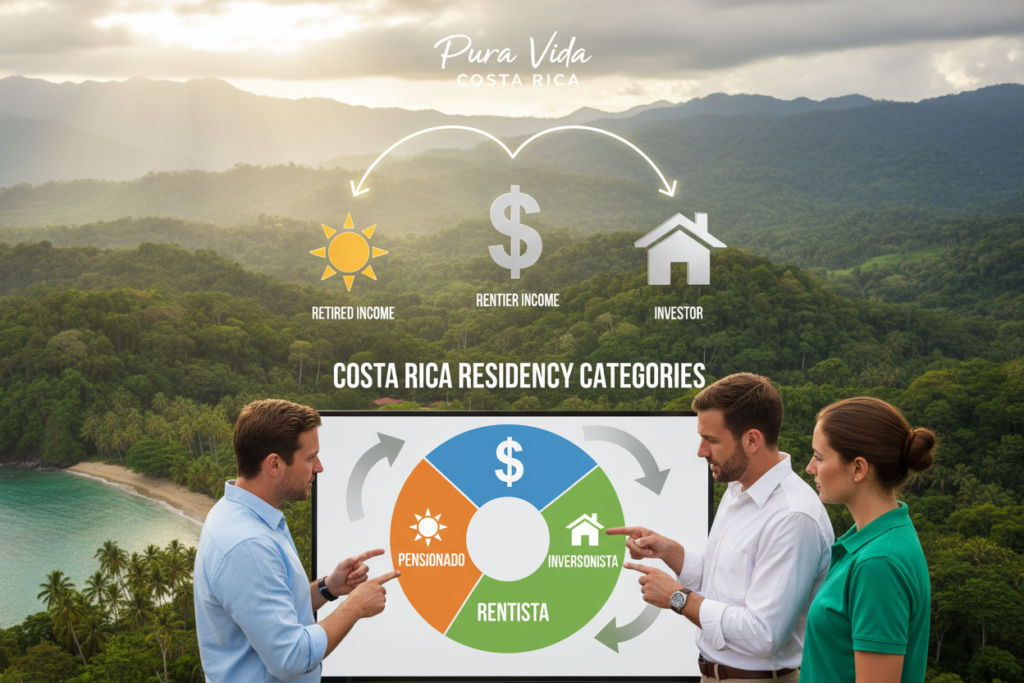
Costa Rica offers several distinct pathways to legal residency, each with specific financial criteria. The three primary categories—Pensionado, Rentista, and Inversionista—form the core of the system. Selecting the correct one is the first major step in your application.
We guide clients through these options daily. Your choice depends entirely on your personal financial profile and long-term goals for living in Costa Rica.
Pensionado (Pensionado) Requirements and Benefits
The Pensionado category is designed for retirees. It requires proof of a guaranteed lifetime pension of at least US$1,000 per month.
This stable income threshold is a key requirement for this popular residency option. Successful applicants gain the right to live in Costa Rica and enjoy various local benefits.
Rentista (Rentista) and Investor (Inversionista) Criteria
For non-retirees, the Rentista program is a common choice. It mandates proof of a guaranteed US$2,500 monthly income for two years.
The Inversionista category, meanwhile, is based on capital. It requires a minimum investment of US$150,000 in approved business ventures or real estate assets within Costa Rica.
These are separate residency categories with different documentation needs. We help you evaluate which pathway aligns with your income or investment capacity.
Who Qualifies for Costa Rica’s Residency?
Foreigners seeking to establish legal residency in Costa Rica must first identify which of the official pathways aligns with their situation. Qualification is based on meeting specific financial thresholds and providing the correct documentation. The primary categories—Pensionado, Rentista, and Inversionista—are designed for long-term stays.
It is crucial to understand a key distinction. The Digital Nomad visa is a popular temporary permit for remote workers. It requires proof of US$3,000 monthly income for individuals or US$4,000 for families.
However, this status does not count toward permanent residency or citizenship. We guide clients toward a more stable future. For those seeking a long-term path, transitioning to the Pensionado or Rentista categories is the strategic move.
Ultimately, foreigners from various backgrounds can qualify. Success depends on meeting the requirements set by immigration authorities. Our team assists you in determining your eligibility from the start. This ensures you invest time in a visa type that leads to your ultimate goal.
Preparing Your Documentation and Translations
Before you set foot in Costa Rica, your paperwork must be perfectly organized and authenticated. This upfront work is the most critical step for a smooth application process. We see many delays stem from incomplete or improperly prepared documents.
Essential Documents and Apostille Process
Every official document must be apostilled by the U.S. Department of State. This includes your birth certificate and FBI background check. The apostille certifies the document’s authenticity for use abroad.
Without this seal, Costa Rican authorities will not accept your paperwork. We advise starting this process well before your planned move. It can take several weeks to complete.
Translation Guidelines into Spanish
All apostilled documents must then be translated into Spanish. This must be done by an official translator registered in Costa Rica. Using an unauthorized translator will cause significant delays at the immigration office.
Having translations ready before you arrive saves valuable time. Keep every paper—original, apostille, and translation—in a single, organized file. Our team provides a detailed checklist to ensure no document is missing from your residency application.
Step-by-Step Process for Applying to CRIE (crie.cr)
Initiating your legal residency journey in Costa Rica involves a clear, sequential process managed by official authorities. We break this down into manageable phases to prevent overwhelm. Our team at CRIE (crie.cr) provides a roadmap for each critical step.
Initial Research and Provisional Visa Application
Your first actions occur outside the country. This phase requires thorough research into the specific residency category that fits your profile.
You must then file for a provisional visa at your nearest Costa Rican consulate. This initial application is your formal request to enter the country under a specific residency pathway. Proper preparation here sets the tone for the entire process.
Submission and Registration at migracion.go.cr
After arriving in Costa Rica, you must complete specific in-country requirements. The first is registering your fingerprints with the Ministry of Public Security in San José.
Following this biometric registration, you submit your formal residency application through the official online portal, migracion.go.cr. This submission is made directly to the Dirección General de Migración y Extranjería (DGME), the governing immigration body.
We guide you through every part of this application, ensuring your submission to the Dirección General is complete. It is also essential to monitor your case status through their official channels.
By partnering with our team, you gain professional support that simplifies these bureaucratic steps. This makes your transition to life in Costa Rica much smoother.
Timelines and Renewal Considerations
Understanding the timeline for your residency application is crucial for planning your move to Costa Rica. We help clients set realistic expectations from the start. This prevents frustration and allows for smooth long-term planning.
Processing Duration and Renewal Steps
The residency process typically takes between three and twelve months. This depends on your category and the immigration office’s workload. Once approved, your temporary status must be renewed every two years.
We proactively track these renewal dates for you. This ensures you never fall out of compliance with local laws. Staying current is essential for maintaining your legal standing in Costa Rica.
Transitioning from Temporary to Permanent Residency
After holding temporary residency for three years, you become eligible to apply for permanent status. This is a significant milestone in your journey. Permanent residency offers greater stability and far fewer renewal requirements.
Transitioning requires proof of your continued commitment to living in the country. Our team provides ongoing support to manage this important step. We handle the renewals efficiently so you can focus on enjoying life in Costa Rica.
Common Mistakes to Avoid During Your Application
A smooth residency application can be derailed by a few common oversights that we frequently encounter. These errors often stem from a lack of familiarity with the specific Costa Rican process. Addressing them early is key to a successful outcome.
One critical mistake is failing to apostille your essential documents before leaving the United States. This authentication cannot be completed from abroad. It causes significant, avoidable delays in your residency process.
Another frequent error is overstaying your tourist visa while your application is pending. This complicates your legal standing and adds unnecessary stress. For investor applicants, using a corporation to hold the required asset is also problematic. The rules mandate personal ownership.
Our team works to prevent these issues by reviewing your entire application package in advance. We identify potential pitfalls long before submission. By avoiding these common mistakes, you keep your path to residency clear and efficient.
Emphasizing Starting from Home with Documents Ready
The foundation of a successful residency application is built long before you arrive in Costa Rica. We cannot stress this enough—beginning your document preparation from home is the single most effective strategy. This proactive approach prevents frustrating delays and sets a confident tone for your entire immigration process.
Gather essential papers like birth certificates, marriage certificates, and your FBI background check while still in the United States. Each of these must be apostilled by the U.S. Department of State before you travel. Completing this authentication step from home is mandatory and saves weeks of potential waiting.
Having every document ready before your flight allows you to start working with your immigration lawyer immediately. Our team provides a detailed guide to organize your files to meet strict official standards. This diligence eliminates the need for costly trips back to retrieve missing paperwork, streamlining your path to legal residency in Costa Rica.
costa-rica-new-residency-rules-and-laws-for-2024-what-you-need-to-know
For 2024, several key adjustments to residency laws directly impact qualification criteria. We analyze these updates to provide a clear summary for your planning. Staying informed is your first defense against unexpected delays or complications.
A major change is found in Law 9996. It officially updates the minimum investment for the Inversionista category to US$150,000. This revision reflects the government’s focus on attracting substantive economic contributions.
Our team monitors every legal shift within the immigration system. We translate complex regulations into actionable steps for your application. This ensures you receive guidance based on the most current information available.
By understanding this framework, you make decisions that protect your legal standing. It also safeguards any financial commitment you make in the country. A proactive approach to compliance is the cornerstone of a successful long-term stay in Costa Rica.
Property Investment Guidelines for Investor Residency
For those pursuing investor residency, understanding property ownership rules is a fundamental step. This pathway requires a significant financial commitment that must be structured correctly from the start. We guide clients through every detail to ensure their purchase meets all legal standards.
The investor category is a popular choice for establishing long-term legal status in Costa Rica. It allows you to leverage a major asset toward your residency goals. However, the government has specific requirements that cannot be overlooked.
Minimum Investment Requirements and Ownership Rules
Your property must be registered in your personal name at the National Registry. Using a corporation or other entity will invalidate your application. This personal ownership rule is strictly enforced by immigration authorities.
The minimum investment threshold is set at US$150,000. This is a non-negotiable figure for qualifying under the investor program. We advise verifying the title and registration of any potential property before finalizing the purchase.
Our team helps you navigate these complexities to structure your investment properly. We ensure your property purchase serves as a valid foundation for your temporary residency application. Following these guidelines protects your financial commitment and legal standing in Costa Rica.
Navigating Legal and Immigration Requirements
One of the most critical aspects of choosing a residency pathway is understanding its work permissions. Your legal status in Costa Rica dictates your ability to seek employment or generate income locally.
Work Permit and Employment Considerations
Not all residency categories grant the same rights. If you hold a Pensionado or Rentista status, you are generally restricted from traditional salaried employment. You may, however, own and operate a business.
Permanent residents enjoy a significant advantage. They can work for any employer in Costa Rica without needing a separate work permit. This is a key distinction in the immigration landscape.
We provide clarity on these legal requirements. Our goal is to help you select a residency path that aligns with your professional and financial goals. Understanding these limitations prevents accidental violations of the immigration laws of Costa Rica.
Strategic Benefits of Costa Rica Residency
Securing legal residency in Costa Rica is more than just a bureaucratic step. It’s a gateway to significant long-term advantages for you and your family. We help clients see beyond the immediate application to the valuable future it unlocks.
A primary strategic benefit is the clear path to citizenship. After maintaining legal residency for seven years, you become eligible to apply. This process can lead to obtaining a powerful Costa Rican passport.
This passport grants visa-free travel access to over 150 countries worldwide. It opens doors across Europe, the Americas, and parts of Asia. This global mobility is a key advantage for international families and businesspeople.
Your status also provides access to the national healthcare system, known as the Caja. You gain the right to vote in local municipal elections. These are tangible integrations into the social fabric of the country.
Living here offers unique opportunities for personal growth in a stable, democratic setting. The high quality of life is a major draw for expatriates. Our team is dedicated to helping you maximize all these benefits.
We ensure your residency journey leads directly to a secure and fulfilling life. Understanding these long-term opportunities makes the initial process a worthwhile investment.
Living in Costa Rica: Lifestyle and Cost Considerations
Your monthly budget and lifestyle choices are central to a successful transition to life in Costa Rica. The country offers a diverse range of settings. You can choose the urban amenities of San José or the tranquil beaches of the Pacific Coast.
We provide realistic insights into the cost of living to help you plan. For a couple, monthly expenses typically range from US$2,000 to US$3,000. A significant benefit is private healthcare, which costs 50-70% less than in the United States.
Managing your finances locally is a smart move. Opening a bank account here simplifies paying bills and daily costs. Understanding the territorial tax system is also crucial for expats managing foreign income.
Our team helps you settle into your new home. We offer tips on local markets and navigating both public and private healthcare. This guidance turns your legal residency into a comfortable, everyday reality.
How to Reach CRIE for Guidance and Support
Taking the first step toward legal residency can feel overwhelming, but you don’t have to navigate it alone. Our team at CRIE provides the expert guidance you need to succeed in your Costa Rica application process. With years of experience, we simplify complex immigration rules into clear, actionable steps for every client.
You can reach us directly via WhatsApp at +506 8706 3888 for immediate questions about your residency goals. This direct line allows for quick discussions about your specific situation and plans for living in Costa Rica. For detailed inquiries or to schedule a consultation, please email info@crie.cr.
Our team responds promptly to all messages, providing professional immigration support tailored to your needs. We pride ourselves on being a trusted partner for expatriates seeking life in Costa Rica.
We help you navigate every step of the immigration process with transparency and care. Our goal is to ensure your residency journey is smooth and successful. Don’t leave your future to chance—contact our experts today to ensure your residency application is handled with the highest level of professionalism.
Additional Resources and Tips for Success
Arming yourself with the right tools is essential for a smooth residency journey in Costa Rica. Success often depends on having organized resources from the very beginning.
We recommend making the official government portal, migracion.go.cr, your primary source for updates. Checking it regularly ensures you have the latest information on immigration procedures.
Our team provides ongoing analysis of residency trends within the country. This forward-looking review prepares you for any shifts in the legal landscape.
For those seeking permanent status, gathering strong evidence is key. Documents like rental agreements and utility bills prove your established ties to Costa Rica.
Looking further ahead, the Supreme Electoral Tribunal (TSE) manages naturalization for citizenship. Utilizing these resources keeps your path to residency clear and successful.
Final Insights for a Successful Residency Journey
Embarking on your residency journey marks the beginning of an exciting new chapter in your life. This significant decision requires careful planning and a firm commitment to legal compliance. We see this as the foundation for a smooth transition.
Choosing the correct residency category and preparing your documents early sets you up for success. Remember, your status here is often a stepping stone. With time, you may qualify for citizenship, further securing your future.
We are honored to guide you through this complex system. Stay focused on your goals and trust the process. We look forward to helping you make Costa Rica your permanent home, where you can fully embrace the “pura vida” lifestyle as new residents.
FAQ
What are the main residency categories available now?
The primary paths are Pensionado, Rentista, and Inversionista. The Pensionado category is for those with a lifetime pension. Rentista requires proof of stable foreign income. The Inversionista path is for individuals making a significant qualifying investment in the country, such as in real estate or a business.
How long does the application process typically take?
Processing times can vary, but you should generally plan for several months. The timeline depends on the Dirección General de Migración y Extranjería’s caseload and how complete your initial submission is. Starting with perfectly prepared documents is the best way to avoid delays.
Can I work in Costa Rica with temporary residency?
Not automatically. Your temporary residency permit does not grant work rights. To work legally, you must secure a separate work permit sponsored by an employer, or you can apply for specific categories that may allow you to manage your own invested capital or business.
What is the most common mistake applicants make?
The biggest pitfall is submitting incomplete or incorrectly legalized documentation. Every foreign-issued document, like birth certificates or bank statements, must have an apostille and a certified translation into Spanish. Overlooking this step guarantees a rejection from immigration authorities.
Do I need to hire a local lawyer for the process?
While not legally mandatory, we strongly recommend it. A qualified immigration attorney understands the evolving rules at the Dirección General de Migración. They navigate the system, ensure your file is flawless, and can prevent costly errors that set your application back months.
What are the financial requirements for the Rentista category?
You must demonstrate a guaranteed stable income from abroad of at least ,500 per month. You need to provide official documentation from your financial institution as proof. This income must be deposited into a Costa Rican bank account for the duration of your temporary residency status.
When can I apply for permanent residency or citizenship?
You can apply for permanent residency after maintaining your temporary status for three years. Citizenship requires seven years of legal residency. The process for citizenship involves additional steps, including a language and civics test, and is a separate application through the immigration system.
Article by Glenn Tellier (Founder of CRIE and Grupo Gap)
Don't wait, contact us right now!
Call or WhatsApp Costa Rica +506 8373 2085 or +506 8706 3888
Call USA/Canada +1 305-906-6784