
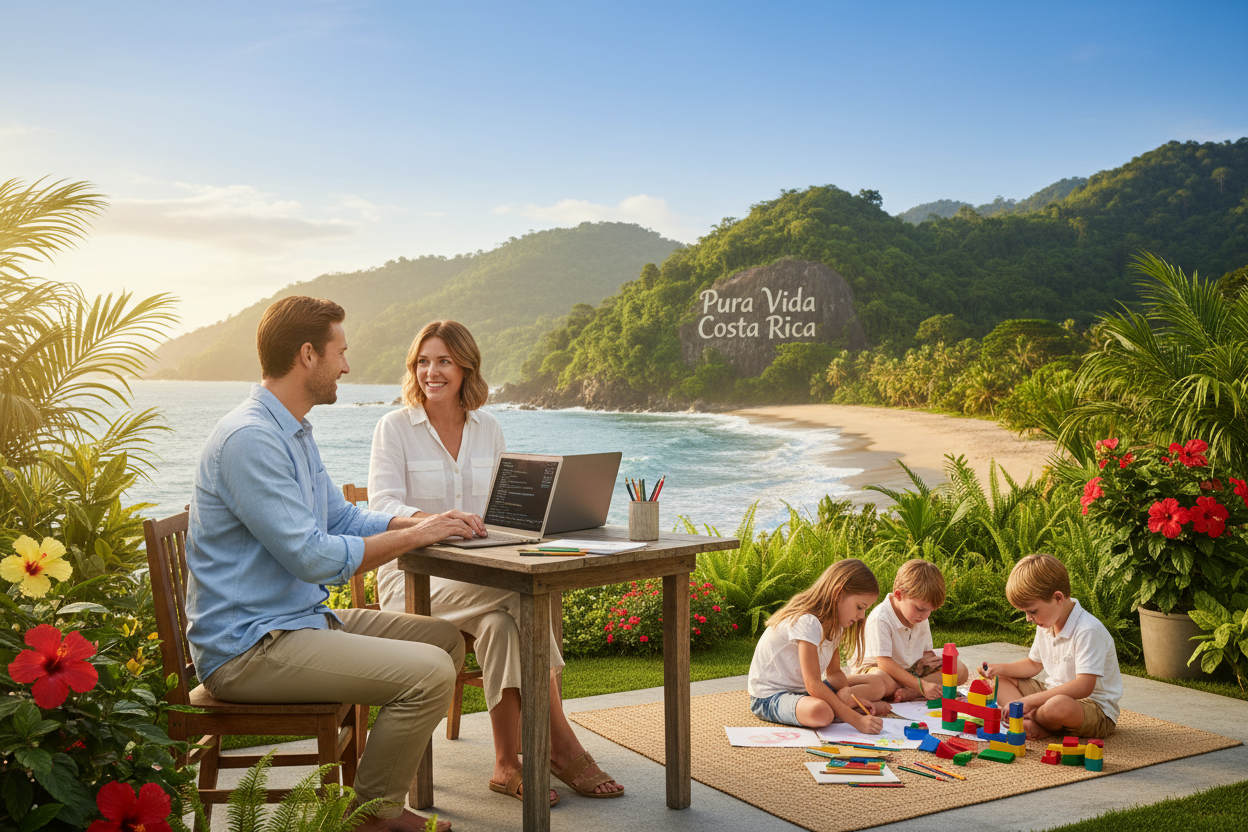
Many families exploring remote work options are searching for a permanent home, not just a temporary adventure. We need to clarify a critical distinction from the start. The popular digital nomad visa (Visa de Nómada Digital) is not a residency program.
This visa allows a stay of up to 12 months with specific tax benefits. Here’s the essential reality: it does not grant you residency status. It also does not count toward the years required for citizenship.
If your goal is to build a genuine, long-term life here—enrolling kids in school or accessing local healthcare—you need a formal residency pathway. The main categories are Pensionado, Rentista, and Inversionista.
This guide details who qualifies for Costa Rican residency. We cover the exact financial thresholds, required documents, and realistic application timelines. We also provide an honest look at daily life, from beautiful beaches to practical challenges.
We at CRIE specialize exclusively in residency and immigration for this nation. Our role is to be your transparent guide through this complex process. We offer expert knowledge without inflated promises or guarantees.
Understanding Costa Rica Residency Options
Establishing a permanent legal foundation in Costa Rica begins with understanding its formal residency pathways. The popular digital nomad visa is not one of them. It is a temporary permit that does not lead to permanent status.
For long-term living, you must pursue one of three primary categories. The Pensionado (Pensionado) is for retirees with a guaranteed pension. The Rentista (Rentista) requires proof of stable external income.
The Inversionista (Inversionista) path demands a significant investment within the country. Each option provides legal residency that counts toward the years required for future citizenship.
This crucial first step must be completed before any citizenship discussion. We always recommend verifying the latest details on the official migration website, migracion.go.cr, for current rules.
Who Can Qualify for Residency in Costa Rica
Your path to legal status begins by assessing which of the official categories aligns with your financial profile. You must prove you have stable, long-term means to support yourself here.
Eligibility Criteria and Income Requirements
Immigration authorities offer three main options. The Pensionado (Pensionado) is for retirees with a guaranteed pension. The Rentista (Rentista) suits people with reliable external income.
The Inversionista (Inversionista) path is for those making a significant investment. Each option has clear financial thresholds you must meet.
Thresholds for Pensionado (Pensionado), Rentista (Rentista), and Investor (Inversionista)
For the Pensionado category, you need a permanent pension of at least US$1,000 per month. This can cover your entire family under one application.
The Rentista pathway requires proof of US$2,500 in monthly income, guaranteed for two years. The Inversionista option demands a minimum US$150,000 investment in local real estate or a business.
A critical rule: any property investment must be in the applicant’s personal name, not a corporation.
Remember, you cannot legally work for a local company without permanent residency. Most people sustain themselves through online work or business ownership from abroad. We’ve seen many business plans fail due to complex regulations.
Meeting these financial requirements is necessary, but approval is never guaranteed.
Preparing Your Documents Before Arrival
The most critical phase of your residency journey begins not in Costa Rica, but from your current home. Arriving without perfectly prepared paperwork can add months of frustrating delays to your timeline.
Required Document Checklist
Every application needs a core set of documents. This includes birth certificates, marriage certificates, and police background checks. Financial proof—like bank statements or pension letters—is also mandatory.
Make sure all documents are recent, typically issued within the past six months. For the exact, current list, always verify requirements at the official migration website, migracion.go.cr.
Apostilles and Translations Guidelines
The apostille process must be completed in your home country. This authenticates documents for international use under the Hague Convention.
Official Spanish translations must follow. They need to be done by a certified translator. Amateur or uncertified versions will be rejected, forcing you to restart.
Simple tasks—like a bank visit—can unexpectedly consume half a day here due to lines or outages. Completing this work from home saves immense time and stress.
Navigating Pensionado (Pensionado), Rentista (Rentista), and Inversionista (Inversionista) Pathways
Selecting the right residency category is a foundational decision. It directly impacts your family’s legal and financial stability in Costa Rica.
Pensionado: Qualifying with a US$1,000+/month Pension
The Pensionado route offers the most straightforward option. You must prove a permanent pension of at least US$1,000 every month.
Official letters and bank statements are required. All documents need apostilles and certified Spanish translations.
Rentista and Investor: Income and Investment Criteria
The Rentista category demands proof of US$2,500 in monthly income. This must be guaranteed for a minimum two-year period.
Remember, basic housing rent often starts above US$1,000 a month. Factor this into your living budget.
The Inversionista path requires a US$150,000 minimum investment. A common error many make involves property ownership.
The investment property must be in your personal name, not held by a corporation. This rule is strict and frequently causes disqualification.
Detailed Step-by-Step Guide to the Application Process
Navigating the official application requires careful attention to detail and an understanding of local bureaucratic rhythms. Patience is essential here. Simple transactions at a bank or government office can easily consume half a day.
Step-by-Step Instructions for Submission
Your work begins at home, ideally three to six months before your move. Gather all required documents like birth certificates and financial proofs. Ensure they are current and from official agencies.
The next phase involves obtaining apostilles and certified Spanish translations. Attempting to skip these steps or using uncertified services leads to immediate rejection.
Finally, compile your complete application package. Submit it through the proper channels. Remember, system outages and power disruptions are not uncommon in this place, which can delay processing.
Contacting CRIE and Important Resources
For professional guidance through every step, contact CRIE. Reach us at info@crie.cr or WhatsApp +506 8706 3888. We help ensure your submission is correct and efficient.
Always verify the latest rules at the official migracion.go.cr website. For detailed guidance on pathways like the digital nomad visa, explore resources at crie.cr. Many people find this support invaluable.
Application Timelines and Expected Milestones
The clock on your application process starts long before you submit any paperwork. We need to set realistic expectations from the start. While some cases conclude in six to eight months, others extend beyond a year.
There are no guaranteed timeframes in Costa Rica. Anyone promising specific approval dates is not being honest about the unpredictable nature of immigration processing here.
The document preparation phase alone typically consumes two to four months. This is if you diligently obtain apostilles and certified translations from your home country. Underestimating this critical step can immediately add half a year or more to your timeline.
Once submitted, the initial review by authorities can take 30 days to several months. The exact time depends on application volume and your case’s complexity. Be prepared for possible requests for additional documents, known as prevenciones.
You typically have 30 days to respond completely. Failing to do so can result in denial, forcing a restart. After initial approval, final steps like obtaining your DIMEX ID card add another one to three months.
Throughout this journey, simple administrative tasks can consume half a day. Power outages during storms and bureaucratic rhythms contribute to the unpredictable pace. Building buffer time into your plans is essential.
The most important milestone is receiving your temporary residency approval. This day allows you to legally reside in the country and begin counting the years toward permanent status. It marks the true start of your family’s new life. Always verify the latest processing details at the official migracion.go.cr website.
Common Pitfalls and Mistakes to Avoid
We see the same application pitfalls derail households year after year. These errors waste significant money and time. The most frequent confusion involves the temporary digital nomad visa and actual residency here.
Frequent Errors in Application and Document Handling
Many people mistakenly view the nomad visa as a residency stepping stone. It is not. This temporary permit offers zero progress toward permanent status.
Another critical error is improper document handling. For the investor pathway, property must be in your personal name, not a corporation. Using expired papers or missing apostilles causes immediate rejection.
Tips for a Smooth Residency Process
Begin document preparation at least six months before your move. Work with qualified specialists who know the local system. Do not sever home-country ties until you have official approval in hand.
Have realistic expectations. Local business ventures often fail due to complex rules. Simple tasks can take half a day. The temporary visa is for a trial period, not for building a permanent future.
Starting From Home: Essential Pre-Arrival Planning
The success of your relocation often depends on actions taken in your current living room more than anything you do after arrival. We cannot overstate the importance of beginning this process at home, with all documents meticulously prepared.
Checklist of Preparations and Early Steps
Start document preparation six months before your move. Obtain birth certificates, marriage certificates, and police background checks from official sources. Have each document apostilled and translated into Spanish by certified professionals.
Financial proof must be current and clearly meet the thresholds for your chosen residency pathway. Compile bank statements, pension letters, or investment documentation as required.
Pack practically for life here. Bring prescription medications, contact lenses, and specialty skincare products from home, as these items are expensive locally. Tech accessories are hard to find outside San Jose, so bring extra chargers and cables.
Note that renting a car is costly but often necessary for getting around. Research potential areas to live based on your priorities. Beach towns offer coastal life, while Central Valley locations provide city amenities.
If you have children, contact schools early to understand costs and enrollment procedures. Pre-arrange temporary housing for your first month. Budget accordingly, as decent family accommodations in popular areas often start above US$1,000 monthly.
Costa Rica Digital Nomad With Family: A Residency Perspective
Many households arrive here on a temporary remote work permit, only to discover it cannot serve as the foundation for a long-term life. This one-year visa allows you to work from beautiful beaches, but it offers no path to permanent status.
Why Residency is Critical for Digital Nomad Families
For children to enroll in local schools or access healthcare, you need legal residency. The temporary visa does not count toward citizenship years. It is an excellent trial period, not a solution for building a future.
Communities in towns like Santa Teresa and Tamarindo are vibrant but transient. Parents seeking deep roots require the stability of formal status. The cost of living in these areas starts above $1,000 monthly for housing alone.
The Rentista pathway often fits online professionals best. It recognizes stable external income of $2,500+ per month and provides the legal footing for a settled future. This status allows true integration into local life.
Use your initial year strategically. Gather documents, explore locations, and prepare your residency application. Contact CRIE to discuss which pathway aligns with your long-term goals.
Leveraging Local Resources and Integrating with Community
True integration into your new home involves tapping into local networks and community resources. Your family’s long-term happiness often depends on these connections as much as legal status.
Official Immigration Websites and CRIE Contact
For definitive legal requirements, always refer to the official migracion.go.cr website. For personalized guidance on your family’s specific pathway, contact CRIE directly.
We provide expert support through the complex process. Reach us at info@crie.cr or WhatsApp +506 8706 3888.
Building Your Support Network in Costa Rica
Each town has active Facebook groups full of local knowledge. Popular places for families include beach towns like Tamarindo and the city neighborhoods of San Jose.
Making local friends enriches your life and provides practical safety nets. Costa Ricans are famously outgoing people.
Enrolling children in school builds a natural community. Participate in weekly farmers markets, yoga classes, and town festivals.
Proactively engaging in community life transforms a beautiful location into a true home.
Ready, Set, Go: Embarking on Your Costa Rican Residency Journey
Embarking on this journey rewards your family with an unparalleled blend of safety, adventure, and natural wonders. Costa Rica offers a life centered around stunning beaches, reliable internet for work, and a genuinely welcoming community.
The path forward requires choosing your financial pathway and meticulously preparing documents from home. This foundational work is your key to a stable future here.
We’re here to guide you through every step. For personalized support, contact us via WhatsApp at +506 8706 3888 or email info@crie.cr. Visit crie.cr to start planning your new life today.
What are the main residency options for a digital nomad moving to Costa Rica with a family?
The primary pathways are the Pensionado, Rentista, and Inversionista (Investor) visas. For a family, the Pensionado visa, based on a guaranteed lifetime pension, is often the most straightforward. The Rentista visa requires proof of stable income, and the Investor visa requires a significant capital investment in the country. We guide clients through each option to find the best fit for their long-term plans.
What are the financial requirements for the Pensionado and Rentista visas?
For the Pensionado visa, you must prove a minimum lifetime pension of US
What are the main residency options for a digital nomad moving to Costa Rica with a family?
The primary pathways are the Pensionado, Rentista, and Inversionista (Investor) visas. For a family, the Pensionado visa, based on a guaranteed lifetime pension, is often the most straightforward. The Rentista visa requires proof of stable income, and the Investor visa requires a significant capital investment in the country. We guide clients through each option to find the best fit for their long-term plans.
What are the financial requirements for the Pensionado and Rentista visas?
For the Pensionado visa, you must prove a minimum lifetime pension of US$1,000 per month. For the Rentista visa, you must demonstrate a stable income of at least US$2,500 per month for two years, guaranteed by a bank. These are the base amounts, and supporting a family may require higher thresholds. We help you structure your financial proof correctly.
What documents do we need to prepare before arriving in the country?
A>You’ll need apostilled and translated birth certificates, marriage certificates, police clearance reports, and proof of income or investment. Every document from abroad must be apostilled and translated by an official translator in Costa Rica. Starting this process from your home country is crucial, as it can take several weeks. We provide a detailed checklist to prevent delays.
How long does the entire residency application process take?
From document submission to provisional approval, you should plan for 3 to 6 months. The timeline depends on the Immigration Department’s caseload and the completeness of your application. Once approved, you’ll receive a *cédula* (ID card), which formalizes your status. We manage expectations with realistic milestones throughout the journey.
What is the most common mistake families make during the application?
The top error is submitting documents without the proper apostille or official translation. Costa Rican authorities will not accept foreign documents without these steps. Another pitfall is underestimating the income requirements for a family unit. We audit all paperwork and financial proofs to avoid these costly setbacks.
Why is obtaining formal residency important for digital nomad families, versus just entering on a tourist visa?
Residency provides stability and access. It allows you to open local bank accounts, import household goods duty-free, enroll in the national healthcare system, and legally drive with a local license. For families, this legal foundation is essential for schooling, long-term leases, and building a true home base. Tourist status does not offer these protections.
What local resources should we contact when starting this process?
The official resource is the Costa Rican Immigration Department (*Dirección General de Migración y Extranjería*). For specific inquiries, contacting the CRIE (Centro de Recepción de Expedientes) is necessary for application submission. Beyond official channels, building a network of a local attorney, a trusted translator, and other expat families is invaluable for support.
,000 per month. For the Rentista visa, you must demonstrate a stable income of at least US,500 per month for two years, guaranteed by a bank. These are the base amounts, and supporting a family may require higher thresholds. We help you structure your financial proof correctly.
What documents do we need to prepare before arriving in the country?
A>You’ll need apostilled and translated birth certificates, marriage certificates, police clearance reports, and proof of income or investment. Every document from abroad must be apostilled and translated by an official translator in Costa Rica. Starting this process from your home country is crucial, as it can take several weeks. We provide a detailed checklist to prevent delays.
How long does the entire residency application process take?
From document submission to provisional approval, you should plan for 3 to 6 months. The timeline depends on the Immigration Department’s caseload and the completeness of your application. Once approved, you’ll receive a *cédula* (ID card), which formalizes your status. We manage expectations with realistic milestones throughout the journey.
What is the most common mistake families make during the application?
The top error is submitting documents without the proper apostille or official translation. Costa Rican authorities will not accept foreign documents without these steps. Another pitfall is underestimating the income requirements for a family unit. We audit all paperwork and financial proofs to avoid these costly setbacks.
Why is obtaining formal residency important for digital nomad families, versus just entering on a tourist visa?
Residency provides stability and access. It allows you to open local bank accounts, import household goods duty-free, enroll in the national healthcare system, and legally drive with a local license. For families, this legal foundation is essential for schooling, long-term leases, and building a true home base. Tourist status does not offer these protections.
What local resources should we contact when starting this process?
The official resource is the Costa Rican Immigration Department (*Dirección General de Migración y Extranjería*). For specific inquiries, contacting the CRIE (Centro de Recepción de Expedientes) is necessary for application submission. Beyond official channels, building a network of a local attorney, a trusted translator, and other expat families is invaluable for support.
Article by Glenn Tellier (Founder of CRIE and Grupo Gap)
Don't wait, contact us right now!
Call or WhatsApp Costa Rica +506 8373 2085 or +506 8706 3888
Call USA/Canada +1 305-906-6784