

Dreaming of a new life in a land of stunning natural beauty and political stability? You’re not alone. Over 70,000 U.S. citizens now call this nation home, attracted by an affordable cost of living and a quality healthcare system.
To live here beyond the standard tourist stay, you need a legal pathway. This guide provides a clear, step-by-step roadmap for qualifying individuals. The key is to begin your document preparation from your home country.
We focus on the three main residency categories: Pensionado (retirees), Rentista (stable income), and Inversionista (investors). Using their official Spanish names is crucial for your application.
A critical point: the Digital Nomad visa is not a residency status. It does not count toward permanent residency or citizenship.
We believe in candid guidance. There are no guarantees in any immigration process. However, having every required paper apostilled, translated, and ready before arrival dramatically improves your chances for success.
This resource is from CRIE (crie.cr). For personalized help, reach us via WhatsApp at +506 8706 3888 or email info@crie.cr.
Documentation Essentials for Costa Rica Residency
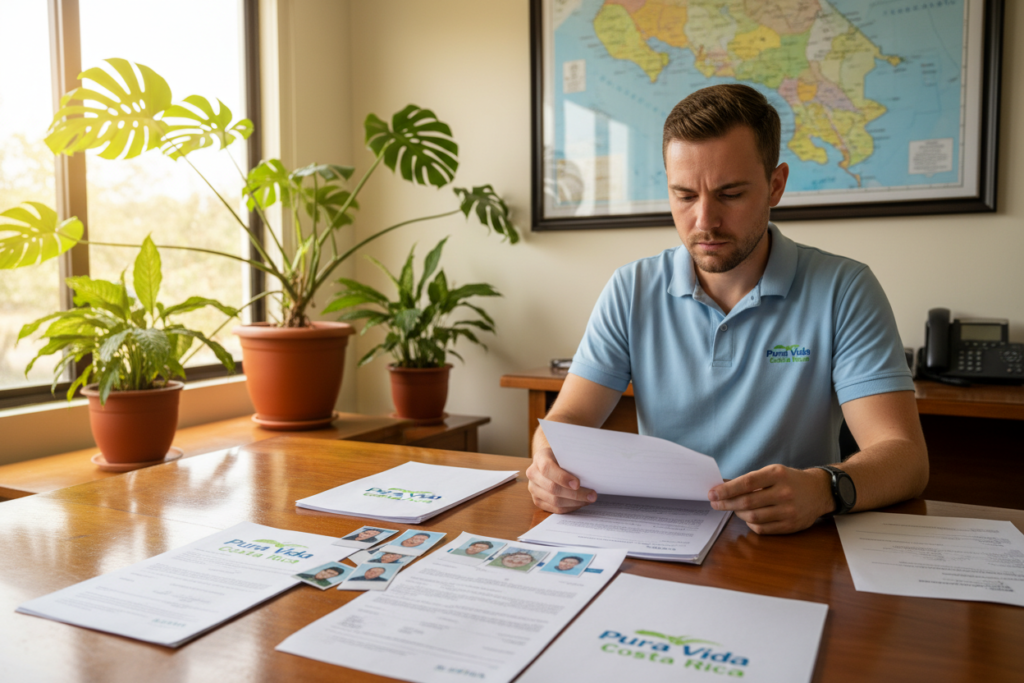
Navigating the paperwork for legal status in Costa Rica begins with a universal set of authenticated records. Every applicant must gather a core portfolio, regardless of their chosen category. We strongly advise initiating this process from your home country to prevent unnecessary holdups.
The essential papers include a valid passport with at least six months’ validity. You also need an apostilled birth certificate and a federal criminal background check with an apostille. For married couples, an apostilled marriage certificate is mandatory to include a spouse in your application.
All documents not originally in Spanish require translation by a certified official translator in Costa Rica. The apostille process itself can take several weeks. Translation adds further time to your timeline.
Proper preparation of these required documents is within your control. Accuracy and completeness significantly lower the risk of rejections or delays during the immigration review. While no outcome is guaranteed, meticulous attention here builds a solid foundation.
Understanding Residency Categories (Pensionado, Rentista, Inversionista)
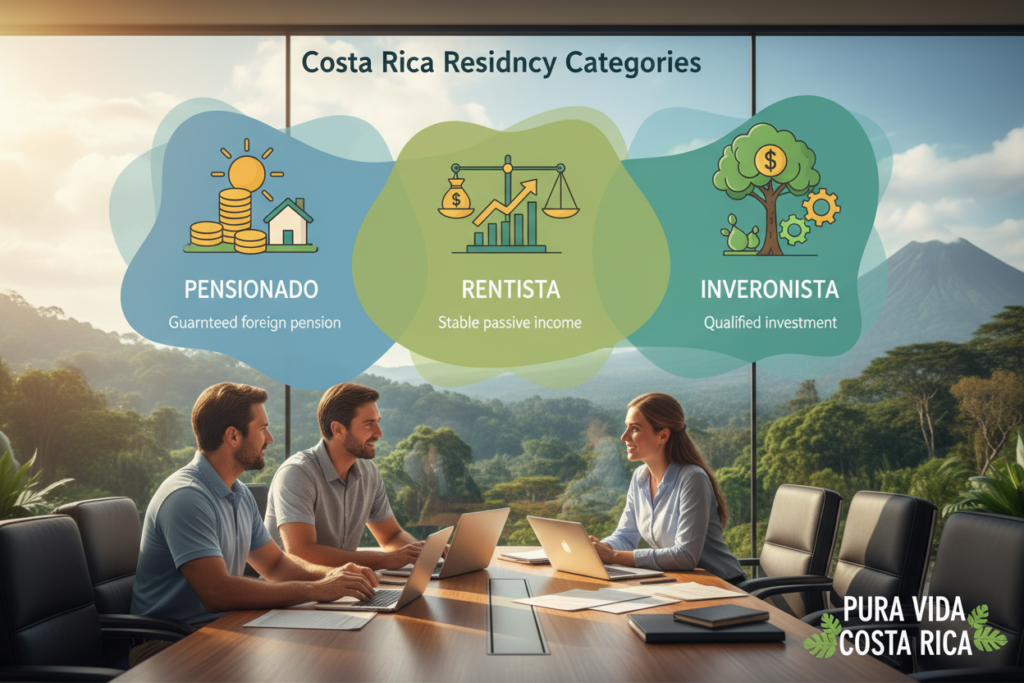
Three primary legal avenues exist for obtaining long-term status in Costa Rica, tailored to retirees, income earners, and investors. Your choice of category depends on your financial profile and life stage. We guide you through the core options.
Eligibility and Qualifications
The Pensionado (Pensionado) category is for retirees. You need a guaranteed pension of at least US$1,000 per month. This income can come from Social Security or a private annuity.
The Rentista (Rentista) option suits those with stable independent income. You must show proof of US$2,500 in monthly income for two years. Alternatively, a US$60,000 deposit in a local bank meets the requirements.
The Inversionista (Inversionista) pathway requires a minimum investment of US$150,000. This can be in real estate, a business, or tourism. A key rule: any property must be in your personal name, not a corporation’s.
Required Documentation Overview
Each category has unique paperwork beyond the core documents. Pensionado applicants provide pension verification letters. Rentista applicants need bank certifications or trust statements.
Inversionista applicants must show proof of ownership and tax payments. After three years of temporary residency, you can apply for permanent status. This offers more flexibility and eliminates renewals.
How to Prepare Immigration Documents for Costa Rica Residency
The journey to securing your legal status hinges on precise document preparation, a process best started from your home country. We outline a clear sequence of steps to follow. This proactive approach is the most effective way to manage your timeline.
Begin by collecting your core paperwork: passport, birth certificate, and federal background check. Each of these records, except the passport, requires an apostille. This international certification authenticates them for use in Costa Rica. Contact your Secretary of State or equivalent authority to start this step, which can take several weeks.
Once apostilled, any document not in Spanish needs translation by a certified official translator in Costa Rica. This is a strict legal requirement. Concurrently, create an online account with the Dirección General de Migración at migracion.go.cr. This portal is for your electronic submission and tracking.
After arrival, a Costa Rican notary must certify your passport. You may also need a special power of attorney if using legal representation. We encourage you to verify all requirements directly on the official immigration website. For personalized support, CRIE is available via WhatsApp or email, though we provide no guarantees.
Step-by-Step Guidance Before Arrival
The most critical phase of your residency application occurs before you ever arrive in Costa Rica. We guide you through the essential actions to take from your home country. This preparation is the key to a smoother process.
Who Qualifies and Their Requirements
First, identify your category. Retirees with a guaranteed pension of US$1,000 or more monthly qualify for Pensionado. Individuals with stable independent income of US$2,500 per month, or a US$60,000 deposit, are eligible for Rentista. Those investing at least US$150,000 in local assets can pursue the Inversionista pathway.
Pre-Arrival Documents and Preparations
Begin gathering your core paperwork immediately. You need a valid passport, an official birth certificate, and a federal criminal background check. If applying with a spouse, include your marriage certificate.
Each of these documents, except the passport, requires an apostille from your home country’s authorities. The background check and apostille process alone can take several weeks. We advise starting this 2 to 3 months before your planned move.
Category-specific proof is also required. Pensionado applicants need a pension verification letter. Rentista applicants must secure bank certifications. Inversionista candidates require property title deeds and tax payment records.
Starting this documentation journey from home provides the necessary time and access. It significantly increases your chances for a successful application once you are in Costa Rica.
Apostilles, Translations, and Notarizations: What You Need to Know
Apostilles, translations, and notarizations form the legal backbone of your residency paperwork. Each serves a distinct purpose in validating your documents for Costa Rican authorities.
Obtaining Apostilles and Certifications
An apostille is an international certification. It authenticates documents like your birth certificate for use in Costa Rica. You must obtain it from your home country’s Secretary of State.
This process can take several weeks. Once in Costa Rica, your passport requires certification by a local notary. Plan for this step upon arrival.
Ensuring Accurate Translations
Any document not in Spanish needs a certified translation. Only translators officially recognized in Costa Rica can perform this work.
Accurate translations prevent delays in your application review. We recommend verifying requirements at migracion.go.cr. The entire authentication and translation process may take 2 to 3 months.
Critical Timelines and Application Milestones
Setting accurate expectations around timelines can transform a stressful application process into a manageable one. We provide realistic timeframes for each stage, though every case is unique and outcomes cannot be guaranteed.
Key Deadlines and Processing Times
The initial document preparation phase typically takes 2 to 3 months. This includes gathering records, obtaining apostilles, and arranging certified translations.
You must submit your complete application within the 90-day validity of your entry stamp. Missing this date can cause significant complications.
After submission, the official review and processing phase begins. This can range from 4 to 15 months, depending on application completeness and current immigration backlogs.
A key milestone during this period is your fingerprint and biometric registration appointment in Costa Rica. Following approval, you will receive your DIMEX card and must enroll in the Caja healthcare system.
Your initial temporary residency is valid for two years and requires renewal. After maintaining this status for three consecutive years, you become eligible for permanent residency.
Processing times change. We recommend checking migracion.go.cr for the most current information. For guidance on these milestones, explore our resource for common questions.
Mistakes to Avoid When Preparing Your Documents
The path to legal status is often delayed not by complex rules, but by preventable errors in document preparation. We see many applicants stumble over the same hurdles.
Understanding these common pitfalls can protect your timeline and improve your overall experience.
Common Pitfalls and Oversights
Submitting an incomplete application is a major setback. Missing a single required paper, apostille, or certified translation can trigger requests for more information. This adds months to your processing time.
Many people underestimate how long it takes to get apostilles and translations. Waiting until arrival in Costa Rica creates significant access problems. Another frequent error is missing the 90-day submission window after entry.
Some assume a tourist or Digital Nomad visa counts toward long-term residency. It does not. Only formal categories like Pensionado provide a pathway to permanent status.
Neglecting to register with the Caja healthcare system after approval is another oversight. This step is mandatory. Misunderstanding the income requirements for your chosen category also causes rejections.
Practical Tips to Stay on Track
Create a detailed checklist for every document. Start the apostille and translation process at least two to three months before your planned move.
Double-check each paper for accuracy and completeness before submission. Verify all financial thresholds directly on the official migracion.go.cr website.
When unsure, seek verification. Contacting CRIE via WhatsApp or email can provide clarity. While outcomes are never guaranteed, avoiding these simple mistakes leads to a smoother process.
Digital Nomad Clarification: Why It Doesn’t Count as Residency
It’s crucial to distinguish between a temporary visa and a formal residency status when planning a long-term move. A common point of confusion involves Costa Rica’s Digital Nomad visa.
This program is a temporary visa, not a legal residency permit. It allows remote workers to live in the country for up to two years.
Time spent under this visa does not count toward the three consecutive years of temporary residency required for permanent status. It also does not contribute to the path toward Costa Rican citizenship.
For digital nomads seeking true legal residency, the Rentista category is the appropriate path. This requires proof of a stable monthly income of US$2,500 for two years, or a US$60,000 deposit in a local bank.
Only the formal categories—Pensionado, Rentista, and Inversionista—lead to permanent residency after three years. The Digital Nomad visa offers simplicity but is a dead end for long-term immigration goals.
We recommend verifying all details on the official migracion.go.cr website. For personalized guidance on your situation, you can contact CRIE.
Gathering Financial Evidence and Meeting Income Thresholds
Your ability to meet specific income or investment thresholds must be backed by official documentation. This financial proof is a critical component of your application review.
Authorities require verifiable records that match the exact requirements of your chosen category. Incomplete or inaccurate evidence is a common reason for delays.
Pensionado: US$1,000+/month Pension Requirements
For the Pensionado category, you need an official pension verification letter. This document must confirm a guaranteed lifetime income of at least US$1,000 per month.
Acceptable sources include U.S. Social Security, government pensions, and private annuities. The letter must come directly from the administering institution.
Rentista and Investor Income Evidence
Rentista applicants must show stable monthly income of US$2,500 for two years. Bank certifications or statements serve as proof.
Alternatively, a one-time deposit of US$60,000 into a Costa Rican bank account satisfies this rule. The funds must remain in the account.
For the Inversionista pathway, proof of a minimum US$150,000 investment is required. This often involves real estate.
You must provide the property title, a current valuation certificate, and proof all taxes are paid. Crucially, the asset must be in your personal name, not a corporation’s.
All financial documents must be current and accurately reflect your situation. We recommend verifying requirements on the official migracion.go.cr website.
Utilizing CRIE and Official Resources Like migracion.go.cr
A dual approach combining personalized support with official verification forms the cornerstone of a well-prepared residency application. We recommend using both expert guidance and the definitive government portal.
How CRIE Supports Your Application
CRIE focuses exclusively on Costa Rica immigration. We offer step-by-step support for your residency process. Our team provides personalized guidance on document preparation and category selection.
We review your paperwork for accuracy and completeness. This helps avoid common mistakes that cause delays. We do not provide pricing quotes or guarantee outcomes.
Accessing Guidance on migracion.go.cr
The official Dirección General de Migración website is migracion.go.cr. This is your source for current forms, legal updates, and processing times. You must create an online account there to submit your application.
We strongly advise cross-referencing all guidance with this authoritative system. Immigration rules can change. The government portal provides the final word on requirements.
Combine CRIE’s expert guide with the official account steps. This creates a solid foundation for your immigration journey. For questions, contact us via WhatsApp at +506 8706 3888 or email info@crie.cr.
Final Steps and Next Actions to Secure Your Costa Rican Residency
Taking decisive action now can transform your dream of living in Costa Rica into a reality. Start your document preparation early from your home country. Understand your category and its financial thresholds.
Avoid common mistakes like incomplete submissions. Use both migracion.go.cr for official forms and CRIE for personalized guidance.
Successful applicants receive a DIMEX card and enroll in the Caja healthcare system. Temporary status lasts two years. After three years, you can apply for permanent residency.
This offers long-term stability and the right to work. While outcomes aren’t guaranteed, proper preparation greatly improves your experience.
Begin gathering your papers today. For support, contact CRIE via WhatsApp at +506 8706 3888 or email info@crie.cr. Your new life awaits.
FAQ
What are the main residency options for moving to Costa Rica?
The primary paths are the Pensionado, Rentista, and Inversionista categories. The Pensionado visa is for retirees with a guaranteed lifetime pension. The Rentista option is for those with stable passive income. The Inversionista program requires a significant financial investment in the country, such as in real estate or a business.
What is the most common mistake people make with their application?
A frequent and costly error is submitting documents without the proper apostille or with an incorrect translation. Every foreign-issued document, like your birth certificate or marriage license, must have a recent apostille and be translated into Spanish by an official translator recognized here.
How long does the residency process typically take?
From submitting your complete file to receiving your physical ID card, you should plan for a timeline of several months to over a year. Government processing times can vary. We build realistic expectations into your plan from day one, as patience and proper preparation are key.
Does a Digital Nomad Visa lead to permanent residency?
No, it does not. The Digital Nomad Visa is a temporary permit for remote workers. It is a separate process and does not count toward the years required for permanent residency. If your long-term goal is to become a resident, you should apply for a formal residency category from the start.
What proof of income do I need to provide?
A> Requirements differ by category. For a Pensionado visa, you must prove a lifetime pension of at least
FAQ
What are the main residency options for moving to Costa Rica?
The primary paths are the Pensionado, Rentista, and Inversionista categories. The Pensionado visa is for retirees with a guaranteed lifetime pension. The Rentista option is for those with stable passive income. The Inversionista program requires a significant financial investment in the country, such as in real estate or a business.
What is the most common mistake people make with their application?
A frequent and costly error is submitting documents without the proper apostille or with an incorrect translation. Every foreign-issued document, like your birth certificate or marriage license, must have a recent apostille and be translated into Spanish by an official translator recognized here.
How long does the residency process typically take?
From submitting your complete file to receiving your physical ID card, you should plan for a timeline of several months to over a year. Government processing times can vary. We build realistic expectations into your plan from day one, as patience and proper preparation are key.
Does a Digital Nomad Visa lead to permanent residency?
No, it does not. The Digital Nomad Visa is a temporary permit for remote workers. It is a separate process and does not count toward the years required for permanent residency. If your long-term goal is to become a resident, you should apply for a formal residency category from the start.
What proof of income do I need to provide?
A> Requirements differ by category. For a Pensionado visa, you must prove a lifetime pension of at least $1,000 per month. For the Rentista visa, you need to demonstrate a stable income of $2,500 per month for two years. This often involves providing bank statements and letters from financial institutions.
What is CRIE and how can it help me?
The Costa Rican Immigration Experts (CRIE) is the official colegio for immigration professionals. Working with an expert affiliated with CRIE ensures your application is handled correctly. They navigate the system’s complexities, manage submissions, and communicate directly with the Immigration Department on your behalf.
Can I start the process before I arrive in the country?
A> Yes, and we strongly recommend it. You can begin gathering and authenticating your required documents, like your passport, birth certificate, and police background check, from your home country. This pre-arrival preparation can significantly speed up your application once you are in Costa Rica.
What are the financial benefits of obtaining residency?
Becoming a legal resident offers several advantages. You can open a local bank account more easily, import a vehicle and household goods tax-free, and gain access to the national healthcare system. It also provides greater stability and simplifies long-term financial planning for your life here.
,000 per month. For the Rentista visa, you need to demonstrate a stable income of ,500 per month for two years. This often involves providing bank statements and letters from financial institutions.
What is CRIE and how can it help me?
The Costa Rican Immigration Experts (CRIE) is the official colegio for immigration professionals. Working with an expert affiliated with CRIE ensures your application is handled correctly. They navigate the system’s complexities, manage submissions, and communicate directly with the Immigration Department on your behalf.
Can I start the process before I arrive in the country?
A> Yes, and we strongly recommend it. You can begin gathering and authenticating your required documents, like your passport, birth certificate, and police background check, from your home country. This pre-arrival preparation can significantly speed up your application once you are in Costa Rica.
What are the financial benefits of obtaining residency?
Becoming a legal resident offers several advantages. You can open a local bank account more easily, import a vehicle and household goods tax-free, and gain access to the national healthcare system. It also provides greater stability and simplifies long-term financial planning for your life here.
Article by Glenn Tellier (Founder of CRIE and Grupo Gap)
Don't wait, contact us right now!
Call or WhatsApp Costa Rica +506 8373 2085 or +506 8706 3888
Call USA/Canada +1 305-906-6784