
Every year, thousands are drawn to this nation for its stunning nature and stable, peaceful way of life. The dream of moving here is compelling, but the legal path requires meticulous preparation from the very start.
Proper authentication of your paperwork is not optional—it’s mandatory for a successful application. The apostille is the cornerstone of this process, verifying your documents for international use.
This guide focuses exclusively on legal residency categories like Pensionado, Rentista, and Inversionista. We do not cover tourist visas or Digital Nomad permits, as those do not lead to permanent status or citizenship.
We act as your guide, bridging the gap between U.S. systems and local immigration law. Our role is to demystify the steps with clear, plain-English explanations.
A critical step begins at home. Gathering, notarizing, and preparing your files before you travel prevents costly delays and repeat trips later.
The nation’s membership in the Hague Convention simplifies everything. Since 2012, it has used the apostille system, saving you from complex consular legalization chains.
We provide expert guidance and facilitation based on published standards. Final decisions on all applications rest solely with the authorities at migracion.go.cr.
Start from Home: Document Preparation and Apostille Essentials

Your journey to legal status begins not at the immigration office, but at home with a meticulous document checklist. The single biggest error is arriving without properly prepared papers. This forces you to work with U.S. agencies from abroad—a frustrating and expensive ordeal.
Gathering Key Documents and Certifications
Every applicant needs foundational records. These include a valid passport, birth certificate, and an FBI criminal background check. If applicable, bring a marriage certificate or divorce decree.
These papers must originate from official government sources. For example, birth and marriage certificates need to be certified copies from the state vital records office. Do not use hospital copies or personal files.
Ensuring Notarization, Apostilles, and Translations
All these documents must receive an apostille and be translated into Spanish by a certified professional. The correct order is key. First, obtain the certified original. Second, get it translated. Third, submit both for the apostille.
An apostille is a specialized certificate from a government authority. It authenticates your document for international use under the Hague Convention.
For the Inversionista category, note that any real estate investment must be titled in your personal name. It cannot be held through a corporation or trust.
Always verify the latest requirements at the official migration website, migracion.go.cr.
Costa Rica Apostille Requirements for Residency: A Step-by-Step Overview
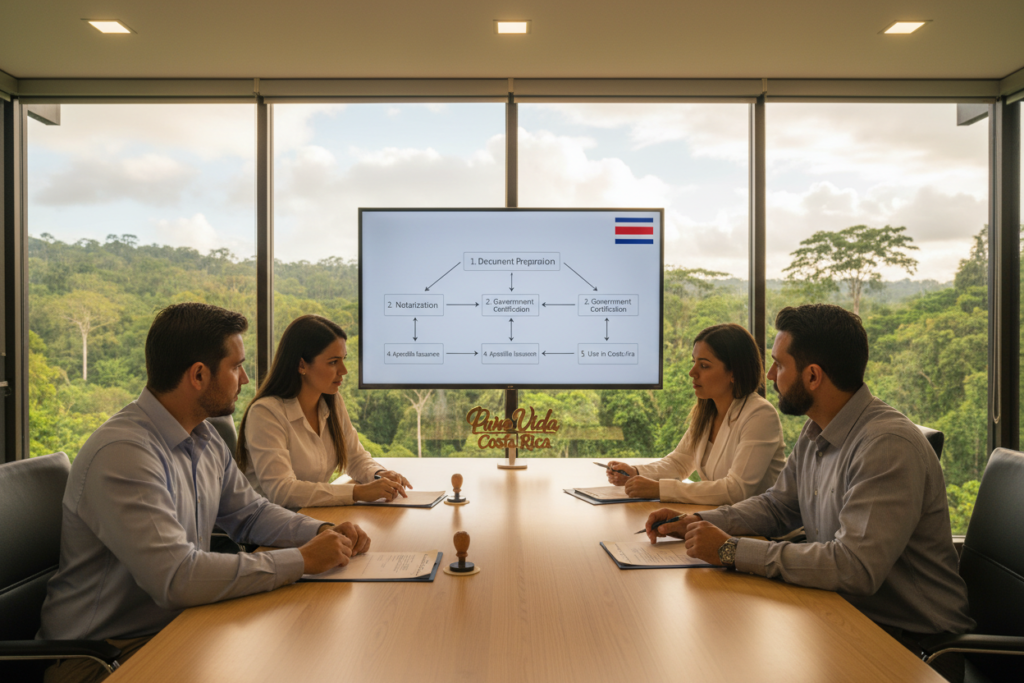
A global treaty has transformed how countries recognize each other’s official documents. This nation joined the Hague Convention in 2012. That membership creates a streamlined system for authentication.
Understanding the Apostille Process under the Hague Convention
Before this convention, a process called legalization was required. It involved multiple government agencies and foreign consulates. Now, a single apostille from the correct U.S. authority is sufficient.
This certification confirms a document’s legitimacy for use in other member countries. The old legalization chain was time-consuming. The modern apostille system is a direct, one-step verification.
How Apostilles Validate Your U.S. Documents for Costa Rica
Officials here verify the apostille’s unique reference number against international registries. This check confirms the certifying authority’s legitimacy. It takes minutes, not weeks.
You must submit original apostilled documents. Copies are not accepted by the authorities. The apostille validates the document’s authenticity, not its content.
Your application at migracion.go.cr requires this certification. It is a mandatory step, but approval depends on meeting all other criteria.
Residency Eligibility and Category-Specific Requirements (Residencia en Costa Rica)
We often see applicants stumble by not understanding the distinct financial proofs required for each type of residency. Legal status here is built on specific categories like Pensionado, Rentista, and Inversionista. Choosing correctly from the start aligns your situation with immigration law.
Meeting the Pensionado (Pensionado) Income Thresholds
The Pensionado category is popular for retirees. It requires proof of a guaranteed lifetime pension of at least US$1,000 per month.
This must come from a government or private pension plan. Social Security retirement benefits can qualify if they meet the threshold.
You need a pension verification letter from the issuing institution. This document must be apostilled and translated into Spanish.
Rentista (Rentista) and Inversionista (Inversionista) Criteria Explained
The Rentista option requires proving a guaranteed monthly income of $2,500 for two years. This can be shown via a bank letter or documentation of overseas payments.
The Inversionista category demands a minimum investment of $150,000 in local real estate or a business. A critical rule: the property must be titled in your personal name, not through a corporation.
Note: The Digital Nomad visa is not a legal residency path. For remote workers, Rentista is typically the closest applicable category.
All these categories grant temporary status first. After three consecutive years, you become eligible to apply for permanent residency.
Timelines, Tips, and Common Mistakes to Avoid
Avoiding costly delays hinges on understanding two key factors: government processing speeds and document expiration dates. We guide clients to plan for a minimum of two to three months for the entire preparation process.
Mapping Out Processing Times and Document Validity
Realistic expectations are vital. Ordering a state-issued birth certificate can take 2-4 weeks. An FBI background check often requires 6-8 weeks from fingerprinting.
State-level apostilles usually process in 5-15 business days. Federal apostilles for those FBI reports add another 5+ weeks. These are actual government timelines.
Validity periods are crucial. While apostilles themselves don’t expire, your criminal background check must be issued within six months of your application submission. An older report means starting over.
Identifying Critical Errors and How to Prevent Them
Common pitfalls derail applications. These include submitting photocopies instead of originals, using non-certified translations, or getting a state-level background check instead of the required FBI report.
Incorrect notarization is a frequent rejection reason. If you need a California birth certificate apostilled, the notarization must be done by a California notary. A notary from another state will cause a rejection.
Remember, a “certified copy” must come directly from the vital records office that issued it. A local notary cannot certify your personal photocopy for this process.
We share these insights to save you time and stress. Final decisions and processing times remain with the authorities.
Step-by-Step Guidance for a Smooth Costa Rica Residency Process
A systematic approach transforms the complex residency process into manageable actions. We break it into two clear phases: preparation at home and in-country procedures. This structure prevents overwhelm and keeps your application on track.
Pre-Arrival Checklist and Document Preparation
Complete these steps before you leave the United States. First, determine your eligibility category. Next, order certified copies of vital records like birth and marriage certificates.
Initiate your federal background check immediately, as it takes the longest. Arrange certified Spanish translations for every document. Then, submit them for the required apostilles through the correct state or federal offices.
Allow 8 to 12 weeks for this entire sequence. Rushing often leads to errors that cause rejection. For families, understanding the process for residency for spouses in Costa Rica is also crucial.
Navigating Post-Arrival Procedures and Fingerprinting
Upon entry, your passport receives a stamp starting the clock. You must submit your complete file within this period. The first in-country step is often biometric fingerprinting with local authorities.
This appointment is mandatory for all applicants. You may also need consular registration. Many choose to grant a special power of attorney to a local legal representative.
Only original apostilled documents are accepted for filing. Keep digital scans and physical copies for your records. Expert guidance can be invaluable in navigating these final steps smoothly.
Final Thoughts: Your Next Steps on the Costa Rica Journey
Taking the leap to relocate begins with a solid foundation of properly authenticated paperwork. This legal process is your gateway to a new life in a beautiful nation.
Start gathering your documents from home now. We recommend budgeting at least two to three months for this critical phase.
Choose your residency category carefully based on your financial situation. Ensure all papers are translated by a certified professional and have valid apostilles.
We provide expert guidance to help navigate this system. For personalized assistance, contact us via WhatsApp at +506 8706 3888 or email info@crie.cr.
Remember, final approval rests solely with the immigration authorities. Always verify the latest requirements at migracion.go.cr.
For comprehensive support throughout your application, explore our additional services.
FAQ
Which documents from the U.S. typically require an apostille for my residency application?
You will need to apostille your birth certificate and, if applicable, your marriage certificate. A federal background check from the FBI also requires this certification. These are the core documents that local authorities must verify as authentic for your file.
How does the apostille process actually work for my U.S. documents?
The apostille is a standardized certification under the Hague Convention. For documents issued by a U.S. state, like a birth certificate, you must get the apostille from that state’s Secretary of State office. For federal documents, like an FBI check, the U.S. Department of State provides it. This stamp validates the document’s signature for use in any other member country, including Costa Rica.
What are the main financial requirements for the Pensionado and Rentista residency categories?
For the Pensionado visa, you must prove a stable lifetime pension of at least
FAQ
Which documents from the U.S. typically require an apostille for my residency application?
You will need to apostille your birth certificate and, if applicable, your marriage certificate. A federal background check from the FBI also requires this certification. These are the core documents that local authorities must verify as authentic for your file.
How does the apostille process actually work for my U.S. documents?
The apostille is a standardized certification under the Hague Convention. For documents issued by a U.S. state, like a birth certificate, you must get the apostille from that state’s Secretary of State office. For federal documents, like an FBI check, the U.S. Department of State provides it. This stamp validates the document’s signature for use in any other member country, including Costa Rica.
What are the main financial requirements for the Pensionado and Rentista residency categories?
For the Pensionado visa, you must prove a stable lifetime pension of at least $1,000 per month. For the Rentista category, you need to demonstrate a guaranteed income of $2,500 per month for two years, often secured through a deposit in a Costa Rican bank. The Inversionista category requires a minimum investment of $150,000 in the country.
How long does the entire document preparation and apostille process usually take?
Timelines can vary significantly. Gathering and notarizing your documents may take a few weeks. The apostille process itself can add several more weeks, depending on the agency’s backlog. We always advise starting this preparation 4-6 months before you plan to submit your application to account for unexpected delays.
What is the most important step to take before I arrive in the country to apply?
The most critical pre-arrival step is completing your document legalization. Ensure your birth certificate, marriage certificate, and background check are all properly notarized, apostilled, and translated into Spanish by a certified translator in Costa Rica. Submitting incomplete paperwork is the primary reason for delays or rejections.
What happens after I submit my application and documents to immigration?
After submission, you will be called to provide your fingerprints (dactiloscopia) at the Dirección General de Migración y Extranjería. Then, your application enters the review phase. During this waiting period, you will receive a temporary permit that allows you to stay in the country while your permanent residency is processed.
,000 per month. For the Rentista category, you need to demonstrate a guaranteed income of ,500 per month for two years, often secured through a deposit in a Costa Rican bank. The Inversionista category requires a minimum investment of 0,000 in the country.
How long does the entire document preparation and apostille process usually take?
Timelines can vary significantly. Gathering and notarizing your documents may take a few weeks. The apostille process itself can add several more weeks, depending on the agency’s backlog. We always advise starting this preparation 4-6 months before you plan to submit your application to account for unexpected delays.
What is the most important step to take before I arrive in the country to apply?
The most critical pre-arrival step is completing your document legalization. Ensure your birth certificate, marriage certificate, and background check are all properly notarized, apostilled, and translated into Spanish by a certified translator in Costa Rica. Submitting incomplete paperwork is the primary reason for delays or rejections.
What happens after I submit my application and documents to immigration?
After submission, you will be called to provide your fingerprints (dactiloscopia) at the Dirección General de Migración y Extranjería. Then, your application enters the review phase. During this waiting period, you will receive a temporary permit that allows you to stay in the country while your permanent residency is processed.
Article by Glenn Tellier (Founder of CRIE and Grupo Gap)
Don't wait, contact us right now!
Call or WhatsApp Costa Rica +506 8373 2085 or +506 8706 3888
Call USA/Canada +1 305-906-6784