
Navigating the immigration system can feel overwhelming. We’re here to simplify one specific pathway for you.
This guide focuses on obtaining legal status through marriage to a Costa Rican citizen. It’s a process that grants significant advantages over standard tourist visas.
You won’t need to leave the country every 90 days. More importantly, it allows you to work legally here.
We’ll walk you through the entire journey. This includes initial eligibility checks, crucial document preparation, and the apostille process.
Our approach emphasizes starting your paperwork from your home country. Proper preparation upfront saves months of delays and prevents costly mistakes.
The process leads to temporary status, renewable annually. After three years, you become eligible for permanent immigration status.
Remember, we provide guidance based on real applicant experiences. Always verify the latest official information for your specific case.
Understanding Costa Rica Residency Through Marriage (Matrimonio)

The Matrimonio category offers a distinct route for those married to a Costa Rican national. This legal framework provides a clearer path than standard visitor status.
Benefits and Legal Advantages
This status grants significant practical rights. You can work legally without a separate permit and stay in the country without 90-day border exits.
Access to the public healthcare system (CAJA) at local rates is another key advantage. The law recognizes same-sex unions performed after May 2020, offering equal process.
Maintaining your status is flexible. You only need to spend one day per year physically in the nation.
Temporary and Permanent Residency Options
You first receive temporary residency (Residencia Temporal). This status is valid for one year and requires annual renewal.
After maintaining this temporary status for three consecutive years, you become eligible for permanent residency (Residencia Permanente). This progression is central to the process.
Permanent status eliminates most annual paperwork. It represents a major step toward long-term stability and life here.
Who Qualifies for Residency via Marriage in Costa Rica
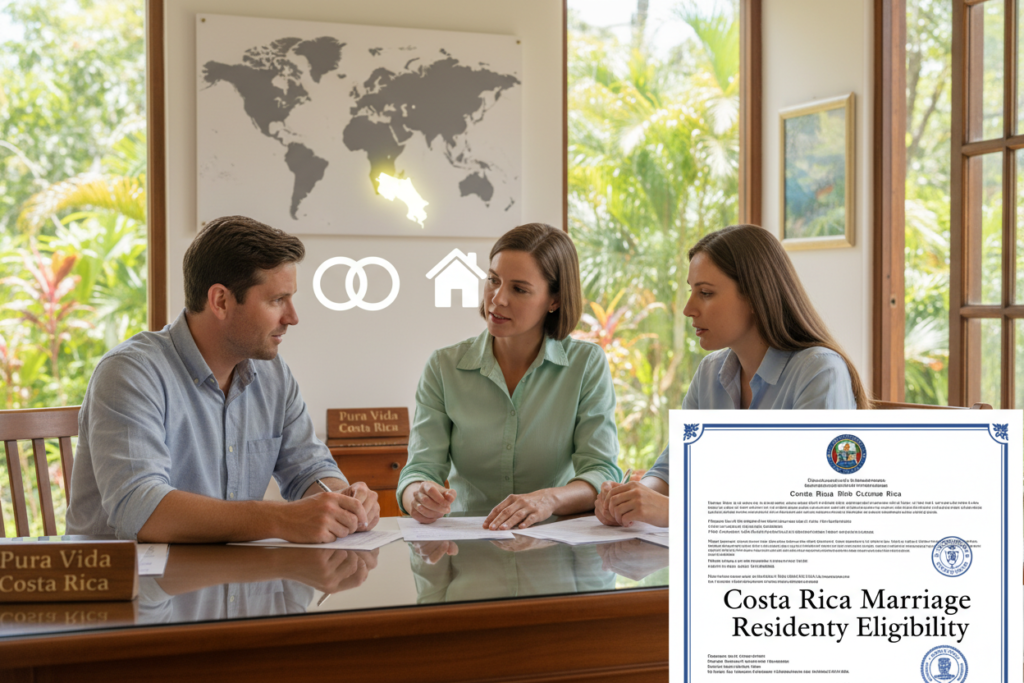
The foundation for a successful application is establishing a legally recognized bond with a Tico citizen. Eligibility is strictly limited to first-degree family connections.
This means your direct link must be as a spouse, child, parent, or unmarried sibling of a Costa Rican national. Extended family like grandparents or cousins do not qualify.
Eligibility Criteria and Proof of Marriage
Your union must be formally registered with the local Civil Registry. For weddings performed abroad, this involves an apostille and official Spanish translation first.
Costa Rica recognizes same-gender marriages performed after May 2020. These couples follow the exact same process as opposite-sex pairs.
Providing proof means submitting the certified document from the Registry. Original certificates from other countries are not accepted by authorities.
Required Identification and Supporting Evidence
You must present a valid passport with at least six months remaining. Certified copies of every page, even blank ones, are required.
The financial requirement is for the household. One stable monthly income covers both partners and any dependent children.
Either partner can be the main applicant. This offers flexibility for residency for spouses based on which person has stronger documentation.
Requirements and Documentation Essentials for Residency
Your application’s success hinges on a precise set of authenticated personal records. We cannot overstate the importance of getting every detail right from the start.
Always verify the latest checklist directly with the official immigration website, migracion.go.cr.
Marriage Certificate, Birth Certificate, and Background Checks
Three core documents form the foundation of your file. You will need a recent birth record, a police clearance, and proof of your union.
Each one must be issued within the last six months. This validity window is strictly enforced by authorities.
Your birth document must be the long-form version showing parental details. The criminal background report must come from your last place of residence.
If your wedding was abroad, that proof must also be recent and properly registered locally.
Importance of Apostilles and Official Translations
Foreign papers require international authentication. For many countries, this means obtaining an Apostille stamp.
If your nation isn’t part of the Hague Convention, consular legalization is the alternative path. Both methods validate your documents for use here.
Any paper not in Spanish needs an official translation by a certified professional. This step is non-negotiable.
We strongly advise starting this entire document preparation in your home country. Attempting it after arrival creates significant delays and complications.
Document Preparation Before Arrival (Preparación de Documentos)
A common thread among successful applications is completing the entire document legalization process from home. Attempting to coordinate apostilles or translations after arriving multiplies delays and costs exponentially.
Organizing U.S. Documents and Legalizations
For U.S. citizens, the first step is ordering a certified birth certificate. Services like VitalChek streamline this for most states. However, states like Arizona require a separate apostille request mailed to the Secretary of State.
Plan for 3 weeks total for this process. Next, obtain your FBI background check. Get fingerprints at a sheriff’s office, then apply online. Results arrive via email within a week.
You must then apostille this report. Mailing it to the Office of Authentications with a $20 fee takes 5-6 weeks. Using an electronic submission or courier service can drastically reduce this timeline.
Ensuring Compliance with Migracion.go.cr Guidelines
Always verify current requirements at migracion.go.cr before starting. Document formats and fees occasionally change. We emphasize starting this process outside Costa Rica to meet the strict six-month validity window for all papers.
Costa Rica Residency Marriage Certificate Requirements
At the heart of every spousal application lies a properly validated marriage document. This proof of union is the non-negotiable cornerstone for this immigration pathway.
We emphasize understanding the key components. Your Certificado de Matrimonio must meet specific legal requirements set by authorities.
Key Components and Legal Framework
If your union took place within the country, obtain the official record directly from the Registro Civil. This local document requires no further authentication for your file.
For marriages performed abroad, the process is more involved. Your foreign certificate needs an Apostille stamp or consular legalization first.
It then requires an official Spanish translation by a certified professional. Crucially, it must also be registered with Costa Rica’s own Civil Registry before you apply.
All documents must be issued within six months of your application filing. This means requesting a recent certified copy, not using your original wedding paper.
Same-sex unions performed after May 2020 follow the exact same framework. There is no separate process or additional scrutiny.
Always verify the latest, specific standards at migracion.go.cr. Processing rules can vary slightly depending on your country of origin.
Detailed Step-by-Step Guidance for Your Application Process
Submitting your application initiates a structured sequence governed by Costa Rican immigration authorities. Many applicants hire a licensed local attorney (abogado de migración) to navigate this phase.
Your lawyer typically prepares the required application letter and Formulario de Filiación for your signature. You then pay the $290 USD filing fee to the Immigration Department.
Filing Procedures and Timelines
Upon receiving your file, immigration assigns a tracking number (número de expediente). Use this to check your status online at migracion.go.cr.
A required step is providing fingerprints at the Ministry of Public Security. This generates an Interpol background check.
Plan for the entire process to take about one year. Some cases finish in 8-10 months, while others extend to 18 months.
Tips for Submitting Your Residency Application
After approval, you must register with the CAJA healthcare system. Then, pay the final government fees totaling $428 USD.
You will schedule an appointment to process your DIMEX identification card. This card serves as your official proof of legal residency in Costa Rica.
Maintain patience throughout. Document expiration is a common delay, so always verify current procedures on the official website.
Common Mistakes to Avoid During the Residency Application
Preventable errors, not complex legal hurdles, are the most common cause of lengthy delays. We see applicants make the same missteps, which often lead to costly re-submission of paperwork.
Handling Document Expiration and Delays
Your papers are only valid for six months from their issue date. The challenge is that you cannot control when authorities review your file.
Processing backlogs can push this date beyond your documents’ validity window. Strategic timing is key—obtain time-sensitive items like your background check last.
For U.S. citizens, using an electronic FBI channeler delivers results in days, not months. This simple step virtually eliminates the risk of an expired report.
Avoiding Misinterpretation of Residency Options
A major confusion involves Digital Nomad status. This is a temporary work permit, not a form of residency.
It does not count toward citizenship requirements. The marriage-based pathway offers far greater long-term stability and rights.
Other frequent errors include incomplete passport copies and misunderstanding which family ties qualify. Always start your renewal process several months early to find appointments.
We strongly advise checking the official immigration website for the latest information. Policies do change, and relying on outdated guidance creates preventable problems.
Additional Residency Options and Financial Thresholds (Pensionado, Rentista, Inversionista)
Beyond the spousal route, the nation provides other formal immigration categories based on financial means. These pathways are ideal for individuals or couples without a local family connection.
Understanding Pensionado and Rentista Income Requirements
The Pensionado (retiree) category requires proof of a lifetime pension of at least US$1,000 per month. Social Security or a private retirement plan typically qualifies.
The Rentista (fixed income) option demands evidence of a guaranteed US$2,500 monthly income for two years. This is often shown through bank statements or trust documents.
Investor (Inversionista) Criteria and Property Ownership Rules
For the Inversionista (investor) status, a minimum investment of US$150,000 in local assets is required. A critical rule is that qualifying real estate must be held in your personal name, not through a corporation.
Note that a Digital Nomad permit is not a form of residency. It offers no path to permanent status. For a couple where one partner is a Costa Rican citizen, the marriage-based pathway usually involves fewer financial legal requirements.
All these categories follow the same timeline. You obtain temporary status for one year, renewable for three years. After maintaining this status for three consecutive years, you become eligible for permanent residency.
Final Steps and Next Actions for a Successful Application
With the groundwork laid, focus shifts to executing your plan and maintaining your status. Begin organizing your apostilled documents from your home country before traveling. This proactive step prevents costly delays.
After initial approval, remember that renewal is required each year for the first three years. Schedule these appointments early and gather proof of your ongoing relationship. The cost is modest, around $15.
Following three consecutive years of temporary status, you become eligible for permanent residency in this country. This eliminates annual renewals and solidifies your long-term standing.
Always verify the latest procedures at the official immigration website. Policies can change. For personalized guidance, contact us via WhatsApp at +506 8706 3888 or email info@crie.cr.
FAQ
What are the main benefits of applying for residency through marriage to a Costa Rican citizen?
The primary benefit is a significantly streamlined path to legal status. You become eligible for both temporary and, eventually, permanent residency without the large financial deposits required by other categories. It also grants you the right to work legally and access the public healthcare system much sooner.
What is the single most important document we need for this application?
The authenticated marriage certificate is the cornerstone of your file. It must be apostilled (or legalized) and translated into Spanish by an official translator. This document proves the legitimacy of your relationship, which is the foundation for your entire application.
How long does the entire residency process through marriage typically take?
You should plan for a multi-year process. After submitting a complete application, receiving initial approval for temporary status can take 8 to 14 months. You must then maintain that status for three years before you can apply for permanent residency. Patience and precise paperwork are essential.
Can we apply if we were married outside of Costa Rica?
Absolutely. Marriages performed legally in other countries are fully recognized. The key is ensuring your foreign marriage certificate is properly apostilled and translated for submission to Immigration here. You do not need to remarry within the country.
What common mistakes should we avoid during the application?
The most frequent errors involve document expiration and improper preparation. Ensure your background check and other supporting papers are issued within the last six months before submission. Also, avoid confusing the requirements for marriage-based residency with other categories, like Pensionado or Inversionista, as the rules differ.
Do both spouses need to pass a background check?
Yes. Both you and your Costa Rican spouse must provide a criminal background report from your country of citizenship or recent long-term residence. These reports also need to be apostilled and officially translated to demonstrate a clean legal history.
What happens after we get temporary residency approval?
Upon approval, you’ll receive a DIMEX card, your official physical ID. You must then renew this temporary status annually for three years, proving your marriage remains valid. After that period, you become eligible to apply for permanent residency, which does not require renewals.
Are there other residency options if our marriage doesn’t meet the timeline requirements yet?
Yes. If you have a stable pension or guaranteed income, the Pensionado or Rentista categories are viable alternatives. For those making a significant investment in property or a business, the Inversionista route may apply. We can help you evaluate which path aligns best with your specific financial situation.
Article by Glenn Tellier (Founder of CRIE and Grupo Gap)
Don't wait, contact us right now!
Call or WhatsApp Costa Rica +506 8373 2085 or +506 8706 3888
Call USA/Canada +1 305-906-6784