

Navigating the path to legal residency in this beautiful country requires clear, realistic expectations. We want to be upfront about current wait periods. What was once a 4 to 10-month procedure has now extended significantly.
Today, applicants should plan for a timeline of 12 to 18 months for approval. This increase is largely due to a surge in applications from North American expatriates. A “clean” file with consistent personal history can help, but delays are common.
This guide focuses exclusively on permanent residency and immigration. We will not cover temporary visa options. Our goal is to provide a detailed, step-by-step roadmap for this important life change.
Success hinges on meticulous preparation, often starting from your home country. Properly authenticated and translated documents are a fundamental first step. We act as your experienced guide through this complex system.
We will walk you through residency categories, financial thresholds, and the official application steps. You will learn how to optimize your submission and avoid common pitfalls. We provide concrete numbers and transparent advice, not vague promises.
Understanding the Costa Rica DIMEX Process

We begin by untangling three critical terms: DIMEX, Cédula, and visa. This foundational clarity prevents costly misunderstandings later in your immigration journey.
Defining DIMEX vs. Cedula and Visa
A DIMEX is your official residency card. It’s the physical proof of your legal resident status in Costa Rica. This is distinct from a Cédula, which is the national identity card for citizens.
Foreign residents do not receive a Cédula. The terms are sometimes confused in casual conversation, but the documents serve different legal purposes.
Most applicants initially enter on a tourist visa. This is typically a 180-day stamp in your passport. It is temporary permission to visit and is separate from the residency process.
Overview of Processing Steps and Timeline
There are three main types of DIMEX transactions. These are first-time issuance, renewal every few years, and duplicate issuance for lost cards.
The complete procedure involves multiple agencies. These include Immigration (DGME), the national bank (BCR), the post office, and the social security system (CAJA). The entire journey from document preparation to receiving your physical card currently spans 12 to 18 months.
Understanding this framework helps you navigate the system more effectively. It allows you to set realistic expectations from the start.
Who Qualifies for Residency in Costa Rica (Residency Categories)
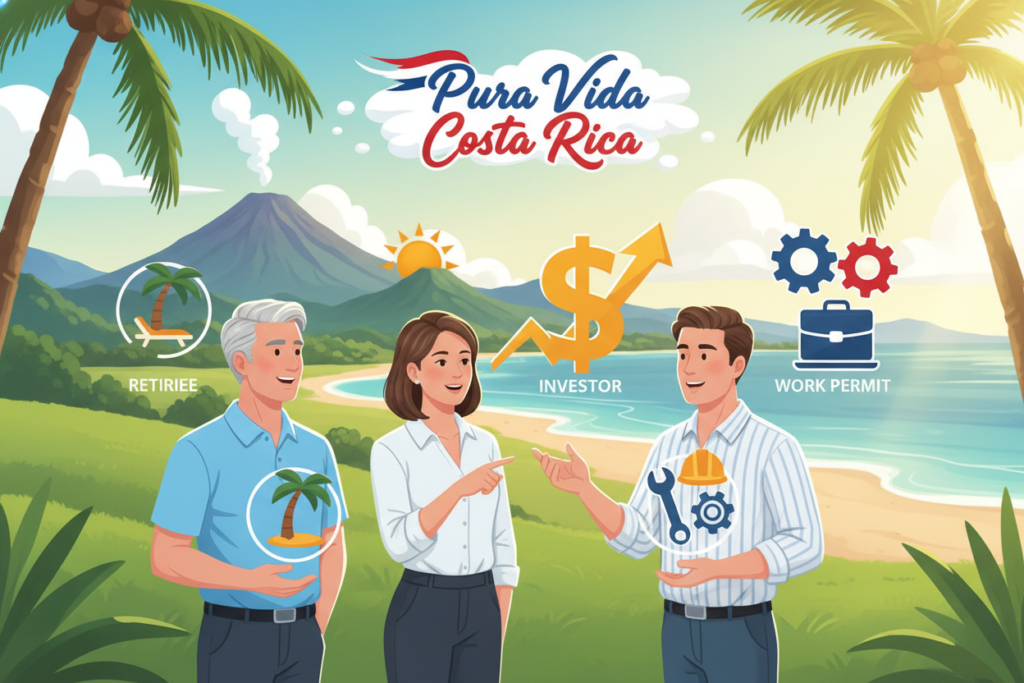
Determining your eligibility for legal status in Costa Rica starts with understanding the official residency categories. Each pathway has strict financial requirements. Choosing the correct one is the first critical step toward your residency card.
Pensionado (Pensionado) – US$1,000+/month Pension Requirements
The Pensionado category is designed for retirees. You must provide proof of a guaranteed lifetime pension of at least $1,000 per month. For married couples, a recent, authenticated marriage certificate is also required.
Rentista (Rentista) and Investor (Inversionista) Thresholds
The Rentista category requires proof of $2,500 in monthly income for two years. This suits those with stable investment returns or annuities.
The Inversionista category demands a minimum $150,000 investment. A crucial rule: the property must be in your personal name, not a corporation’s. We also briefly note the Vinculo category for spouses of citizens.
Remember, the popular Digital Nomad status is not a residency category. It does not lead to permanent status or citizenship. For remote workers, the Rentista option is the closest true residency path.
Preparing Your Documents Before Arrival
Your journey to obtaining a residency card truly begins with meticulous document preparation in your home country. A complete, properly authenticated file is the single best way to avoid extended delays.
Required Documents, Apostilles, and Translations
Universal requirements include your birth certificate and a criminal background check. These must bear an apostille and an official Spanish translation. Any discrepancy in your full legal name or your parents’ names can cause significant setbacks.
For U.S. applicants, this means state certification followed by an apostille. Canadian applicants face a more complex chain involving Global Affairs and consular stamps. Your FBI or RCMP report also needs this full treatment.
Category-specific proof—like pension letters or bank statements—requires the same rigorous authentication. If applying with a spouse, your marriage certificate must follow the same path. Ensure any typed information is on standard letter-sized paper.
We recommend obtaining multiple certified copies. Finally, always verify the latest specifications with immigration authorities at migracion.go.cr before you begin. This proactive step saves precious time.
Step-by-Step Guidance to Applying for Residency in Costa Rica
Receiving the Resolution from DGME marks a pivotal transition from waiting to active preparation. This official document is your proof of approval. It triggers the final steps to obtain your physical residency card.
Detailed Checklist and Timelines
Upon approval, you must pay three government fees at the Banco de Costa Rica (BCR). The receipts must show your full name exactly as on your passport. You also need proof of CAJA enrollment.
Check your status in the Validacion de Derechos system. It should read “CUMPLE CON LOS REQUISITOS”. This confirms you meet the requirements.
Your appointment checklist includes your passport, the Resolution, BCR receipts, and CAJA proof. Bring photocopies of your original category documents with DGME stamps. You must also present a signed informed consent form (CONSTANCIA DE CONSENTIMIENTO INFORMADO DIMEX).
Mistakes to Avoid During the Application Process
Name discrepancies between your passport and other papers cause major delays. Arriving late for your scheduled time will result in being turned away. Also, only specific BCR branches or post offices handle these services.
Plan renewals 90 days before your card’s expiry date. If you delay more than three months past expiration, a lawyer’s affidavit is required. Letting your status lapse over one year forces you to restart the criminal background check process.
Always verify the latest steps at the official migracion.go.cr website. This ensures you have current information.
Navigating the Appointment Process with BCR & Correos de Costa Rica
Once your residency is approved, securing the plastic card requires navigating a specific booking system. You have two primary options for this mandatory in-person visit.
Booking an Appointment and Required Payments
For Banco de Costa Rica (BCR) branches, call 800-BCRCITA or use their online booking portal. You will need your full name, email address, and residency card number. Appointments are typically set 1-2 weeks in advance.
The post office system, Correos de Costa Rica, uses its own website for scheduling. Many applicants find staff at these locations more accommodating, especially in smaller towns.
A special benefit exists for those aged 65 and older. They can visit the main DGME offices in San José on specific days without an appointment. This often results in receiving the card the same day.
At your scheduled time, officials will verify your documents, take your photo, and capture your fingerprint. You will make the required government payment at this time.
Afterward, you receive a Comprobante de Solicitud as proof of application. A digital version of your card is often emailed to you. The physical card is then sent to your chosen post office branch for pickup.
While the official card delivery timeline is 22 business days, actual waits vary. Plan for 2-4 weeks, though delays of 2-3 months can occur. Keep your application voucher as proof during the wait.
Optimizing Your Costa Rica DIMEX Processing Time
While government processing times are largely fixed, your own preparation can dramatically influence how smoothly your application moves through the system. We focus on the factors within your control to help avoid preventable delays.
Tips to Streamline Your Application
A “clean and green” file with consistent personal history receives less scrutiny. Begin gathering apostilled documents and professional translations before you arrive.
For renewals, initiate the process three months before your card expires. Applicants aged 65+ can visit offices in San José for same-day plastic card issuance, bypassing the post office wait.
Always verify your CAJA enrollment status in the online system before any appointment. Ensure all required payments are current to prevent last-minute issues.
Book your appointment at available branches as soon as slots open. Have every document organized and ready. A complete file is the best way to secure your residency card efficiently. For detailed guidance on maintaining your status, learn about the renewal process.
Starting from Home: Get Your Documents Ready & Verify Requirements
The foundation of a smooth residency application is laid long before you set foot in the country. We cannot stress this enough. Your most important work happens in your home nation.
Plan for a 2 to 4-month timeline to gather, authenticate, and translate every required paper. Rushing this phase is the primary cause of extended delays and rejections.
Using migracion.go.cr for Updated Guidelines
Always begin by visiting the official immigration website, migracion.go.cr. Requirements and forms can change. Verifying the current specifications before you spend money on apostilles prevents costly mistakes.
Create a complete checklist for your specific residency category from this source. For U.S. applicants, apostilles come from the Secretary of State. The process for Canadians involves more steps with Global Affairs Canada and consular stamps.
Professional translations must be done by authorized translators. We recommend obtaining multiple certified copies of key documents like birth certificates. This safeguards against loss during the long application process.
Final Insights on Your Costa Rica DIMEX Journey
Securing your residency status is a significant milestone that unlocks long-term opportunities. Success hinges on meticulous preparation from your home country, ensuring consistent personal details across all documents.
While the current wait period is substantial, the plastic card grants legal status, access to national healthcare, and resident benefits. It also forms the foundation for future permanent status or citizenship after several years.
Remember to verify all current requirements at the official immigration website. Individual situations vary, and professional guidance can be invaluable for navigating this complex system.
For personalized support with your application or document preparation, contact us. Reach out via WhatsApp at +506 8706 3888 or email info@crie.cr.
With proper preparation and realistic expectations, the journey toward establishing your life in this beautiful country is well worth the effort.
FAQ
What exactly is the DIMEX card, and how is it different from a cédula?
The DIMEX is your official foreign resident identification card, issued after your residency application is approved. It functions like a national ID for legal matters, banking, and signing contracts. A cédula is for Costa Rican citizens. Think of your DIMEX as your proof of legal status and primary ID while living here.
How long does it typically take to get the plastic card after my residency is approved?
After approval, you’ll get a paper permit first. The physical plastic card currently takes about three to six months to be produced and mailed. This timeline can fluctuate based on government system updates and appointment availability at the post office for enrollment.
What are the most common reasons for delays in the application process?
Delays often stem from incomplete documentation—missing apostilles, translations, or proof of income. Not paying the correct fees to the bank (BCR) and Caja on time, or errors on the application form can also set you back. Using the official immigration website for the latest checklist is crucial to avoid these pitfalls.
Can I renew my DIMEX card before it expires?
Yes, and we strongly recommend you do. The renewal process can be initiated several months before the expiration date on your current card. Starting early helps avoid a lapse in your legal status, as processing renewals also takes time and requires a new appointment.
What’s the first step I should take from my home country to speed things up?
Begin by gathering and authenticating your core documents—birth certificate, marriage certificate if applicable, and proof of pension or income. These need to be apostilled and officially translated into Spanish. Having these ready before you arrive or start the application shaves months off your total processing time.
Is an in-person appointment always required to get the card?
For the initial biometric enrollment and photo capture to produce your card, yes, an in-person appointment at a designated post office branch is mandatory. For renewals, the process may vary, but an appointment is typically still required to update your information and photo.
Article by Glenn Tellier (Founder of CRIE and Grupo Gap)
Don't wait, contact us right now!
Call or WhatsApp Costa Rica +506 8373 2085 or +506 8706 3888
Call USA/Canada +1 305-906-6784