

Navigating the final steps to secure your legal status can be puzzling. A key requirement, often misunderstood, is the Guarantee Deposit (Depósito de Garantía).
This is a government-mandated security, not an application fee. It acts as a repatriation guarantee, ensuring funds are available if needed. The good news is this sum is fully refundable under specific conditions.
The amount isn’t a flat rate. It’s set by the immigration authority—the Dirección General de Migración y Extranjería (DGME). Your nationality determines the final figure based on official tables.
Understanding this procedure is vital for your financial planning. It helps you budget accurately and prevents unexpected hurdles during the approval phase.
We aim to demystify this process. Our role is to provide clear, step-by-step guidance on who pays, when, and how to ensure everything is handled correctly for a future return.
This guide covers permanent residency categories like Pensionado, Rentista, and Investor (Inversionista). Note that Digital Nomad status operates under different rules.
We’ll walk you through eligibility, document preparation, timelines, and common pitfalls. Our focus is on honest, practical advice grounded in official DGME requirements.
Understanding Costa Rica Residency Categories (Pensionado, Rentista, Investor/Inversionista)
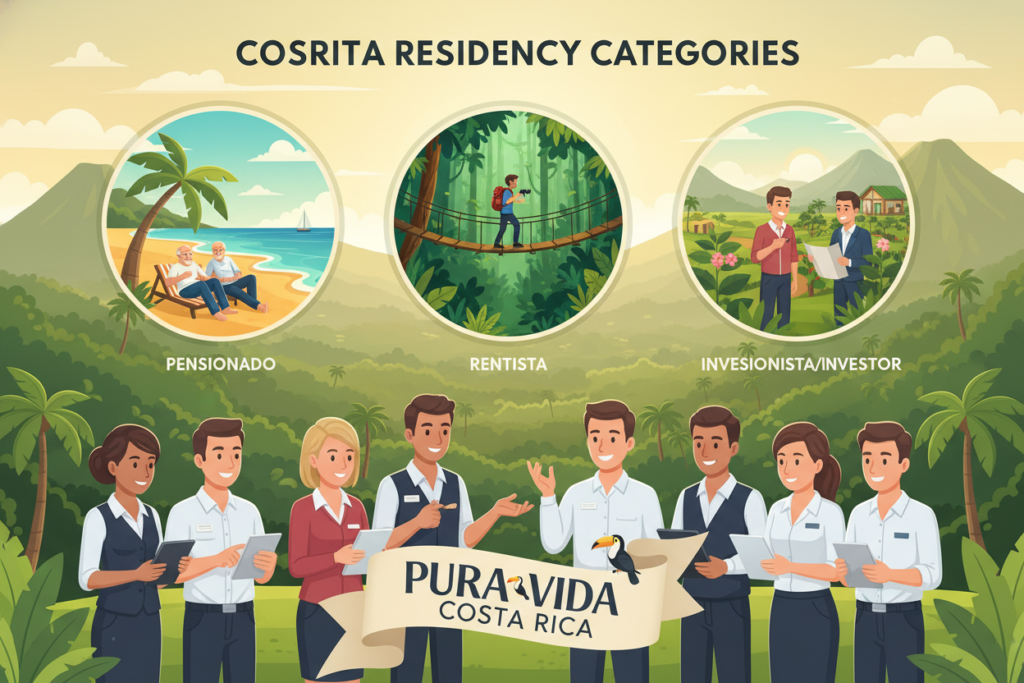
We break down the three main temporary residency categories that form the foundation for most applicants. These formal pathways—Pensionado, Rentista, and Inversionista—are the ones that trigger the Guarantee Deposit requirement discussed in this guide.
Eligibility Criteria and Financial Thresholds
The Pensionado category is for retirees with a guaranteed pension of at least US$1,000 per month. The Rentista option requires proof of stable income of US$2,500 monthly for two years.
For the Investor (Inversionista) route, a minimum investment of US$150,000 is needed. This asset must be held in your personal name, not through a corporation.
These are temporary residency permits, granted initially for two years and renewable. They can lead to permanent residency status after the required time.
Why Digital Nomad Does Not Qualify for Residency
It’s crucial to understand that the Digital Nomad visa is an “estancia,” or temporary stay. It does not count toward residency timelines or citizenship eligibility.
For those seeking a true pathway, the Rentista category is often the closest fit if you can demonstrate the required stable monthly income.
Who Qualifies for Costa Rica Residency
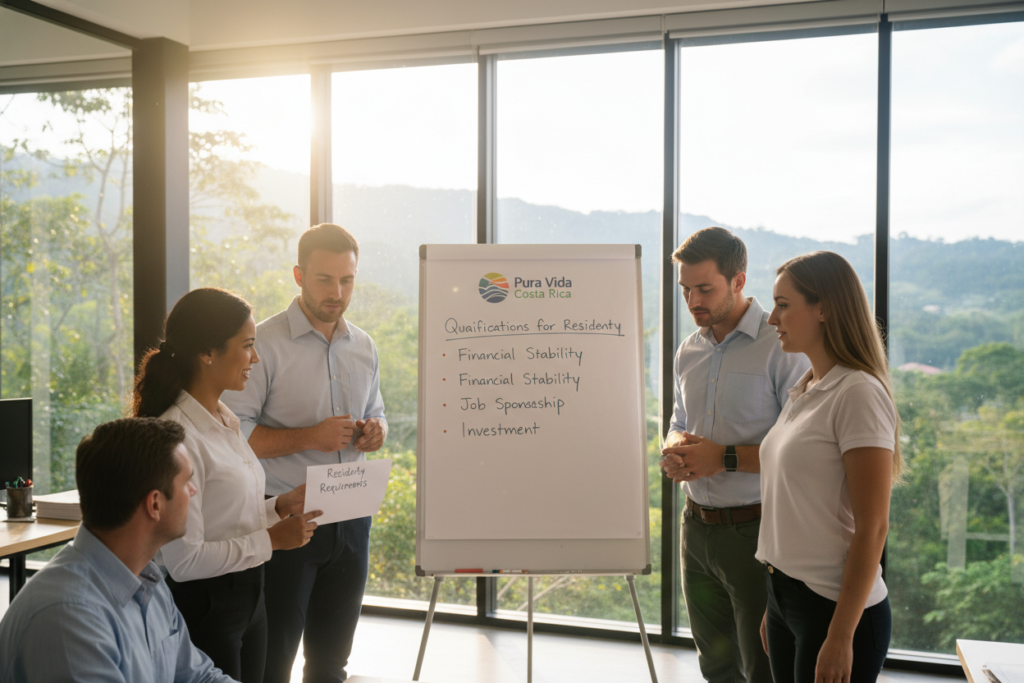
The gateway to obtaining legal status is defined by specific financial and personal criteria. We’ll clarify the exact thresholds and paperwork needed for each pathway.
Specific Income and Investment Requirements
Foreign nationals must fit into one of three main categories. The Pensionado route requires a guaranteed monthly pension of at least USD $1,000.
The Rentista category demands proof of stable income. Applicants need to show USD $2,500 per month for a minimum of two years.
For the Investor option, a minimum investment of USD $150,000 is mandatory. This asset must be held in your personal name.
Documentation Needed for Each Category
All residency applications share a core set of documents. You will need a completed form, passport photos, and certified passport copies.
An apostilled birth certificate and a valid police record are also required. Include an apostilled marriage certificate if applicable.
Every foreign document must be apostilled and officially translated into Spanish. Starting this preparation early avoids major delays.
Family members can be included with proper documentation. Meeting these requirements is your first step before the Guarantee Deposit phase.
Gathering Essential Documents Before Arrival
The foundation of a smooth residency journey is laid long before you set foot in the country. We see too many applicants rush this vital phase. Successful submissions begin with meticulous preparation at home.
Apostilles, Legalizations, and Official Translations
All foreign documents must be authenticated. For most, this means obtaining an apostille. This international certification validates public documents for use in Hague Convention countries.
Key papers needing this stamp include your birth certificate and marriage certificate. Your police record also requires an apostille and must be issued within six months of your application submission.
Important exceptions exist. Nations like Canada and China are not party to the Apostille Convention. They require different legalization through their own government channels.
Even apostilled documents must be officially translated into Spanish. This must be done by a certified translator within the country. Plan for this step and its associated cost.
We strongly advise verifying the current checklist at the official government website, migracion.go.cr. Requirements can change. Starting this entire process 2-3 months before your move builds a crucial buffer.
Confirming your specific document list with a professional guide prevents a common, costly error. You avoid authenticating the wrong papers or missing a critical certification.
Step-by-Step Guidance for the Residency Application Process
A clear roadmap transforms the complex residency application process into manageable steps. We outline the key stages to set realistic expectations and prevent common delays.
Pre-Submission: Preparing Your Paperwork at Home
This initial stage is critical. Gather all required documents in your home country. This includes obtaining apostilles, arranging certified translations, and verifying financial proof.
Confirm your complete checklist with a professional guide before traveling. Proper preparation here minimizes risks during the official filing.
Submission and Beyond: From Filing to Approval
You can submit your complete application package to the Dirección General de Migración y Extranjería (DGME). Filing is possible in person at their offices or through a consulate abroad.
The review period by the immigration authority typically takes 6 to 12 months. During this time, you may enter and exit freely as a tourist.
Upon approval, you’ll receive a resolution outlining next steps. These include the Guarantee Deposit and residency renewal requirements for the future. The final stage involves DIMEX card issuance and CCSS registration.
Costa Rica Immigration Deposit Refund Process
One post-approval requirement stands out for its financial significance and refundable nature. This is the Guarantee Deposit, or Depósito de Garantía.
Understanding the Guarantee Deposit
This sum acts as a repatriation guarantee for the government. It provides funds to cover return travel costs if ever required.
The exact amount is not a flat fee. It varies by your nationality according to official tables set by the DGME.
Your approval resolution will specify your personal figure. The security deposit is paid after you receive this official approval notice.
The total is set in US dollars or the local colón equivalent. Confirm the current exchange rate when instructed to pay.
Receipt Requirements and Timely Payments
Your payment receipt is a critical document. It must show your full legal name exactly as it appears in your passport.
Abbreviations or nicknames will cause problems. Mismatched details are a top cause for processing delays and may require a new payment.
This security is generally refundable. You can request it back when you formally end your residency in Costa Rica.
It is also returned if you obtain citizenship through naturalization. Timely and correct payment with a proper receipt is essential for a smooth process.
Managing Government Fees and Compliance
We categorize the required government expenses into four distinct phases to simplify your planning. These costs are not a single payment.
Official fees apply at the filing, approval, DIMEX card issuance, and ongoing compliance stages. Understanding this schedule prevents budget surprises.
Filing-Stage Payments and Required Receipt Details
The initial filing phase includes specific government fees. These costs vary based on your residency category.
You should always confirm the exact amounts when ready to submit. The official website provides the latest fee schedules.
Every payment receipt is a critical document. It must display your full legal name exactly as shown in your passport.
Abbreviations or nicknames will cause processing delays. The payment reference code must also be correct for each specific fee.
We always confirm which payments are due for your case before you proceed. This prevents the common error of paying the wrong fee at the wrong time.
Keep the original receipts and clear digital copies. Lost documentation can create significant complications later in the process.
Remember, all government fees are subject to change. Verifying current amounts is an essential final step.
Avoiding Common Mistakes in Your Application
Attention to detail in financial transactions can make or break your application timeline. Many delays are self-inflicted and entirely avoidable with proper guidance.
Payment Errors and Receipt Mismatches
The most frequent issue we see is payment receipts with names that don’t match passport details. Abbreviations or nicknames trigger rejections, forcing a re-payment of the fee.
Another common error is using the wrong payment reference code. Even the correct amount paid to the right account can be invalidated by an incorrect reference.
Paying government costs too early is a pitfall. Some applicants pay before receiving official instructions, only to find the payment isn’t valid for the required stage.
Losing original receipts or submitting blurry copies causes unnecessary holdups. Always keep physical originals safe and maintain high-quality digital backups.
Many assume the Guarantee Deposit is a standard amount. It actually varies by nationality—confirm your specific figure from official tables to budget accurately.
Renewing your resident ID card late incurs monthly penalties. These add up quickly and are avoidable with timely action.
Confusing residency categories leads to wrong fee payments. Paying Pensionado fees for a Rentista case, for example, creates rework and delays.
We help prevent these mistakes by confirming your exact fee checklist and reviewing receipt formatting before submission. Realistic expectations and meticulous attention to detail are your best defenses.
The Timeline: From Application to Residency Approval
A realistic grasp of the timeline is crucial for planning your transition and avoiding frustration. The process unfolds across several distinct stages, each with its own duration.
Key Milestones in the Process
The average processing time from submission to official approval is 6 to 12 months. This can vary significantly based on your case details and current volumes.
Key stages include pre-submission document preparation, filing, the review period, and receiving your approval resolution. Post-approval compliance steps follow this.
Your initial legal status is granted as a two-year permit. You must renew this before it expires and visit the country at least once per year to maintain valid status.
After maintaining this status continuously for about seven years, you become eligible to apply for permanent residency. This removes the annual presence requirement.
You may also apply for citizenship after this qualifying period. While your application is under review, you can travel in and out freely as a tourist.
Remember, final steps like DIMEX card issuance add more time. Budget an additional 1-3 months after approval before you hold your physical resident ID.
Preparing Your Financial Proof and Supporting Documentation
Your financial documentation forms the bedrock of a successful residency application. Proper preparation here prevents the most common delays. We guide you through the exact evidence required for each pathway.
Bank Statements, Certified Financial Records, and More
Requirements vary significantly by category. Each has its own threshold and verification process.
For the Pensionado route, you need official proof of a guaranteed monthly pension. This must be a formal letter from your provider, not just bank deposit records.
The Rentista category requires proof of stable income. A bank letter from your home country is ideal. If banks don’t issue such letters, a Certified Public Accountant can certify your income using tax returns or business records.
Investor applicants must show proof of their minimum investment. This is typically a property title or business documentation in your personal name.
All documents must be recent, properly certified, and translated into Spanish. Income sourced locally requires verification from a bank within the National Banking System.
The Dirección General de Migración y Extranjería (DGME) may request additional proof during review. Starting this preparation from home ensures full compliance and smooth processing for your status issuance.
Final Steps and Wrapping Up Your Residency Journey
Completing your journey to legal resident status involves a few critical final actions. After approval, you must pay your specific guarantee deposit and attend appointments for DIMEX card issuance.
Mandatory Caja enrollment registers you for national healthcare. Monthly payments made here are a key ongoing compliance requirement.
To maintain your status, visit the country annually and keep Caja contributions current. After several years, you may apply for permanent residency.
For personalized guidance, contact us on WhatsApp at +506 8706 3888 or email info@crie.cr. Always verify current rules at the official authority website, migracion.go.cr.
FAQ
What is the immigration security deposit, and when do I pay it?
The security deposit is a guarantee payment required by the Dirección General de Migración y Extranjería. You pay this amount, typically 0 USD or its colón equivalent, at the final stage of your residency application, just before your card is issued. It’s separate from the initial filing fees.
How and when do I get my deposit back?
You can request a refund of your guarantee deposit after maintaining your permanent residency status for a minimum of five years without any legal issues. You must submit a formal petition to the immigration authority with proof of compliance, and the funds are returned to the original payer.
What are the main financial requirements for temporary residency?
Requirements vary by category. For a Pensionado visa, you need a guaranteed lifetime pension of at least
FAQ
What is the immigration security deposit, and when do I pay it?
The security deposit is a guarantee payment required by the Dirección General de Migración y Extranjería. You pay this amount, typically $150 USD or its colón equivalent, at the final stage of your residency application, just before your card is issued. It’s separate from the initial filing fees.
How and when do I get my deposit back?
You can request a refund of your guarantee deposit after maintaining your permanent residency status for a minimum of five years without any legal issues. You must submit a formal petition to the immigration authority with proof of compliance, and the funds are returned to the original payer.
What are the main financial requirements for temporary residency?
Requirements vary by category. For a Pensionado visa, you need a guaranteed lifetime pension of at least $1,000 USD monthly. A Rentista must demonstrate a stable income of $2,500 per month for two years. The Inversionista category requires a minimum investment of $150,000 in property or approved projects.
Why don’t Digital Nomads qualify for this type of residency?
The Digital Nomad program is a separate, non-resident visa with a shorter duration and different rules. It does not lead to permanent status and therefore does not require the security deposit or follow the same long-term financial proof process as traditional residency applications.
What documents do I need to prepare before starting my application?
Essential documents include a passport valid for over two years, a birth certificate, and a police clearance report—all apostilled or legalized and officially translated into Spanish. You’ll also need certified financial proof, like bank statements or pension letters, meeting the specific category thresholds.
What is the most common mistake applicants make with government payments?
A frequent error is not obtaining the correct, itemized receipt from the bank. The payment slip must explicitly state it’s for “Migración” and include your full name and case file number. A generic bank deposit without these details can cause significant delays or rejection.
How long does the entire process take, from filing to approval?
The timeline can vary widely. After submission, you might wait 6 to 12 months for initial review and document requests. Following approval, you’ll complete medical checks and Caja enrollment before the final card issuance. We always advise planning for a process that spans several months to over a year.
Are the government fees the same for all applicants?
No, the required payments differ. Initial filing fees are standard, but costs for medical exams, legal translations, and the caja enrollment vary per person. The final security deposit amount, however, is a fixed sum for all permanent residency applicants at that final stage.
,000 USD monthly. A Rentista must demonstrate a stable income of ,500 per month for two years. The Inversionista category requires a minimum investment of 0,000 in property or approved projects.
Why don’t Digital Nomads qualify for this type of residency?
The Digital Nomad program is a separate, non-resident visa with a shorter duration and different rules. It does not lead to permanent status and therefore does not require the security deposit or follow the same long-term financial proof process as traditional residency applications.
What documents do I need to prepare before starting my application?
Essential documents include a passport valid for over two years, a birth certificate, and a police clearance report—all apostilled or legalized and officially translated into Spanish. You’ll also need certified financial proof, like bank statements or pension letters, meeting the specific category thresholds.
What is the most common mistake applicants make with government payments?
A frequent error is not obtaining the correct, itemized receipt from the bank. The payment slip must explicitly state it’s for “Migración” and include your full name and case file number. A generic bank deposit without these details can cause significant delays or rejection.
How long does the entire process take, from filing to approval?
The timeline can vary widely. After submission, you might wait 6 to 12 months for initial review and document requests. Following approval, you’ll complete medical checks and Caja enrollment before the final card issuance. We always advise planning for a process that spans several months to over a year.
Are the government fees the same for all applicants?
No, the required payments differ. Initial filing fees are standard, but costs for medical exams, legal translations, and the caja enrollment vary per person. The final security deposit amount, however, is a fixed sum for all permanent residency applicants at that final stage.
Article by Glenn Tellier (Founder of CRIE and Grupo Gap)
Don't wait, contact us right now!
Call or WhatsApp Costa Rica +506 8373 2085 or +506 8706 3888
Call USA/Canada +1 305-906-6784