
Over 70,000 U.S. citizens now call this beautiful country home. Costa Rica offers breathtaking beaches, year-round warm weather, and a cost of living often lower than in the United States. Its political stability and modern infrastructure make it a compelling destination.
Understanding the official types-of-residencies-in-costa-rica is the essential first step. Each legal pathway is designed for different financial situations and life circumstances. This knowledge is crucial before any move or investment decision.
We provide transparent guidance on Costa Rica’s residency process—no hype, no promises. Our role is to explain what it actually entails. We’ll cover key categories like Pensionado, Rentista, and Inversionista, plus clarify the Digital Nomad visa.
Successful applications begin at home with proper document preparation, not after arrival. This is a critical reality for expats to grasp. Gathering the correct paperwork from your home country is the foundation of a smooth process.
This guide delivers actionable steps, required documentation, and realistic timelines. We focus on current immigration requirements and common mistakes to avoid. Let’s navigate the path to your residency in Costa Rica together.
Introduction to Costa Rica Residency

For many Americans, the dream of living in Costa Rica begins with understanding the critical distinction between tourist stays and official residency status. Entering as a tourist—for up to 180 days at immigration’s discretion—is not a legal pathway for long-term living.
Legal residency is a formal status granted by the government. It provides the right to remain beyond tourist limits, access public healthcare, and open local bank accounts. This status is the foundation for eventually applying for permanent residence.
Costa Rican immigration law offers several distinct residency pathways. Each category serves specific groups of people, like retirees or investors. Choosing the right option depends on your financial situation and long-term plans.
We focus exclusively on this legal process. Our guidance centers on residency and immigration requirements, not tourism or real estate. This singular focus helps you navigate the bureaucracy with clarity.
The application process is detailed but entirely manageable with proper preparation. Understanding the specific requirements for your chosen visa is the key. In the following sections, we’ll break down each category to help you find your way.
Understanding Key Residency Categories (Pensionado, Rentista, Inversionista, and Digital Nomad)
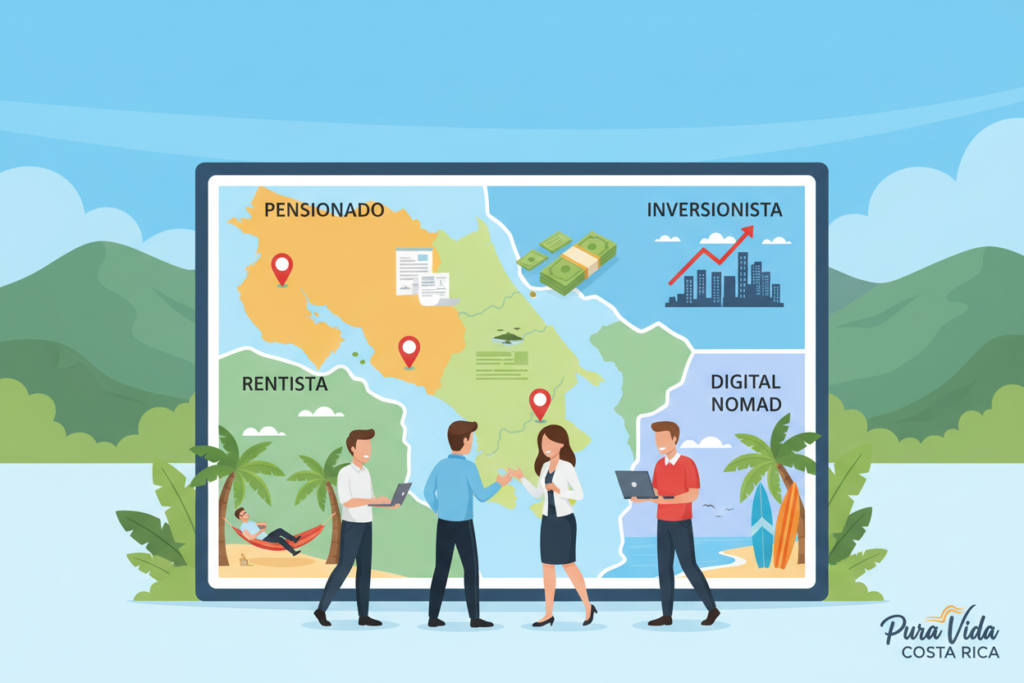
Your financial profile and life goals directly determine which residency option in Costa Rica is right for you. We outline the main legal pathways to help you make an informed choice.
The Pensionado category is for retirees with a guaranteed lifetime pension. It requires proof of at least US$1,000 per month in pension income.
For non-retirees, the Rentista visa offers a pathway. You must demonstrate stable foreign income of US$2,500 monthly for two years.
The Inversionista category is for investors. It mandates a minimum investment of US$150,000 in approved local assets, like real estate or a business.
It’s crucial to understand the Digital Nomad visa is a separate 12-month work permit. It requires US$3,000 monthly income but does not grant residency status. This visa does not count toward permanent residency or citizenship.
Each category has unique paperwork and timelines. Selecting the wrong one creates delays. The following sections detail each pathway’s specific requirements.
types-of-residencies-in-costa-rica Explained
Navigating the path to long-term living in Costa Rica involves understanding its two-tier residency system. Most expats begin with a temporary status, which is the initial step for all legal categories.
Temporary residency must be renewed every two years. You start in your chosen category—like Pensionado or Rentista—and must maintain this status for three consecutive years.
After three years of continuous temporary residency, you become eligible to apply for permanent status. This progression is a core part of the immigration framework.
Permanent residency offers greater stability. It removes the need for frequent income verification and grants unrestricted work rights as an employee.
Citizenship is a separate, longer process. It requires seven years of legal residency—or five if married to a Costa Rican—and involves language and cultural testing.
We emphasize that understanding this timeline helps you plan realistically. Always verify current requirements at the official migracion.go.cr website.
Pensionado Residency: Benefits and Requirements
Designed specifically for retirees, the Pensionado category offers a clear residency option based on lifetime pension income. It is tailored for those with a stable, guaranteed retirement fund.
Eligibility Criteria and Income Thresholds (US$1,000+/month)
Your total pension must meet a minimum of US$1,000 per month. This income must be guaranteed for life, not temporary.
Qualifying sources include U.S. Social Security, government pensions, and military retirement. Private employer plans or union pensions also count. Disability retirement income qualifies if it meets the monthly threshold.
Required Documentation and Process Insights
You need an official pension award letter confirming the lifetime amount. Other core documents are a valid passport, FBI background check, and birth certificate.
All U.S. documents require an apostille and a certified Spanish translation. Property ownership is not a requirement for this visa. If you buy real estate, title it in your personal name.
Once submitted to immigration, the process takes 3-12 months. We cannot guarantee approval speed. Proper document preparation is your best strategy.
Rentista Residency: Income Proof and Application Process
If you’re under retirement age but financially independent, the Rentista visa could be your route to living in Costa Rica. This category is for individuals who can prove stable, guaranteed income from outside the country.
Income Verification and Two-Year Requirements
You must show at least US$2,500 per month for two consecutive years. Alternatively, a one-time deposit of US$60,000 into a local bank account meets the financial requirements.
Acceptable income sources are passive. Think investment dividends, rental property earnings, or trust distributions. Wages from employment do not qualify for this application.
Document Checklist and Tips
Gather two full years of bank statements or investment records. You’ll also need a valid passport, an apostilled FBI background check, and an apostilled birth certificate.
Organize all documents before you leave home. Trying to collect 24 months of financial records from abroad creates major delays. Meeting the income threshold is just one part of the process—complete and properly authenticated paperwork is essential.
Investor Residency: Investment Thresholds and Ownership Rules
Investor residency in Costa Rica is not just about buying property. It’s a formal process with specific financial and legal rules. The Inversionista category is for individuals making a substantial investment in the local economy.
Minimum Investment Requirements (US$150,000)
You must invest a minimum of US$150,000. This threshold is confirmed in Costa Rican immigration law. The capital must be maintained throughout your temporary residency period.
This investment can fund various approved projects. The goal is to benefit the country economically. You must prove the funds have been deployed.
Property Ownership and Eligible Investment Options
If your investment is in real estate, a critical rule applies. The property title must be in your personal name. Holding it in a corporation or trust will disqualify your application.
Eligible options extend beyond property. You can invest in an existing Costa Rican business or start a new one. Funding reforestation, tourism development, or government-approved national interest projects also qualifies.
Any business investment should create jobs for Costa Rican citizens or transfer technology. There is also an annual residency obligation. Inversionista residents must spend at least six months per year in the country.
Required documents include the property deed or business registration. You must also provide proof the investment is in your personal name. A valid passport and apostilled background checks are standard.
Digital Nomad Visa Clarification: What It Is and Isn’t
Many remote workers explore the Digital Nomad visa, but it’s crucial to understand its legal limitations. This is a temporary work authorization, not a formal residency category.
The visa allows you to live in Costa Rica for 12 months, renewable for another 12. You must work remotely for employers or clients outside the country. Individual applicants need stable monthly income of at least US$3,000. Families must prove US$4,000 per month.
Time spent on this visa does not count toward permanent residency or citizenship. This is a critical distinction. For a true residency route, the Rentista option is a closer alternative.
Digital Nomad holders cannot access public healthcare like residents. They must maintain private insurance. If your long-term plan includes staying beyond two years, starting with a proper residency category is the better strategic choice.
Step-by-Step Guide: Who Qualifies for Residency in Costa Rica
Qualifying for residency starts with a honest assessment of your financial and personal circumstances. We provide a clear, sequential guide to navigate the application process successfully.
Eligibility Overview for Each Category
First, identify which residency category fits your profile. The Pensionado option is for retirees with guaranteed lifetime income. The Rentista visa suits those with stable passive earnings. The Inversionista pathway is for investors with significant capital.
Your choice depends on your income sources and long-term goals. Matching your situation to the correct category is the essential first step.
Detailed Application Steps and Timeline
The Costa Rican application process follows six key stages. Begin by gathering all required documents while still in the United States. This includes financial statements, background checks, and birth certificates.
Next, have each document apostilled and translated by an official translator in Costa Rica. Then, submit your complete package to the immigration authority (DGME).
After filing, expect a review period of 3 to 12 months. Timelines vary based on caseload. Once approved, you will receive your DIMEX identification card. We emphasize organizing your paperwork before arrival to avoid delays.
Essential Documents: Apostilles, Translations, and Certification
The backbone of any successful residency application lies in the meticulous preparation of your official documents. Two specific steps—apostille certification and professional translation—are mandatory for U.S. applicants.
Document Apostille Process Explained
An apostille is a special certificate that verifies a document’s authenticity for international use. Costa Rica requires it because both countries are members of the Hague Apostille Convention.
Core documents like your birth certificate, marriage certificate (for a spouse), and FBI background check need this stamp. The process involves submitting certified copies to your state’s Secretary of State office.
Allow 2-4 weeks for processing. Timing is critical—most documents must be reissued within six months of your application submission.
Certified Translation Tips and Best Practices
Once apostilled, every document must be translated into Spanish. This must be done by an official translator authorized in Costa Rica.
Translations completed in the U.S. are not accepted. This step is non-negotiable for a valid application.
Missing or improper authentication is a leading cause of delays. We strongly advise completing this entire paperwork process before you leave home.
Application Timelines: What to Expect and How to Prepare
A realistic view of the application timeline is your best defense against frustration during the waiting period. The complete process, from gathering documents to receiving your DIMEX card, typically spans 6 to 15 months.
Variation depends on application complexity and immigration workload. We break the timeline into clear phases.
Document collection and apostille certification often take 1 to 3 months. After submission, the review process takes 3 to 12 months. Final approval and card issuance add another few weeks.
Once you file, you receive proof your petition is in process. After approval, complete biometric registration and pay final fees. You must also register with the Caja for healthcare.
Your DIMEX card is your official residency ID. Carry it for banking and official interactions. Temporary residency status is valid for two years from issuance.
Renewal is required every two years. After three consecutive years, you can apply for permanent residency. These timelines are estimates—patience and thorough preparation are essential.
Common Pitfalls: Mistakes to Avoid Throughout the Process
We see the same procedural mistakes causing delays and rejections for residency hopefuls time and again. Knowing what to avoid is a powerful way to streamline your journey.
Inadequate Documentation and Overlooked Details
The most common error is submitting incomplete paperwork. Missing a single apostille or using an uncertified translator leads to immediate rejection.
Many expats don’t realize key documents have a shelf life. Apostilled background checks and birth certificates often expire six months after issuance. Submitting expired paperwork invalidates your entire application.
Timing Errors and Overstaying Your Tourist Visa
A critical trap involves your tourist status. Filing a residency application does not extend your legal stay. You must still adhere to the 90 or 180 days granted upon entry.
If your residency process takes longer, you cannot simply remain. Overstaying creates legal complications that can jeopardize your application. The correct way is to exit Costa Rica and re-enter or seek legal counsel to maintain status.
Other oversights include forgetting to register with the Caja healthcare system. Also, you don’t need to own property for most categories. Understanding these pitfalls helps, but every case is unique.
Pre-Arrival Strategies: Organizing Your Paperwork Before Leaving Home
The most strategic move you can make for a smooth residency application begins long before you board a plane. Successful applications are built on thorough preparation completed in your home country. Trying to assemble documents after you arrive creates unnecessary stress and delays.
Why does pre-arrival preparation matter so much? Obtaining apostilles, FBI background checks, and certified documents is exponentially easier from the United States. You have direct access to state and federal services. Attempting this from abroad means relying on mail forwarding or embassy services, which introduces errors.
Start your pre-departure checklist early. Request your FBI background check, as it can take 8-12 weeks. Obtain a certified birth certificate from your state of birth. Secure your marriage certificate if applicable. Also, gather pension letters or financial statements for your chosen visa type.
Next, handle the apostille process. Identify the correct Secretary of State office for each document. Submit requests with fees and allow 3-4 weeks for processing. Remember, all documents must later be translated by an authorized Costa Rican translator.
We recommend allowing 2-3 months for this entire phase. Keep all originals, apostilles, and future translations in one secure folder. This organized approach eliminates the panic of discovering missing paperwork after you’ve already relocated and become residents.
Navigating Legal and Financial Considerations for Residency
Establishing your daily life as a legal resident in Costa Rica involves navigating several key systems beyond the initial application. A local bank account is essential for paying bills and managing finances.
Opening a Costa Rican bank account requires your passport, DIMEX card, and proof of address. The process is more bureaucratic than in the U.S. and can take several weeks.
All residents must enroll in the Caja Costarricense de Seguro Social (CCSS). This public healthcare system requires monthly contributions of 7-11% of your declared income.
Temporary residents are generally prohibited from formal employment with a Costa Rican company. You can own a business or work remotely. Permanent residents gain full work rights.
You can own property with the same rights as citizens. Always verify current rules at migracion.go.cr. We focus solely on guiding you through these residency requirements.
Ready to Start Your Journey? Next Steps to Secure Your Costa Rican Residency
Thousands have successfully obtained residency in Costa Rica by following a structured, document-focused approach. Your path begins with temporary status in your chosen category. After three consecutive years, you can apply for permanent residency for greater stability.
While citizenship is an option later, most Americans maintain permanent residency. The essential first step is securing legal status. This requires matching your finances to the correct visa type and preparing your paperwork.
We suggest you review your income or investment profile now. Begin gathering documents like background checks from home. Always verify current rules at the official immigration website.
We focus solely on residency and immigration guidance. For personalized help, contact us. WhatsApp +506 8706 3888 or email info@crie.cr.
The process demands patience and thorough preparation. With a clear plan and proper guidance, your goal of living in Costa Rica is achievable.
FAQ
What is the main difference between temporary and permanent residency in Costa Rica?
Temporary residency is your initial status, granted for specific categories like Pensionado or Inversionista, and is valid for two years before renewal. Permanent residency is typically applied for after three years of holding temporary status. It offers more stability, with no renewal fees to the immigration authority, though you must maintain your qualifying conditions, like a steady pension.
Can I work in Costa Rica with a Pensionado or Rentista visa?
No, you cannot. Both the Pensionado and Rentista categories are designed for retirees or individuals with stable passive income. They explicitly prohibit you from engaging in salaried work for a Costa Rican employer. If you wish to work locally, you would need to explore a different residency route, such as a work permit sponsored by an employer.
How long does the residency application process typically take?
A> You should plan for a process that takes 6 to 12 months from submitting your complete dossier to receiving your cédula (ID card). Much of this timeline depends on government processing speeds and ensuring your documents—like apostilled birth certificates and income proofs—are flawless from the start. Starting your paperwork before you arrive can shave months off the wait.
Is the Digital Nomad Visa a path to permanent residency?
No, it is not. The Digital Nomad Visa is a separate, renewable one-year permit designed for remote workers. It does not count toward the time required to apply for permanent residency. It’s a fantastic option for a trial run, but if you decide to stay long-term, you’ll need to apply for a standard temporary residency category that fits your situation.
What is the single most common mistake applicants make?
A> Overstaying the 90-day tourist visa while your application is pending is a critical error. You must leave the country—often to a neighboring border—to reset your tourist stamp before it expires, even after you’ve filed your residency paperwork. Failing to do this can result in fines and jeopardize your entire application.
Do I need to open a local bank account for my residency application?
A> For several categories, yes. Rentistas must demonstrate a monthly transfer into a Costa Rican bank account. Pensionados often need to receive their pension income locally. We guide our clients through opening a Costa Rican bank account, which is a required step for proving financial solvency to immigration authorities.
Why are apostilles and certified translations so important?
A> Costa Rican immigration law requires that all foreign-issued documents, from marriage certificates to FBI background checks, be apostilled (an international certification) and translated into Spanish by an official translator in Costa Rica. Submitting documents without these steps is the fastest way to have your application rejected or significantly delayed.
Should I hire a lawyer or a residency service to help?
A> While not legally mandatory, the process is complex, bureaucratic, and conducted entirely in Spanish. Even small errors can set you back months. Professional services, like ours, manage the entire process—from document preparation to government liaison—ensuring it’s done correctly the first time. For most expats, this investment saves significant time, money, and stress.
Article by Glenn Tellier (Founder of CRIE and Grupo Gap)
Don't wait, contact us right now!
Call or WhatsApp Costa Rica +506 8373 2085 or +506 8706 3888
Call USA/Canada +1 305-906-6784