

Many dream of relocating to Costa Rica for its natural beauty and stable democracy. The path to legal residency, however, has a stark reality. A staggering 80% of all applications are rejected, primarily due to simple paperwork errors.
This is where our expertise becomes essential. For over 20 years, CRIE has focused exclusively on Costa Rica residency and immigration. We act as your knowledgeable partner, guiding you from the very first step.
Efficient tracking is more than checking an online status. It’s about building a foundation of meticulously prepared documents from your home country. Every apostille, translation, and financial proof must meet exact legal standards long before you arrive.
We offer candid transparency, not shortcuts or guarantees. The main pathways—Pensionado, Rentista, and Inversionista—have specific financial thresholds you must genuinely meet. Understanding this is the first step to a successful residency process.
Costa Rica’s immigration system is transparent and rule-based. Its complexity, however, rewards those who prepare correctly. Professional guidance simplifies this journey and helps you navigate each requirement.
A successful application typically spans 6 to 14 months and involves multiple review stages. Organized document management from the start is the cornerstone of efficient tracking. Proper preparation truly begins at home.
Understanding Costa Rica Residency: A Step-by-Step Overview
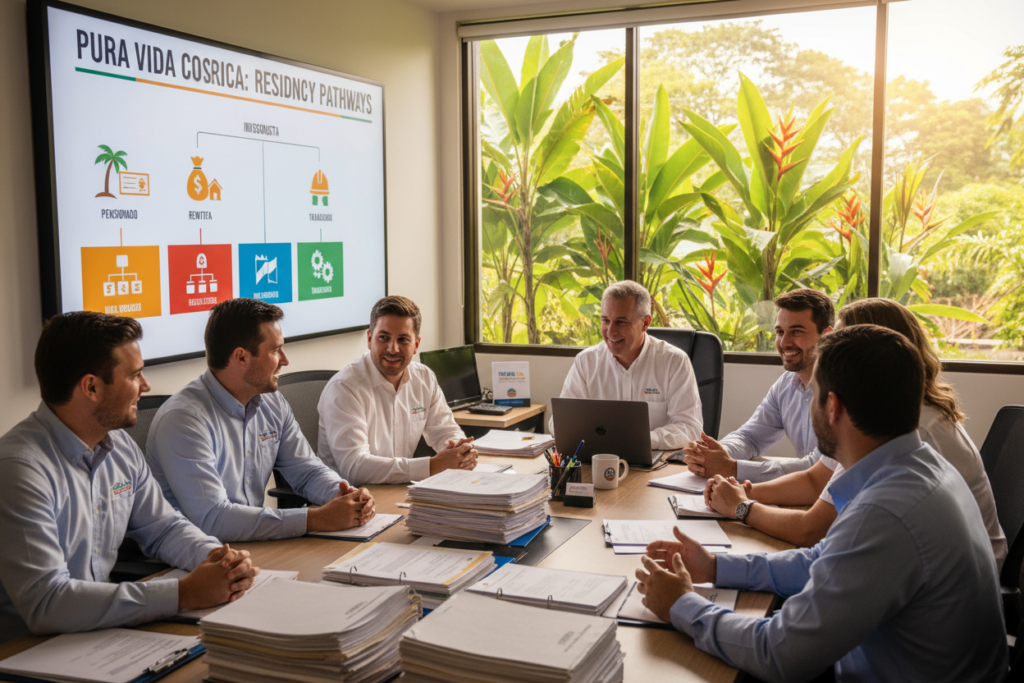
Navigating Costa Rica’s residency options begins with understanding three distinct financial pathways. Choosing the correct category—one that matches your actual finances—is the critical first decision for your application strategy.
Exploring Residency Categories (Pensionado, Rentista, Inversionista)
The Pensionado (Pensionado) category is for retirees. It requires proof of a lifetime pension of at least US$1,000 per month from a recognized institution. This grants renewable two-year temporary residency.
The Rentista (Rentista) pathway has two options. You can prove US$2,500 monthly passive income for two years. Alternatively, deposit US$60,000 in a Costa Rican bank, leaving it untouched during the process.
The Inversionista (Investor) category demands a minimum US$150,000 investment, often in real estate. A key rule: the property must be in your personal name, not a corporation.
The Benefits of Becoming a Costa Rican Resident
Legal residency provides significant advantages. You gain access to the country’s respected public healthcare system, known as Caja. It also opens local banking services and eliminates tourist visa worries.
All three pathways lead toward permanent residency. After maintaining temporary status for three years with annual visits, you can apply for permanent residency. This is a multi-year journey with clear legal rights.
Who Qualifies for Costa Rica Residency (Residencia)
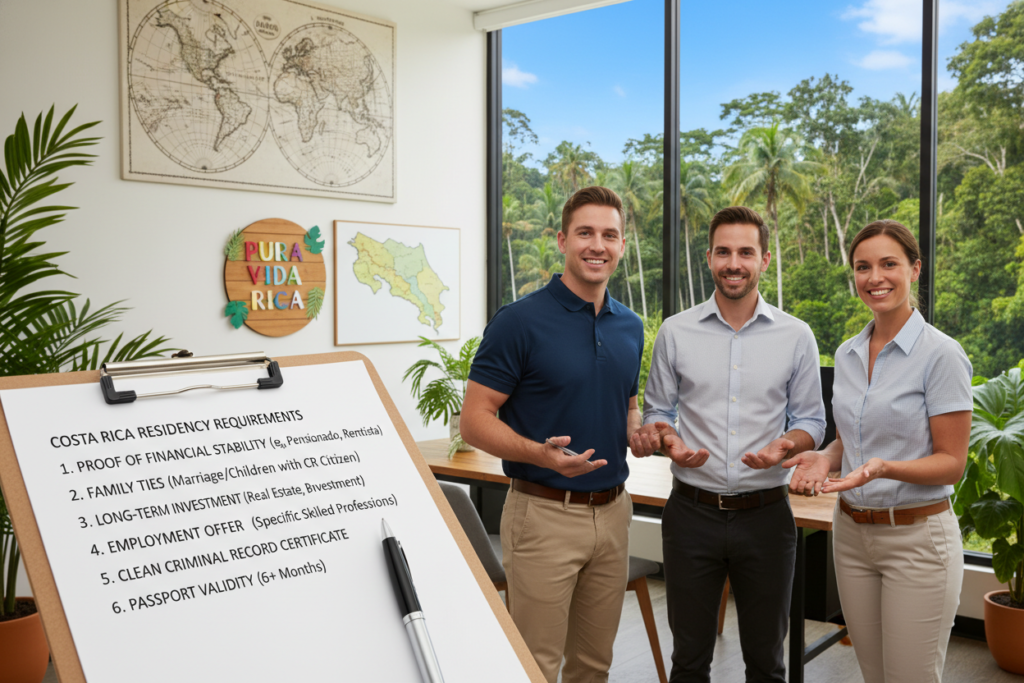
Qualifying for legal residency in Costa Rica is not a matter of preference but of meeting precise, non-negotiable financial criteria. The three main pathways—Pensionado, Rentista, and Inversionista—have fixed thresholds. Applicants must genuinely meet these requirements with verifiable proof.
Eligibility Criteria and Required Financial Thresholds
The Pensionado category requires a guaranteed lifetime pension of at least US$1,000 per month. This income must come from a recognized government or institutional source.
Rentista applicants have two options. They must prove a stable passive monthly income of US$2,500 for two consecutive years. Alternatively, a US$60,000 deposit in a local bank serves as proof of financial stability.
The Inversionista, or Investor, route demands a minimum investment of US$150,000. A critical rule is that real estate purchased for this purpose must be titled in the applicant’s personal name, not a corporate entity.
Special Conditions for Pensionado, Rentista, and Inversionista
A key point of confusion is the Digital Nomad visa. This is a temporary work permit, not a formal residency option. It does not count toward permanent residency or citizenship.
Universal requirements apply to all residency applications. Applicants must provide recent police clearances from every country they’ve lived in as an adult. Those aged 12 and older must submit fingerprints.
Costa Rican immigration authorities verify all financial claims rigorously. Falling short of these thresholds, even slightly, is a common reason for application rejection. There are no shortcuts in this process.
Preparing Your Documents: Apostilles, Translations, and Checklists
A common misconception is that you can gather your residency documents after moving to Costa Rica. In reality, this critical phase must be completed in your home country. Meticulous preparation here prevents major delays later.
Essential Documents to Gather Before Arrival
Every application requires a core set of papers. This includes apostilled birth certificates for all family members. You also need police clearances from your home country and any nation where you lived for over two years as an adult.
Financial proof is category-specific. Pensionado applicants need pension verification letters. Rentista applicants require bank statements. Inversionista applicants must show property titles. All financial documents must be current, typically issued within the last six months.
Tips for Obtaining Apostilles and Certified Translations
The apostille is an international authentication. You get it from the proper authority in your document’s country of origin, like a U.S. Secretary of State. Each apostille costs between $15 and $50.
Every apostilled document must then be translated into Spanish. This must be done by a translator approved by Costa Rica’s Ministry of Foreign Affairs. They apply an official seal. Translations typically cost $20 to $40 per page.
Timing is crucial. For U.S. applicants, FBI background checks alone can take 8-12 weeks. The entire document gathering, apostilling, and translation process often requires 3-4 months of planning before submission.
We recommend a strict organizational system. Keep the original, apostilled version, and official translation for each document together. This prevents oversights that cause rejections. For comprehensive support, explore our document preparation services to ensure your paperwork meets all legal standards.
Timelines and Document Submission: Navigating the Process
Government processing times are a standard part of the residency application process, not a reflection of your file’s quality. The complete journey, from gathering documents at home to final approval, typically spans 9 to 18 months.
Understanding Processing Durations and Timelines
Once submitted, official processing by the Dirección General de Migración y Extranjería takes 6 to 14 months. Applications are reviewed in strict submission order by officials.
A major cause of delays is submitting expired documents. Papers like police clearances older than six months will be rejected. This forces you to start over, adding months to your timeline.
Key Steps for a Smooth Submission Process
The submission process has clear steps. First, organize all apostilled and translated documents. Next, pay the required government fees: $250 for filing, $100 for temporary residency approval, and $200 for permanent residency.
Officials may request clarifications during their review. Responding promptly keeps your application moving forward. No legitimate service can guarantee faster processing.
Patience and meticulous organization are your greatest assets. Setting reminders for key dates helps manage this multi-stage process effectively.
Mistakes to Avoid During Your Application Journey
Simple paperwork errors are the primary reason most residency applications fail in Costa Rica. The sobering 80% rejection rate largely stems from preventable oversights, not a lack of qualification.
Common Paperwork Errors and Pitfalls
Submitting expired police clearances is a top error. Documents must be issued within six months of filing. Using non-approved translators also causes rejections.
Financial proof must meet exact thresholds. Rentista applicants need clear proof of $2,500 monthly income. Inversionista property must be in a personal name, not a corporation.
Name inconsistencies across passports and birth certificates create red flags. Missing signatures or incomplete document sets are other common pitfalls.
Strategies to Prevent Application Delays
Create a pre-submission checklist. Verify every document is current and apostilled. Use only translators approved by Costa Rica’s Ministry of Foreign Affairs.
Double-check name consistency across all papers. Ensure financial records clearly show the required income or investment. Confirm property is titled personally for Inversionista applicants.
These steps help avoid costly delays. A final meticulous review of your complete packet is the best defense against rejection.
Efficient Application Tracking for Costa Rica Immigration with CRIE: Monitoring Your Application Status
Efficient tracking transforms the waiting period from passive uncertainty into informed management. Once your documents are submitted, the official online portal becomes your primary tool for visibility.
Using Online Tools to Check Your Status
Visit migracion.go.cr to check your residency application status. You need your passport number and submission receipt. The system is user-friendly but operates only in Spanish.
We help interpret these updates accurately. Regular monitoring ensures you spot any requests quickly.
Interpreting Status Updates from Migracion.go.cr
“SOLICITUD RECIBIDA” confirms your application is logged. “PREVIO” flags missing documents needing immediate action.
“RESOLUCION FIRMAS” means your file is finalizing. Expect a resolution within 15 working days.
Checking weekly prevents delays. Upon approval, you receive your DIMEX resident card. This grants full legal residency status in Costa Rica.
Proactive tracking through this online system is key to a smooth immigration process.
Step-by-Step Guidance for Digital Preparation: Start from Home
The most decisive phase of your Costa Rica residency journey happens long before you set foot in the country. Comprehensive document preparation must be completed in your home country. This is where you have access to issuing authorities and can correct errors without the complications of international mail.
Organizing Your Documents Before Departure
Begin by creating a category-specific checklist. Pensionado applicants need pension verification letters. Rentista applicants require bank statements proving passive income.
Inversionista applicants must gather property titles. Establish a systematic filing system both physical and digital. Create labeled folders for originals, apostilles, and certified translations.
Simultaneously, scan every document for secure cloud backup. This organization prevents costly oversights.
Ensuring Documents Meet All Legal Requirements
The verification phase is critical. Confirm each document’s issue date is within six months of submission. Verify apostilles are from the correct authority, like a U.S. Secretary of State.
Ensure translations are by Ministry-approved professionals. Financial documents must clearly show the required income or investment thresholds.
Cross-reference names and dates across all papers for perfect consistency. This meticulous organization separates successful applications from the 80% that fail.
Allocate 3-4 months for this preparation, accounting for processes like FBI checks. Proper preparation from home is the foundation of success.
Understanding Financial Thresholds and Residency Categories
Meeting the financial criteria for Costa Rican residency is about more than just numbers. It’s about proving sustainable economic stability. Officials verify all claims rigorously to ensure applicants can support themselves.
Pensionado: Minimum US$1,000+/month Pension Requirement
The Pensionado category requires a lifetime pension of at least $1,000 monthly. Qualifying sources include Social Security, government pensions, or established private funds. This income must be guaranteed and permanent.
Rentista and Inversionista: Income and Investment Criteria
Rentista applicants have two paths. They can prove a passive monthly income of $2,500 for 24 consecutive months. Alternatively, a $60,000 deposit in a Costa Rican bank must remain untouched during the application.
The Inversionista route demands a minimum investment of $150,000, typically in real estate. A critical rule is that the property must be titled in your personal name, not a corporation. Foreigners have the same ownership rights as citizens.
Beyond the purchase price, expect transaction costs of 3-4%. Annual property taxes are a low 0.25% of the registered value. Always verify clear title through the National Registry.
These thresholds exist for a reason. Attempts to artificially meet them are detectable. For a clear overview of initial steps, review the Costa Rica visa process for US. Genuine, well-documented financial proof is non-negotiable.
Navigating Costa Rica’s Immigration System and Legal Framework
Costa Rica’s immigration system is a direct reflection of the country’s long-standing commitment to peace and social stability. Since abolishing its army in 1948, the nation has redirected resources into education and healthcare, fostering a stable democracy. This foundation supports a clear, rule-based legal framework for immigration.
The Dirección General de Migración y Extranjería (DGME) is the sole authority managing all residency applications. This centralized system operates entirely in Spanish and follows specific procedural rules with limited flexibility for errors.
Key Regulations and Required Compliance Steps
Understanding how the system works is crucial. Requirements evolve, so always verify current rules at migracion.go.cr. For example, proof of health insurance is now mandatory for all applicants.
Compliance is an ongoing process. Temporary residency permits are valid for two years and must be renewed. You must visit Costa Rica at least once annually to maintain your status.
The pathway to permanent residency opens after three consecutive years of maintaining temporary status. If an application faces rejection, formal appeals exist but add significant time. We emphasize getting it right the first time through meticulous preparation.
Your Roadmap to Success in Costa Rica Immigration
Turning the dream of Costa Rican residency into reality requires a clear roadmap. This starts with an honest financial assessment and document collection in your home country.
Begin preparation 3-4 months before submission. Choose the residency category that matches your genuine finances. Ensure every document is current, properly apostilled, and translated by approved professionals.
After submission, monitor your application status regularly. Maintain compliance with annual visits. This systematic approach leads toward permanent residency.
With diligent preparation, achieving legal status is a realistic goal. It opens doors to the country’s renowned healthcare and high quality of life.
We provide the professional guidance and systematic support needed for a successful application. Contact us via WhatsApp at +506 8706 3888, email info@crie.cr, or visit our website to begin your confident journey.
FAQ
What are the main residency categories for moving to Costa Rica?
The primary paths for foreign applicants are Pensionado, Rentista, and Inversionista. The Pensionado category is for retirees with a guaranteed lifetime pension. Rentista is for those with stable, verifiable income. The Inversionista option requires a significant financial investment in the country, such as in real estate or a business.
How much monthly income do I need for the Pensionado residency?
To qualify for Pensionado residency, you must prove a minimum lifetime pension of at least US
FAQ
What are the main residency categories for moving to Costa Rica?
The primary paths for foreign applicants are Pensionado, Rentista, and Inversionista. The Pensionado category is for retirees with a guaranteed lifetime pension. Rentista is for those with stable, verifiable income. The Inversionista option requires a significant financial investment in the country, such as in real estate or a business.
How much monthly income do I need for the Pensionado residency?
To qualify for Pensionado residency, you must prove a minimum lifetime pension of at least US$1,000 per month. This income must be guaranteed and permanent. We help ensure your proof of pension meets the strict legal requirements set by Costa Rican immigration authorities.
What is the most common mistake that delays a residency application?
The most frequent error is submitting documents that are not properly apostilled or translated. Every foreign-issued document, like birth certificates or police records, must have an apostille and a certified Spanish translation. Missing this step will cause significant delays in the process.
Can I start my residency application from my home country?
A> Yes, a crucial first step is digital preparation from home. You should begin gathering, apostilling, and translating all required personal documents before you travel. This proactive organization helps prevent delays and ensures you arrive with a complete dossier ready for submission.
How long does the residency application process typically take?
The official processing duration varies, but applicants should generally plan for several months. Government review times can fluctuate. Using proper tracking tools to monitor your file’s status with Migración Costa Rica is essential for managing expectations and staying informed.
What are the financial requirements for the Rentista category?
The Rentista category requires proof of a stable income of at least US$2,500 per month for two years. This is often demonstrated through a bank deposit or a notarized guarantee. We guide clients in providing the correct financial documentation to meet this threshold.
Why is professional guidance recommended for the residency process?
Costa Rica’s immigration system has specific legal and procedural nuances. Professional guidance helps you navigate the regulations, avoid common pitfalls, and ensure every document meets the current requirements. This support significantly increases the chance of a successful and efficient application.
How can I track the status of my application with immigration?
You can monitor your case using the online system on the official Migración Costa Rica website (Migracion.go.cr). We assist our clients in understanding how to use this portal and interpret the different status updates, so you always know where your application stands.
,000 per month. This income must be guaranteed and permanent. We help ensure your proof of pension meets the strict legal requirements set by Costa Rican immigration authorities.
What is the most common mistake that delays a residency application?
The most frequent error is submitting documents that are not properly apostilled or translated. Every foreign-issued document, like birth certificates or police records, must have an apostille and a certified Spanish translation. Missing this step will cause significant delays in the process.
Can I start my residency application from my home country?
A> Yes, a crucial first step is digital preparation from home. You should begin gathering, apostilling, and translating all required personal documents before you travel. This proactive organization helps prevent delays and ensures you arrive with a complete dossier ready for submission.
How long does the residency application process typically take?
The official processing duration varies, but applicants should generally plan for several months. Government review times can fluctuate. Using proper tracking tools to monitor your file’s status with Migración Costa Rica is essential for managing expectations and staying informed.
What are the financial requirements for the Rentista category?
The Rentista category requires proof of a stable income of at least US,500 per month for two years. This is often demonstrated through a bank deposit or a notarized guarantee. We guide clients in providing the correct financial documentation to meet this threshold.
Why is professional guidance recommended for the residency process?
Costa Rica’s immigration system has specific legal and procedural nuances. Professional guidance helps you navigate the regulations, avoid common pitfalls, and ensure every document meets the current requirements. This support significantly increases the chance of a successful and efficient application.
How can I track the status of my application with immigration?
You can monitor your case using the online system on the official Migración Costa Rica website (Migracion.go.cr). We assist our clients in understanding how to use this portal and interpret the different status updates, so you always know where your application stands.
Article by Glenn Tellier (Founder of CRIE and Grupo Gap)
Don't wait, contact us right now!
Call or WhatsApp Costa Rica +506 8373 2085 or +506 8706 3888
Call USA/Canada +1 305-906-6784