

We guide clients through Costa Rica residency and immigration every day. A key part of that journey is establishing your financial foundation here. Your residency status directly unlocks—or limits—your access to local banking services.
Both residents and non-residents can open a bank account in Costa Rica. The paperwork is relatively minimal. However, being a legal resident opens significantly more options with fewer restrictions. For Americans splitting time or moving permanently, a local account lets you pay bills like a local and avoid foreign fees.
This guide walks you through opening a bank account in Costa Rica. We connect the dots between your residency category and your banking privileges. Starting your document preparation from home creates the smoothest path forward. We provide practical steps based on real bank requirements, helping you avoid common delays.
Understanding the Costa Rican Banking Landscape

Costa Rica’s banking system is characterized by a dual structure of government-owned and private institutions. Your residency status is a key factor in determining which type aligns with your needs. We focus on securing your residency, which directly impacts your financial access, but we do not provide banking services or advice.
Public vs. Private Banks
State-owned banks like Banco de Costa Rica (BCR), Banco Nacional, and Banco Popular dominate the landscape. They offer full deposit insurance and have extensive ATM networks, even in remote areas. These banks are often more accessible to non-residents.
Private banks, including BAC Credomatic and Scotiabank, typically provide more personalized service. They often have shorter wait times and more English-speaking staff. However, they usually require proof of legal residency to open an account.
Digital and Traditional Banking Options
Digital banking capabilities vary. Some private institutions lead with advanced online platforms. Traditional public banks offer reliable but sometimes simpler digital services.
Your choice should balance your need for high-tech access with the requirement for widespread physical locations. Understanding these options helps you plan your financial setup in Costa Rica effectively from the start.
Exploring Residency Options for a Smooth Transition
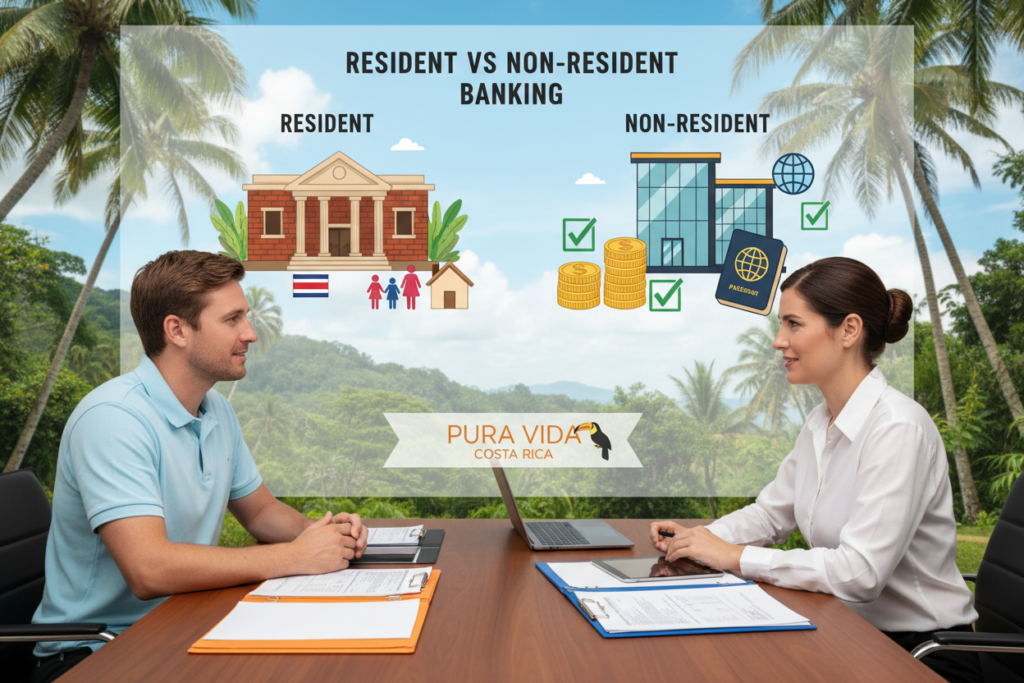
Securing full banking access in Costa Rica is intrinsically tied to achieving legal residency status. Your classification fundamentally determines which services a bank will offer you—and what restrictions will apply.
Resident vs. Non-Resident Considerations
Non-residents can open an account at select banks. However, these accounts come with significant limitations. Monthly deposit caps are common, often set at $1,500 or less.
More critically, non-residents typically cannot access SINPE. This national payment system requires a local ID card, like a cédula or DIMEX.
Legal residents face no such barriers. With proper documentation, you gain unlimited deposits and full digital banking privileges. You can also open investment and business accounts.
It’s crucial to understand that Digital Nomad status is not legal residency. It does not count toward permanent status or citizenship. For extended stays, we recommend exploring actual residency options.
Starting your residency application from home creates the smoothest path. Gathering documents beforehand leads to full banking access within months.
Navigating CRIE: Your Guide to Costa Rica Residency (Residencia)
CRIE specializes in guiding applicants through the precise residency categories established by Costa Rican immigration law. This legal status is your key to full banking access in Costa Rica.
Eligibility and Who Qualifies
Three primary categories serve most foreign applicants. Each has specific financial thresholds you must document and maintain over time.
The Pensionado (Pensionado) category requires proof of a permanent pension of at least US$1,000 per month. This verifiable income unlocks your residency.
The Rentista (Rentista) category demands stable income of US$2,500 monthly for two years. Bank statements provide the necessary proof.
The Inversionista (Investor) category needs a minimum US$150,000 investment in Costa Rican real estate. The property title must be in your personal name.
Starting your documentation from home saves significant time and avoids delays. Gather apostilled certificates before you arrive.
For detailed information, contact us via WhatsApp at +506 8706 3888 or email info@crie.cr. We’ll guide you through the exact bank account requirements.
Preparing Your Documentation Before Arrival
The foundation for a smooth transition to Costa Rican life is laid long before you board the plane. We cannot overstate how much time and frustration proper advance preparation saves. Gathering your paperwork from home is the single most critical step for both residency and banking access.
Required Apostilles and Translations
Every official document from outside the country requires an apostille. This international certification, under the Hague Convention, verifies its legitimacy. You must obtain apostilles in your home nation before departure.
Required papers typically include birth certificates, marriage certificates, and police checks. Financial statements also need this authentication. After apostilling, documents require translation by an official translator in Costa Rica or at a consulate.
For banking purposes, you’ll need proof of income letters in Spanish. Recent bank statements covering three months are standard. A utility bill establishes your address, and your passport must have six months validity.
Banks work with international authorities on anti-money laundering. They require clear proof of where deposits originate. Having these documents ready allows you to open a bank account swiftly after arrival.
If you’re uncertain about specific needs, verify directly at migracion.go.cr. Starting with a complete packet from home streamlines your banking and residency processes in Costa Rica.
Step-by-Step Process for opening-a-bank-account-in-costa-rica
The procedure to establish your financial presence involves a clear, step-by-step approach. Proper preparation is your greatest asset for a smooth experience.
Research which institutions align with your status first. Public banks like Banco de Costa Rica often welcome non-residents with minimal requirements.
Gathering the Essential Documents
Your document packet is the cornerstone of the process. Start with your original passport and several photocopies of the ID page.
You will need a working cellphone number and an email address. If you are a legal resident, your DIMEX card is mandatory.
Prepare proof of income, like a constancia de salario or pension statements. Banks also require three months of statements from your current financial institution.
A utility bill or lease proves your local address. Be ready to explain the source of any funds you plan to deposit.
Making the Initial Deposit and Setup
Plan for a minimum opening deposit. This typically ranges from $25 to $100 USD, though some accounts require more.
Ask specifically for a dual-currency account option. These allow you to hold both colones (CRC) and US dollars in one place.
Some banks also offer euro accounts. This flexibility simplifies managing money from different sources.
Remember, we at CRIE secure your residency status—which unlocks banking access. We do not provide banking services or handle account openings directly.
Scheduling Appointments and Completing KYC Verification
The appointment and verification stage is where preparation meets practice in Costa Rican banking. This final in-person step finalizes your access.
We always recommend scheduling an appointment. It ensures a staff member with the right expertise is ready for you. This is especially key if you need English-language support.
Tips to Ensure a Smooth In-Person Visit
Plan your visit time carefully. Avoid Fridays and month-end paydays. These periods create the longest wait times, even with an appointment.
Confirm your specific branch hours. For instance, many Banco Nacional locations in Guanacaste are open only on weekdays from 8:30 a.m. to 3:45 p.m.
All banks require thorough Know Your Customer (KYC) checks. Be ready to provide detailed information about your income and the source of your funds.
Bring printed copies of every document. Individual bank employees have different preferences. Physical paperwork prevents last-minute delays.
Embrace the local pace. Processes may feel slower, but patience and clear questions will see your new account set up successfully.
Setting Up Your Account: Deposits and Digital Access
Many expatriates overlook a critical step during their first banking appointment: activating digital services on the spot. Your physical card will not be ready for at least a week. This makes configuring online access immediately essential.
Enabling Online Banking and Mobile Transactions
Before leaving the branch, insist your representative sets up your full online banking profile. This includes creating a username, password, and activating a digital cellphone token for two-step security. Do not assume this happens automatically.
Download your bank’s mobile app right there with staff assistance. Test your login credentials to confirm everything works. Institutions like Banco Nacional, Banco de Costa Rica, and Banco Popular have reliable platforms.
BAC Credomatic leads in digital capabilities, allowing independent online setup. If you hold a DIMEX card, ask to enroll in SINPE for instant local transfers.
Remember, using an ATM outside your network incurs fees of 1,500-4,600 CRC. Once you collect your card, test it at a machine immediately to verify your PIN.
Timeline Expectations and Next Steps
The journey to full financial integration in Costa Rica follows two parallel but interconnected timelines. We won’t make promises or guarantees about specific timeframes. Government processing speeds vary based on factors beyond anyone’s control.
Opening a basic bank account here typically takes one to two weeks. This spans from your initial branch visit to receiving an activated debit card. It assumes you brought complete documentation for approval during your first appointment.
Residency approval timelines depend heavily on your preparedness. Applicants with fully apostilled documents often see decisions within 3-6 months. Those gathering paperwork after arrival frequently wait 8-12 months or longer.
Your banking access expands once you receive your DIMEX card. This foreign resident ID typically arrives 2-4 weeks after residency approval. It unlocks full services like SINPE mobile payments.
Plan for multiple in-person visits to your financial institution. You’ll need trips for the initial setup, card collection, and potentially resolving access issues. Verify current estimates at official sources like migracion.go.cr rather than expat forums.
Building buffer time into your plans reduces stress. For major commitments like buying property, ensure your residency and banking setup is finished first. Don’t assume everything will process quickly.
Avoiding Common Pitfalls and Mistakes
The difference between a smooth banking experience and a frustrating one often lies in avoiding a few common errors. We see these issues repeatedly, and they are almost always preventable with proper foresight.
Document Errors and Miscommunications
Arriving without apostilled documents is the most expensive error. It forces you to navigate international authentication from abroad. This can add months and significant cost to your timeline.
Even at the bank, experiences vary. One employee may accept digital files on your phone. Another will insist on printed copies, sending you away. Always bring physical paperwork to every appointment.
Staff knowledge can differ, especially at smaller branches. If your representative seems unsure about foreign accounts, politely ask for a manager. Do not assume all services are offered automatically.
You must ask for specific features. For example, staff may not mention dual-currency options or SINPE mobile payment enrollment. The local service culture expects you to request what you need.
Creating a comprehensive checklist before you travel solves most problems. Verify each document’s apostille and translation status. This simple step prevents the majority of common delays.
Understanding Banking Fees, Exchange Rates, and Service Options
Banking fees and exchange rates form a significant part of managing your finances locally. While we specialize in residency, not banking advice, understanding general cost structures helps you ask better questions.
Comparing Service Charges Across Banks
Most banks do not charge to open an account. They require a minimum deposit instead, typically $25 to $100 USD. State-owned banks often have lower, more transparent fees.
Private institutions may have different fee schedules. Always ask for a complete written fee list during your appointment.
ATM fees apply when using another bank’s machine. These transactions can cost 1,500 to 4,600 CRC. Monthly maintenance fees depend on your account balance and activity.
Exchange rate markups are a key hidden cost. Banks often add 3% to 5% above the mid-market rate when converting money. International wire transfers also carry substantial fees.
Request a detailed schedule of all potential charges. This includes minimum balance requirements and any penalties. Having this information prevents financial surprises later.
Integrating Residency and Banking Strategies
A strategic approach to your move involves synchronizing the timelines for your residency approval and account setup. Treating them as one unified project prevents delays and maximizes your financial access from day one.
The most efficient path often starts with a basic non-resident account upon arrival. This provides immediate functionality. Once your DIMEX card arrives, you can upgrade to a full-service resident account seamlessly.
Your residency category dictates your ideal banking setup. Pensionado recipients need accounts that smoothly receive foreign pension deposits. Rentista applicants benefit from accounts that clearly document stable monthly income.
For Inversionista clients or those starting a business, coordination is key. Secure your personal residency and open a personal bank account first. This established history significantly smoothes the process for future investment or corporate accounts.
We guide you through the residency requirements that unlock this access. Maintaining detailed financial records from the start strengthens both your application and your banking relationship in Costa Rica.
Essential Tips for Starting from Home with Ready Documents
The most powerful step you can take for a smooth relocation is meticulous document preparation from your home country. We cannot emphasize this enough. Expats with complete, apostilled paperwork often secure residency in 3-6 months. Those gathering documents after arrival typically wait 8-12 months.
Create a comprehensive checklist at least three months before your move. Include birth certificates, marriage certificates, police clearances, and financial statements. This list is your blueprint for both residency and banking success in Costa Rica.
Obtain apostilles for every document while still at home. US citizens should contact their state’s Secretary of State office. Also, arrange certified Spanish translations through a Costa Rican consulate or an official translator. Doing this from home saves critical weeks.
Compile thorough financial proof for your chosen residency category. This includes pension letters or investment statements. Open a secure digital backup for all scanned documents. This protects you and allows easy sharing with officials.
Research specific requirements for your target bank in Costa Rica before you leave. Gather reference letters or employment verification if needed. For a personalized checklist, consider a consultation with us. We guide you to prepare exactly what you need for your local account.
Leveraging Expert Guidance and CRIE Resources
Expert guidance transforms the often-overwhelming process of establishing your legal and financial life in Costa Rica. We built CRIE to provide the specialized residency and immigration expertise foreigners need. Our focused approach prevents costly delays and mistakes.
Utilize Official Sources: crie.cr and migracion.go.cr
Always verify critical details through official channels. The government website migracion.go.cr is the source for current immigration policies. Our website crie.cr serves as a comprehensive knowledge base for foreigners exploring Costa Rica residency options.
We stay current on all requirements, but policies can change. We recommend double-checking timelines and rules directly. This ensures you have the most accurate information.
Contact Us: WhatsApp +506 8706 3888 | info@crie.cr
Reach out to us for a personalized assessment. We will identify the right residency category for your situation. We provide a detailed roadmap for your application.
We do not give pricing quotes or approval guarantees. Government processing speeds and costs change. What we guarantee is accurate guidance and thorough document preparation assistance.
We work with clients remotely from their home countries. This allows you to start the process immediately. Remember, we handle residency only—you’ll need separate relationships for banking services and other professional accounts.
Final Thoughts on Unlocking Your Costa Rica Banking Potential
Your ability to manage money effectively in Costa Rica hinges on understanding the link between residency and banking. Your legal status determines whether you get basic access or full services like SINPE mobile payments.
Opening a bank account here is achievable for tourists and non-residents. However, becoming a legal resident unlocks superior options. Costa Rican banks serve many American expats and offer multi-currency accounts.
Success comes from preparation. Gather apostilled documents from home and know your residency category. The bureaucracy is real, but proper guidance smooths the path.
Ready to unlock your full banking potential? Contact CRIE via WhatsApp at +506 8706 3888 or email info@crie.cr. We’ll guide you through the residency process that opens doors.
FAQ
Do I need residency to open a bank account in Costa Rica?
No, residency is not strictly required. Many private banks will open accounts for non-residents. However, having legal residency status—like Pensionado or Rentista—often simplifies the process significantly. It can grant you access to more services and better terms.
What is the main difference between public and private banks in Costa Rica?
Public banks, like Banco Nacional, are state-owned and can have stricter requirements and longer wait times for foreigners. Private banks, such as BAC Credomatic or Scotiabank, often provide more flexible services for non-residents and expatriates, with English support and faster processes.
What documents do I absolutely need to start the process?
A> You will need your valid passport, proof of address from your home country (like a utility bill), and proof of income or funds. All foreign documents must be apostilled and officially translated into Spanish by a certified translator in Costa Rica before your bank appointment.
Can I open an account completely online or from abroad?
A> You cannot open a full account remotely. The final step requires an in-person visit to a local branch for identity verification (KYC). However, you can start by contacting banks, submitting preliminary information, and scheduling your appointment before you arrive to save time.
How long does the entire account opening process take?
A> The timeline varies. If all your documents are perfectly prepared, the in-person appointment might take 1-2 hours. However, the full process—from document preparation to receiving your debit card and online access—can take several weeks. Planning ahead is crucial.
What are the most common mistakes foreigners make?
A> The biggest pitfalls are showing up with documents that aren’t apostilled or translated, not having clear proof of fund sources, and underestimating the time required. Miscommunication about the purpose of the account can also cause delays. Proper preparation is your best defense.
What should I know about fees and exchange rates?
A> Expect monthly maintenance fees, charges for international ATM withdrawals, and currency exchange spreads. Rates for converting USD to Costa Rican colones can vary between institutions. Private banks often have more competitive rates and clearer fee structures for foreign account holders.
Why is working with CRIE recommended for this process?
A> Navigating the system alone can be challenging. We provide expert guidance on residency options, document legalization, and bank selection. Our experience helps you avoid errors, reduce wait times, and successfully integrate your residency and banking strategies from the start.
Article by Glenn Tellier (Founder of CRIE and Grupo Gap)
Don't wait, contact us right now!
Call or WhatsApp Costa Rica +506 8373 2085 or +506 8706 3888
Call USA/Canada +1 305-906-6784