Dreaming of a life amid breathtaking beaches and lush rainforests? Making that “pura vida” lifestyle a permanent reality requires a clear, legal path. We’ve created this guide as your comprehensive roadmap for moving to Costa Rica and securing your status.

The journey to legal residency here is structured, with specific pathways designed for different financial situations. For U.S. citizens, the main categories are Pensionado (for retirees), Rentista (for those with guaranteed income), Inversionista (for investors), and the Digital Nomad visa.

Each option has precise financial requirements—like a $1,000 monthly pension or a $150,000 investment. We’ll walk you through who qualifies and the exact documents you need.

A crucial point to understand upfront: the popular Digital Nomad visa does not lead to permanent residency or citizenship. It’s a separate, temporary status.

Success hinges on meticulous preparation. The process typically takes 3 to 12 months from start to approval. Much of the work—like getting documents apostilled and translated—must be done before you arrive.

Our role is to be your trusted, candid guide through this complexity. We provide clear, actionable direction while emphasizing that final decisions always rest with Costa Rican immigration authorities.

Introduction to Your Costa Rica Residency Journey
A tranquil scene showcasing the Costa Rica residency journey goals. In the foreground, a diverse group of three Caucasian individuals dressed in professional business casual attire, engaged in a discussion over documents and a laptop amidst tropical greenery. In the middle, a clear table displaying Costa Rican residency paperwork and a "Pura Vida Costa Rica" sign, symbolizing optimism and new beginnings. The background features the lush landscapes of Costa Rica with vibrant flora and fauna under soft, golden sunlight filtering through the trees. The atmosphere conveys a sense of hope and determination, capturing the essence of embarking on a new life in this beautiful country.

Transitioning from visitor to resident in Costa Rica involves aligning your dreams with practical legal steps. Moving to Costa Rica represents a major life change. We’re here to guide you through that transition.

Setting Your Goals for a New Life

First, clarify your personal goals. Are you seeking a peaceful retirement? Perhaps you want a lower cost of living or access to affordable healthcare.

Maybe you simply crave a lifestyle centered on nature. Defining these aims is crucial. Your goals directly influence which residency pathway fits best.

Benefits of Legal Residency in Costa Rica

Legal status provides stability beyond tourist visas. It grants access to the public healthcare system, known as Caja. You can also own property without certain restrictions.

Furthermore, it creates a pathway to permanent residency and even citizenship. The country’s political stability and lower cost of living are major draws.

We help you understand these advantages. This ensures your legal status supports your long-term vision for life here.

Overview of Costa Rica Residency Options (Opciones de Residencia)
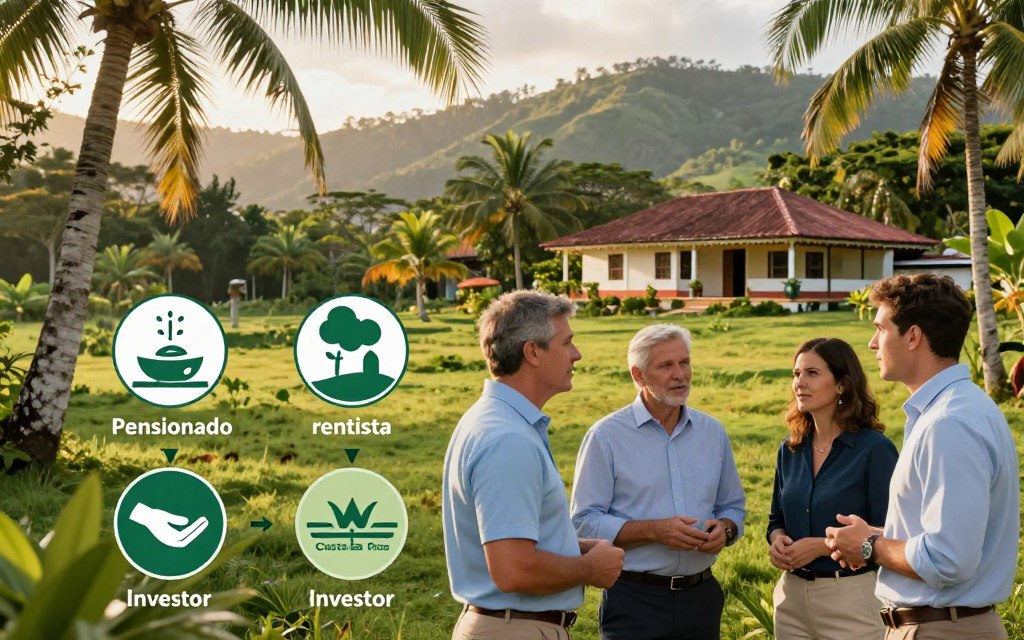
A stylized overview of Costa Rica's residency options, showcasing a serene tropical landscape featuring iconic elements like lush greenery, palm trees, and the vibrant colors of nature. In the foreground, a group of three Caucasian individuals dressed in business casual attire (polo shirts and button-downs) discuss residency options, appearing engaged and professional. The middle section includes graphical representations of different visa types (such as pensionado, rentista, and investor statuses) illustrated with icons and visuals, blending seamlessly with the scenery. In the background, a picturesque view of a traditional Costa Rican house and rolling hills, illuminated by warm sunlight that creates a welcoming atmosphere. The image subtly incorporates the brand name "Pura Vida Costa Rica" into the design, while maintaining an informative yet inviting feel.

Costa Rica’s immigration system offers several structured routes for obtaining legal status, each with its own criteria. For U.S. citizens, the primary residency pathways are Pensionado (for retirees), Rentista (for those with stable passive income), and Inversionista (for investors). A fourth option, Vínculo, exists for those with immediate family ties to a Costa Rican citizen.

Each categoría has precise financial thresholds and document needs under Costa Rican law. There is no universal solution. Understanding your specific situation upfront prevents wasted time and effort.

A crucial point of confusion is the Digital Nomad visa. It is a temporary visa for remote workers. It does not lead to permanent residency or citizenship. For remote professionals seeking a true residency path, the Rentista category is often the closest fit.

This overview helps you identify which category aligns with your finances and goals. We’ll now explore each pathway’s specific requirements in detail.

Understanding Pensionado (Pensionado) Requirements

The Pensionado program is Costa Rica’s dedicated residency option for individuals with guaranteed retirement income. It provides a structured legal pathway for retirees seeking long-term stability.

Minimum Income and Documentation Thresholds

You must prove a lifetime pension of at least $1,000 per month. This is the core financial requirement. Qualifying sources include U.S. Social Security, government pensions, and corporate plans.

Investment withdrawals or standard IRAs usually do not qualify. You need an official letter from your pension provider.

This letter must confirm your monthly income and its lifetime nature. It requires apostille certification and a professional Spanish translation.

Key Benefits for Retirees

Approved Pensionado holders gain significant advantages. You can import household goods and one vehicle tax-free.

You also gain access to the public healthcare system, known as Caja. This status creates a direct path to permanent residency after three years.

Remember, the $1,000 per month meets the legal minimum. A comfortable budget for living expenses is often higher.

We help you prepare these documents correctly. This avoids delays and ensures your application reflects your true financial situation.

Detailing the Rentista (Rentista) Path and Requirements

For individuals with stable passive income but not a formal pension, Costa Rica’s Rentista program offers a clear residency pathway. It is designed for those who can prove a guaranteed financial stream.

Establishing a Guaranteed Monthly Income

The core requirement is proof of a guaranteed monthly income of at least $2,500 US dollars. This must be sustained for a full two-year period.

Qualifying sources are broader than the pension-based category. They include investment distributions, rental property earnings, annuity payments, or trust funds.

An alternative route involves depositing $60,000 into a Costa Rican bank. The bank then certifies this capital can generate the required income per month.

Two-Year Financial Commitment

You are committing to this income level for 24 months. Documentation must show consistent deposits and a guarantee of continuation.

For remote workers seeking actual residency, this is typically the closest viable path. The Digital Nomad visa is temporary and does not lead to permanent status.

We help you structure and document your income to meet these specific requirements. Proper preparation is key to a successful application.

Navigating the Inversionista (Inversionista) Route

If you possess substantial capital and seek to invest it directly into the Costa Rican economy, the Inversionista category may be your ideal fit. This pathway requires a minimum commitment of $150,000 US dollars, a threshold established in law.

Qualifying investments include purchasing real estate, acquiring equity in a local business, or funding approved national projects. The goal is to demonstrate a clear economic benefit to the country.

Investment Minimums and Personal Ownership Rules

The core financial requirement is non-negotiable. Your capital must be verifiably deployed in qualifying Costa Rican assets. This could be a residential property, a commercial venture, or a sustainable development project.

A critical and often misunderstood rule involves real estate. For your investment to qualify for this residency, the property title must be in your personal name. Using a local corporation—a common practice for existing owners—will cause your application to be rejected.

You must maintain this investment value throughout your temporary residency. Furthermore, this category carries a stricter physical presence requirement. You should plan to spend at least six months per year in the country.

Clarifying the Digital Nomad Option Versus True Residency

One of the most frequent points of confusion we encounter is the distinction between a temporary stay permit and actual legal residency. The Digital Nomad visa, officially called “Estancia para Trabajadores Remotos,” is often misunderstood.

This visa allows remote workers to live in Costa Rica for up to one year, renewable for a second. It requires proof of a $3,000 monthly income, or $4,000 for families, plus valid health insurance.

Why Digital Nomad Does Not Lead to Residency

Critically, this status is not a residency category. The time spent under this visa does not count toward the three-year requirement for permanent residency. It also does not contribute to eventual citizenship eligibility.

When your two-year period ends, you revert to a tourist status. You gain no long-term legal progression. For remote workers seeking a true foundation, the Rentista category is typically the appropriate path.

Rentista requires documenting a guaranteed $2,500 monthly income for two years. This creates a direct route to permanent status. We help clients structure their remote income to meet this requirement properly.

The Digital Nomad option offers short-term convenience. True residency provides long-term stability for building a life here.

How to Qualify for legal-residency-options-for-expats-in-costa-rica-2026-crie

Qualification for residency is less about picking a category and more about honestly assessing your personal and financial profile against strict standards. The first step is a realistic self-assessment. You must match your income sources and long-term goals to the correct pathway.

Universal requirements apply to all applications. You need a clean criminal background check from every country you’ve lived in for the past three years. Your passport must be valid, and civil documents like birth certificates require authentication.

Financial proof is category-specific but always scrutinized. Authorities verify bank statements, pension letters, and investment accounts thoroughly. They ensure you meet thresholds sustainably, not just on paper.

Age is generally not a barrier. Costa Rica welcomes applicants from all countries. Processing times may vary based on your nationality and existing agreements.

Remember, qualification demonstrates ongoing stability. You’ll need to prove continued compliance at each renewal. Medical exams and health insurance needs differ by category.

We help you navigate this process. For deeper insights, see our comprehensive expat guide. Also, check the official FAQ page for common questions.

Step-by-Step Document Preparation Process

We often tell clients that the real work of securing residency happens at home, through diligent document gathering and certification. A flawless application is built on this foundation, preventing frustrating delays after you arrive.

Gathering Essential Documents at Home

Start by obtaining certified copies of core civil documents. These include your birth certificate, marriage certificate if applicable, and divorce decrees. Each must be an original, recently issued copy.

The FBI criminal background check is critical. It can take 8-12 weeks to receive. Begin this process immediately, as the report must be recent when you submit.

Apostilles and Official Translations

Every document from the US requires an apostille. This is a certification from the Secretary of State or US Department of State. It validates the document for international use.

Official translation into Spanish is the final step. This must be done in Costa Rica by a translator approved by the Ministry of Foreign Affairs. Budget for this required service after you arrive.

Essential Timelines and Process Expectations

Managing expectations for your residency timeline is a critical part of the journey. The entire process, from starting paperwork to holding your card, typically spans 4 to 12 months. This variation depends on application volume and your specific category.

Submission, Processing, and Approval Phases

Phase one involves document preparation in your home country. This step usually takes two to three months. You must order certified papers, get background checks, and secure apostilles.

Next, you’ll submit everything in Costa Rica. This in-country step often requires one to two weeks. It includes official translations and filing with immigration authorities.

The review period is the longest variable. Government processing typically takes three to eight months. Officials verify all your documents and financial proof during this time.

Finally, approval leads to DIMEX card issuance. This final phase generally requires two to four weeks. You’ll provide biometrics and receive your official identification.

We emphasize these are typical ranges, not guarantees. Immigration processing speeds can change. Planning for flexibility is key to a smooth transition.

Common Pitfalls and Mistakes to Avoid

Even the most meticulously planned application can be derailed by a few easily avoidable errors. We see these common missteps cause significant delays every year.

Document Errors and Overstaying Concerns

The most frequent error involves submitting incorrect documents. Missing apostilles or using photocopies instead of certified originals leads to immediate rejection.

Background checks older than six months are also invalid. This single mistake can restart your entire timeline.

Translation is another strict requirement. Using an online service or a friend instead of an official Costa Rican traductor oficial means immigration will not accept your paperwork.

Do not overstay your tourist visa while waiting. You must maintain legal status through extensions, even after filing your application. Immigration authorities view overstays seriously.

Financial proof must show consistent, guaranteed income. One-time deposits or unofficial screenshots will not suffice. A complete application avoids these pitfalls from the start.

Preparing Financial and Eligibility Proof

The strength of your residency application rests entirely on the official financial documents you provide. Each category has specific proof requirements. Immigration authorities verify every detail with precision.

Validating Your Monthly Income and Pension Proof

For Pensionado, you need an official letter from your pension provider. It must state your lifetime benefit amount in dollars per month. This letter requires an apostille and professional translation.

Rentista applicants must prove a guaranteed monthly income of at least $2,500. This proof can come from investment distributions or rental agreements. Alternatively, a $60,000 deposit in a local bank works.

Certification and Bank Documentation

Your bank statements must show consistent income deposits over 6-12 months. One-time transfers do not meet the requirements. The bank’s certification letter is crucial for the deposit method.

Inversionista applicants need a licensed property appraisal. It must confirm a value of $150,000 or more. Clear title in your personal name is mandatory—corporate ownership disqualifies the application.

We help you gather all necessary third-party verifications. This ensures your financial proof is complete and compelling for a successful outcome.

Importance of Document Authentication and Official Translations

Before your paperwork ever reaches an immigration desk, it must pass through two critical validation gates. Costa Rican law is very specific on this point. Your documents from your home country require formal authentication.

They also need a certified Spanish translation. Skipping either step will cause your application to be rejected. We treat this preparation as its own essential phase.

The Apostille Process Explained

If you are from the United States, you will use the apostille process. This is an international standard under the Hague Convention. It validates your documents for use in Costa Rica.

You submit certified originals to the Secretary of State where the document was issued. For federal papers, use the U.S. Department of State. They attach a special certificate.

This entire process typically takes a few weeks per document. Applicants from non-convention countries face a longer legalization chain. It involves multiple government authentications.

Working with Approved Translators

All translations must be completed within Costa Rica. You must use a traductor oficial registered with the Ministry of Foreign Affairs. This is a strict immigration requirement.

You cannot use online services or bring pre-translated documents. Only these approved translators provide the legally recognized stamp. We coordinate with trusted professionals for this step.

Building this cost and a few days into your timeline is essential. Proper authentication and translation form the bedrock of a successful application.

Tips for Starting Your Application From Home

Organizing your application from home eliminates countless logistical headaches and potential delays. The most successful applicants begin their document preparation in their country of origin. They avoid the nightmare of trying to coordinate from abroad after arrival.

Create a detailed timeline working backward from your target submission date. Order certified documents like birth certificates and FBI background checks first. These steps can take three months or more.

Understand your specific category’s requirements before you order anything. A brief consultation with a qualified specialist can prevent costly errors. It ensures you gather the correct financial proof and civil documents.

Order multiple certified copies of key papers. Set up a dedicated tracking system for each document’s status. This discipline turns a complex process into a manageable checklist.

Following these steps means your in-country submission is a smooth, one-day event. You arrive prepared, not scrambling.

Managing Renewal and Transition to Permanent Residency

Securing your temporary residency card is a major milestone, but it’s not the final destination. Costa Rica’s system is designed as a clear progression. You start with temporary status and can advance to more stable forms of residency over time.

Maintaining Your Temporary Status

Your initial temporary residency is valid for two years. Renewal is not automatic. You must proactively submit updated proof before expiration.

This includes current financial documents and a clean criminal record. You must also show you’ve kept any required social security payments current. A lapse in status can reset your eligibility clock for the next step.

Steps Toward Permanent Residency and Citizenship

After maintaining your temporary residency for three consecutive years, you become eligible for permanent status. This offers significant stability. You are no longer bound by the specific financial rules of your original category.

Citizenship is a separate, longer-term goal. U.S. citizens can apply after seven total years of legal residency. This reduces to five years if married to a Costa Rican citizen.

Costa Rica permits dual citizenship. You can naturalize without renouncing your American passport.

Integrating Cultural and Legal Requirements in Costa Rica

Legal status grants you the right to stay, but cultural fluency determines the quality of your life experience. True integration in this country involves a dual focus. You must navigate official systems while embracing local customs.

Learning Local Spanish Essentials

Spanish proficiency is not required for initial approval. However, learning functional Spanish dramatically improves daily life. It helps with banking, healthcare visits, and building genuine neighborly relationships.

Understanding legal documents you must sign is also crucial. We recommend starting language lessons early. This investment pays off in smoother daily interactions.

Embracing the “Pura Vida” Lifestyle

The famous “Pura Vida” ethos is a real cultural mindset. It emphasizes life quality over material accumulation. Patience and personal relationships are valued over urgency.

Adapting to this, especially the slower bureaucratic pace, reduces frustration. Enrolling in the Caja healthcare system is required for most. Monthly contributions are based on declared income.

Many residents supplement this with private insurance. Understanding the local legal framework requires adjusted expectations. Processes often take weeks where days might suffice elsewhere.

In-person appearances are frequently needed. Building good relationships with your local attorney or bank manager matters. Popular areas for newcomers include San José, Tamarindo, Atenas, and Puerto Viejo.

Each offers a distinct lifestyle and community. Remember your ongoing obligations like annual tax filings. Keep your residency card updated and contributions current.

Embarking on Your New Chapter in Costa Rica

Building a stable future here is a journey best started with expert guidance. Your path to residency is entirely achievable with proper preparation and a trusted partner. We specialize exclusively in this process, offering the focused knowledge you need.

We provide candid, realistic support for your application. While final approval rests with immigration authorities, we ensure your submission is complete and professionally presented. This gives you the strongest possible foundation for success.

Taking the first step is simple. Contact our team via WhatsApp at +506 8706 3888 or email info@crie.cr for an honest assessment. Visit crie.cr for comprehensive resources and always verify the latest rules at the official migracion.go.cr site.

Let’s work together to turn your dream of moving to Costa Rica into a well-planned reality. Your new life awaits.

FAQ

What is the fastest residency option for a retiree moving to Costa Rica?

For retirees, the Pensionado visa is often the fastest route. It requires a guaranteed lifetime pension of at least What is the fastest residency option for a retiree moving to Costa Rica?For retirees, the Pensionado visa is often the fastest route. It requires a guaranteed lifetime pension of at least

FAQ

What is the fastest residency option for a retiree moving to Costa Rica?

For retirees, the Pensionado visa is often the fastest route. It requires a guaranteed lifetime pension of at least

FAQ

What is the fastest residency option for a retiree moving to Costa Rica?

For retirees, the Pensionado visa is often the fastest route. It requires a guaranteed lifetime pension of at least $1,000 per month from a qualified source like Social Security. The process is straightforward because it relies on stable, verifiable income rather than a large capital investment or complex business setup.

Can I use rental income from back home to qualify for the Rentista visa?

Yes, you can. The Rentista visa requires proof of a guaranteed $2,500 monthly income for two years. This can come from various sources, including real estate rentals, investments, or even a structured annuity. You’ll need official documentation, like notarized lease agreements and bank statements, to prove this income is stable and ongoing.

If I buy a property, does that automatically make me a resident?

No, purchasing property does not grant automatic residency. However, it can be your path through the Inversionista (Investor) category. You must invest a minimum of $150,000 in a business or real estate. The property must be in your personal name, not a corporate entity, and you must provide official proof of the investment value to immigration authorities.

Why doesn’t the Digital Nomad visa lead to permanent residency?

The Digital Nomad visa is a legal *temporary* stay permit, not a residency category. It’s designed for remote workers to live and work in Costa Rica for one or two years. It does not count toward the time required for permanent residency and cannot be converted into a Pensionado, Rentista, or Inversionista visa. It’s a great trial period but a separate track.

How long does the entire application process typically take?

A> You should plan for a multi-stage process taking several months. After gathering and authenticating all your documents—which can take weeks—the formal submission and review by Costa Rican immigration can take an additional 3 to 6 months. We always advise starting the document prep from your home country and building a realistic timeline with buffer periods for unexpected delays.

What is the most common mistake that leads to application denial?

The most frequent pitfalls are incomplete document authentication. Every foreign-issued document, like a birth certificate or pension letter, needs an apostille (or embassy legalization) and an official translation by a Costa Rica-approved translator. Submitting documents without these steps will cause immediate rejection. Another critical error is letting your tourist visa expire while waiting.

What are the financial proof requirements for the Pensionado visa?

You must provide official certification of your pension income. For U.S. Social Security, this is the SSA-1099 form or a benefits verification letter. This document must be apostilled and translated. You’ll also need recent bank statements showing the monthly deposits. The immigration system requires clear proof that this income is permanent and meets the $1,000 per month minimum.

When should I start the apostille and translation process?

Start immediately, even before you finalize other plans. The apostille process is done in your home country and can take several weeks depending on the state or issuing agency. We recommend obtaining multiple certified copies of crucial documents. Then, have them translated by a translator registered with the Costa Rican Ministry of Foreign Affairs to ensure no delays later.

How do I transition from temporary to permanent residency?

You must maintain your temporary status (Pensionado, Rentista, etc.) for three consecutive years. This means renewing your cédula (ID) annually and proving you continue to meet the financial requirements. After three years, you can apply for permanent residency. Maintaining a clean criminal record and not overstaying any visa during this period is absolutely essential.

,000 per month from a qualified source like Social Security. The process is straightforward because it relies on stable, verifiable income rather than a large capital investment or complex business setup.

Can I use rental income from back home to qualify for the Rentista visa?

Yes, you can. The Rentista visa requires proof of a guaranteed ,500 monthly income for two years. This can come from various sources, including real estate rentals, investments, or even a structured annuity. You’ll need official documentation, like notarized lease agreements and bank statements, to prove this income is stable and ongoing.

If I buy a property, does that automatically make me a resident?

No, purchasing property does not grant automatic residency. However, it can be your path through the Inversionista (Investor) category. You must invest a minimum of 0,000 in a business or real estate. The property must be in your personal name, not a corporate entity, and you must provide official proof of the investment value to immigration authorities.

Why doesn’t the Digital Nomad visa lead to permanent residency?

The Digital Nomad visa is a legal *temporary* stay permit, not a residency category. It’s designed for remote workers to live and work in Costa Rica for one or two years. It does not count toward the time required for permanent residency and cannot be converted into a Pensionado, Rentista, or Inversionista visa. It’s a great trial period but a separate track.

How long does the entire application process typically take?

A> You should plan for a multi-stage process taking several months. After gathering and authenticating all your documents—which can take weeks—the formal submission and review by Costa Rican immigration can take an additional 3 to 6 months. We always advise starting the document prep from your home country and building a realistic timeline with buffer periods for unexpected delays.

What is the most common mistake that leads to application denial?

The most frequent pitfalls are incomplete document authentication. Every foreign-issued document, like a birth certificate or pension letter, needs an apostille (or embassy legalization) and an official translation by a Costa Rica-approved translator. Submitting documents without these steps will cause immediate rejection. Another critical error is letting your tourist visa expire while waiting.

What are the financial proof requirements for the Pensionado visa?

You must provide official certification of your pension income. For U.S. Social Security, this is the SSA-1099 form or a benefits verification letter. This document must be apostilled and translated. You’ll also need recent bank statements showing the monthly deposits. The immigration system requires clear proof that this income is permanent and meets the

FAQ

What is the fastest residency option for a retiree moving to Costa Rica?

For retirees, the Pensionado visa is often the fastest route. It requires a guaranteed lifetime pension of at least $1,000 per month from a qualified source like Social Security. The process is straightforward because it relies on stable, verifiable income rather than a large capital investment or complex business setup.

Can I use rental income from back home to qualify for the Rentista visa?

Yes, you can. The Rentista visa requires proof of a guaranteed $2,500 monthly income for two years. This can come from various sources, including real estate rentals, investments, or even a structured annuity. You’ll need official documentation, like notarized lease agreements and bank statements, to prove this income is stable and ongoing.

If I buy a property, does that automatically make me a resident?

No, purchasing property does not grant automatic residency. However, it can be your path through the Inversionista (Investor) category. You must invest a minimum of $150,000 in a business or real estate. The property must be in your personal name, not a corporate entity, and you must provide official proof of the investment value to immigration authorities.

Why doesn’t the Digital Nomad visa lead to permanent residency?

The Digital Nomad visa is a legal *temporary* stay permit, not a residency category. It’s designed for remote workers to live and work in Costa Rica for one or two years. It does not count toward the time required for permanent residency and cannot be converted into a Pensionado, Rentista, or Inversionista visa. It’s a great trial period but a separate track.

How long does the entire application process typically take?

A> You should plan for a multi-stage process taking several months. After gathering and authenticating all your documents—which can take weeks—the formal submission and review by Costa Rican immigration can take an additional 3 to 6 months. We always advise starting the document prep from your home country and building a realistic timeline with buffer periods for unexpected delays.

What is the most common mistake that leads to application denial?

The most frequent pitfalls are incomplete document authentication. Every foreign-issued document, like a birth certificate or pension letter, needs an apostille (or embassy legalization) and an official translation by a Costa Rica-approved translator. Submitting documents without these steps will cause immediate rejection. Another critical error is letting your tourist visa expire while waiting.

What are the financial proof requirements for the Pensionado visa?

You must provide official certification of your pension income. For U.S. Social Security, this is the SSA-1099 form or a benefits verification letter. This document must be apostilled and translated. You’ll also need recent bank statements showing the monthly deposits. The immigration system requires clear proof that this income is permanent and meets the $1,000 per month minimum.

When should I start the apostille and translation process?

Start immediately, even before you finalize other plans. The apostille process is done in your home country and can take several weeks depending on the state or issuing agency. We recommend obtaining multiple certified copies of crucial documents. Then, have them translated by a translator registered with the Costa Rican Ministry of Foreign Affairs to ensure no delays later.

How do I transition from temporary to permanent residency?

You must maintain your temporary status (Pensionado, Rentista, etc.) for three consecutive years. This means renewing your cédula (ID) annually and proving you continue to meet the financial requirements. After three years, you can apply for permanent residency. Maintaining a clean criminal record and not overstaying any visa during this period is absolutely essential.

,000 per month minimum.

When should I start the apostille and translation process?

Start immediately, even before you finalize other plans. The apostille process is done in your home country and can take several weeks depending on the state or issuing agency. We recommend obtaining multiple certified copies of crucial documents. Then, have them translated by a translator registered with the Costa Rican Ministry of Foreign Affairs to ensure no delays later.

How do I transition from temporary to permanent residency?

You must maintain your temporary status (Pensionado, Rentista, etc.) for three consecutive years. This means renewing your cédula (ID) annually and proving you continue to meet the financial requirements. After three years, you can apply for permanent residency. Maintaining a clean criminal record and not overstaying any visa during this period is absolutely essential.

,000 per month from a qualified source like Social Security. The process is straightforward because it relies on stable, verifiable income rather than a large capital investment or complex business setup.Can I use rental income from back home to qualify for the Rentista visa?Yes, you can. The Rentista visa requires proof of a guaranteed ,500 monthly income for two years. This can come from various sources, including real estate rentals, investments, or even a structured annuity. You’ll need official documentation, like notarized lease agreements and bank statements, to prove this income is stable and ongoing.If I buy a property, does that automatically make me a resident?No, purchasing property does not grant automatic residency. However, it can be your path through the Inversionista (Investor) category. You must invest a minimum of 0,000 in a business or real estate. The property must be in your personal name, not a corporate entity, and you must provide official proof of the investment value to immigration authorities.Why doesn’t the Digital Nomad visa lead to permanent residency?The Digital Nomad visa is a legal *temporary* stay permit, not a residency category. It’s designed for remote workers to live and work in Costa Rica for one or two years. It does not count toward the time required for permanent residency and cannot be converted into a Pensionado, Rentista, or Inversionista visa. It’s a great trial period but a separate track.How long does the entire application process typically take?A> You should plan for a multi-stage process taking several months. After gathering and authenticating all your documents—which can take weeks—the formal submission and review by Costa Rican immigration can take an additional 3 to 6 months. We always advise starting the document prep from your home country and building a realistic timeline with buffer periods for unexpected delays.What is the most common mistake that leads to application denial?The most frequent pitfalls are incomplete document authentication. Every foreign-issued document, like a birth certificate or pension letter, needs an apostille (or embassy legalization) and an official translation by a Costa Rica-approved translator. Submitting documents without these steps will cause immediate rejection. Another critical error is letting your tourist visa expire while waiting.What are the financial proof requirements for the Pensionado visa?You must provide official certification of your pension income. For U.S. Social Security, this is the SSA-1099 form or a benefits verification letter. This document must be apostilled and translated. You’ll also need recent bank statements showing the monthly deposits. The immigration system requires clear proof that this income is permanent and meets the

FAQ

What is the fastest residency option for a retiree moving to Costa Rica?

For retirees, the Pensionado visa is often the fastest route. It requires a guaranteed lifetime pension of at least

FAQ

What is the fastest residency option for a retiree moving to Costa Rica?

For retirees, the Pensionado visa is often the fastest route. It requires a guaranteed lifetime pension of at least $1,000 per month from a qualified source like Social Security. The process is straightforward because it relies on stable, verifiable income rather than a large capital investment or complex business setup.

Can I use rental income from back home to qualify for the Rentista visa?

Yes, you can. The Rentista visa requires proof of a guaranteed $2,500 monthly income for two years. This can come from various sources, including real estate rentals, investments, or even a structured annuity. You’ll need official documentation, like notarized lease agreements and bank statements, to prove this income is stable and ongoing.

If I buy a property, does that automatically make me a resident?

No, purchasing property does not grant automatic residency. However, it can be your path through the Inversionista (Investor) category. You must invest a minimum of $150,000 in a business or real estate. The property must be in your personal name, not a corporate entity, and you must provide official proof of the investment value to immigration authorities.

Why doesn’t the Digital Nomad visa lead to permanent residency?

The Digital Nomad visa is a legal *temporary* stay permit, not a residency category. It’s designed for remote workers to live and work in Costa Rica for one or two years. It does not count toward the time required for permanent residency and cannot be converted into a Pensionado, Rentista, or Inversionista visa. It’s a great trial period but a separate track.

How long does the entire application process typically take?

A> You should plan for a multi-stage process taking several months. After gathering and authenticating all your documents—which can take weeks—the formal submission and review by Costa Rican immigration can take an additional 3 to 6 months. We always advise starting the document prep from your home country and building a realistic timeline with buffer periods for unexpected delays.

What is the most common mistake that leads to application denial?

The most frequent pitfalls are incomplete document authentication. Every foreign-issued document, like a birth certificate or pension letter, needs an apostille (or embassy legalization) and an official translation by a Costa Rica-approved translator. Submitting documents without these steps will cause immediate rejection. Another critical error is letting your tourist visa expire while waiting.

What are the financial proof requirements for the Pensionado visa?

You must provide official certification of your pension income. For U.S. Social Security, this is the SSA-1099 form or a benefits verification letter. This document must be apostilled and translated. You’ll also need recent bank statements showing the monthly deposits. The immigration system requires clear proof that this income is permanent and meets the $1,000 per month minimum.

When should I start the apostille and translation process?

Start immediately, even before you finalize other plans. The apostille process is done in your home country and can take several weeks depending on the state or issuing agency. We recommend obtaining multiple certified copies of crucial documents. Then, have them translated by a translator registered with the Costa Rican Ministry of Foreign Affairs to ensure no delays later.

How do I transition from temporary to permanent residency?

You must maintain your temporary status (Pensionado, Rentista, etc.) for three consecutive years. This means renewing your cédula (ID) annually and proving you continue to meet the financial requirements. After three years, you can apply for permanent residency. Maintaining a clean criminal record and not overstaying any visa during this period is absolutely essential.

,000 per month from a qualified source like Social Security. The process is straightforward because it relies on stable, verifiable income rather than a large capital investment or complex business setup.

Can I use rental income from back home to qualify for the Rentista visa?

Yes, you can. The Rentista visa requires proof of a guaranteed ,500 monthly income for two years. This can come from various sources, including real estate rentals, investments, or even a structured annuity. You’ll need official documentation, like notarized lease agreements and bank statements, to prove this income is stable and ongoing.

If I buy a property, does that automatically make me a resident?

No, purchasing property does not grant automatic residency. However, it can be your path through the Inversionista (Investor) category. You must invest a minimum of 0,000 in a business or real estate. The property must be in your personal name, not a corporate entity, and you must provide official proof of the investment value to immigration authorities.

Why doesn’t the Digital Nomad visa lead to permanent residency?

The Digital Nomad visa is a legal *temporary* stay permit, not a residency category. It’s designed for remote workers to live and work in Costa Rica for one or two years. It does not count toward the time required for permanent residency and cannot be converted into a Pensionado, Rentista, or Inversionista visa. It’s a great trial period but a separate track.

How long does the entire application process typically take?

A> You should plan for a multi-stage process taking several months. After gathering and authenticating all your documents—which can take weeks—the formal submission and review by Costa Rican immigration can take an additional 3 to 6 months. We always advise starting the document prep from your home country and building a realistic timeline with buffer periods for unexpected delays.

What is the most common mistake that leads to application denial?

The most frequent pitfalls are incomplete document authentication. Every foreign-issued document, like a birth certificate or pension letter, needs an apostille (or embassy legalization) and an official translation by a Costa Rica-approved translator. Submitting documents without these steps will cause immediate rejection. Another critical error is letting your tourist visa expire while waiting.

What are the financial proof requirements for the Pensionado visa?

You must provide official certification of your pension income. For U.S. Social Security, this is the SSA-1099 form or a benefits verification letter. This document must be apostilled and translated. You’ll also need recent bank statements showing the monthly deposits. The immigration system requires clear proof that this income is permanent and meets the

FAQ

What is the fastest residency option for a retiree moving to Costa Rica?

For retirees, the Pensionado visa is often the fastest route. It requires a guaranteed lifetime pension of at least $1,000 per month from a qualified source like Social Security. The process is straightforward because it relies on stable, verifiable income rather than a large capital investment or complex business setup.

Can I use rental income from back home to qualify for the Rentista visa?

Yes, you can. The Rentista visa requires proof of a guaranteed $2,500 monthly income for two years. This can come from various sources, including real estate rentals, investments, or even a structured annuity. You’ll need official documentation, like notarized lease agreements and bank statements, to prove this income is stable and ongoing.

If I buy a property, does that automatically make me a resident?

No, purchasing property does not grant automatic residency. However, it can be your path through the Inversionista (Investor) category. You must invest a minimum of $150,000 in a business or real estate. The property must be in your personal name, not a corporate entity, and you must provide official proof of the investment value to immigration authorities.

Why doesn’t the Digital Nomad visa lead to permanent residency?

The Digital Nomad visa is a legal *temporary* stay permit, not a residency category. It’s designed for remote workers to live and work in Costa Rica for one or two years. It does not count toward the time required for permanent residency and cannot be converted into a Pensionado, Rentista, or Inversionista visa. It’s a great trial period but a separate track.

How long does the entire application process typically take?

A> You should plan for a multi-stage process taking several months. After gathering and authenticating all your documents—which can take weeks—the formal submission and review by Costa Rican immigration can take an additional 3 to 6 months. We always advise starting the document prep from your home country and building a realistic timeline with buffer periods for unexpected delays.

What is the most common mistake that leads to application denial?

The most frequent pitfalls are incomplete document authentication. Every foreign-issued document, like a birth certificate or pension letter, needs an apostille (or embassy legalization) and an official translation by a Costa Rica-approved translator. Submitting documents without these steps will cause immediate rejection. Another critical error is letting your tourist visa expire while waiting.

What are the financial proof requirements for the Pensionado visa?

You must provide official certification of your pension income. For U.S. Social Security, this is the SSA-1099 form or a benefits verification letter. This document must be apostilled and translated. You’ll also need recent bank statements showing the monthly deposits. The immigration system requires clear proof that this income is permanent and meets the $1,000 per month minimum.

When should I start the apostille and translation process?

Start immediately, even before you finalize other plans. The apostille process is done in your home country and can take several weeks depending on the state or issuing agency. We recommend obtaining multiple certified copies of crucial documents. Then, have them translated by a translator registered with the Costa Rican Ministry of Foreign Affairs to ensure no delays later.

How do I transition from temporary to permanent residency?

You must maintain your temporary status (Pensionado, Rentista, etc.) for three consecutive years. This means renewing your cédula (ID) annually and proving you continue to meet the financial requirements. After three years, you can apply for permanent residency. Maintaining a clean criminal record and not overstaying any visa during this period is absolutely essential.

,000 per month minimum.

When should I start the apostille and translation process?

Start immediately, even before you finalize other plans. The apostille process is done in your home country and can take several weeks depending on the state or issuing agency. We recommend obtaining multiple certified copies of crucial documents. Then, have them translated by a translator registered with the Costa Rican Ministry of Foreign Affairs to ensure no delays later.

How do I transition from temporary to permanent residency?

You must maintain your temporary status (Pensionado, Rentista, etc.) for three consecutive years. This means renewing your cédula (ID) annually and proving you continue to meet the financial requirements. After three years, you can apply for permanent residency. Maintaining a clean criminal record and not overstaying any visa during this period is absolutely essential.

,000 per month minimum.When should I start the apostille and translation process?Start immediately, even before you finalize other plans. The apostille process is done in your home country and can take several weeks depending on the state or issuing agency. We recommend obtaining multiple certified copies of crucial documents. Then, have them translated by a translator registered with the Costa Rican Ministry of Foreign Affairs to ensure no delays later.How do I transition from temporary to permanent residency?You must maintain your temporary status (Pensionado, Rentista, etc.) for three consecutive years. This means renewing your cédula (ID) annually and proving you continue to meet the financial requirements. After three years, you can apply for permanent residency. Maintaining a clean criminal record and not overstaying any visa during this period is absolutely essential.,000 per month from a qualified source like Social Security. The process is straightforward because it relies on stable, verifiable income rather than a large capital investment or complex business setup.

Can I use rental income from back home to qualify for the Rentista visa?

Yes, you can. The Rentista visa requires proof of a guaranteed ,500 monthly income for two years. This can come from various sources, including real estate rentals, investments, or even a structured annuity. You’ll need official documentation, like notarized lease agreements and bank statements, to prove this income is stable and ongoing.

If I buy a property, does that automatically make me a resident?

No, purchasing property does not grant automatic residency. However, it can be your path through the Inversionista (Investor) category. You must invest a minimum of 0,000 in a business or real estate. The property must be in your personal name, not a corporate entity, and you must provide official proof of the investment value to immigration authorities.

Why doesn’t the Digital Nomad visa lead to permanent residency?

The Digital Nomad visa is a legal *temporary* stay permit, not a residency category. It’s designed for remote workers to live and work in Costa Rica for one or two years. It does not count toward the time required for permanent residency and cannot be converted into a Pensionado, Rentista, or Inversionista visa. It’s a great trial period but a separate track.

How long does the entire application process typically take?

A> You should plan for a multi-stage process taking several months. After gathering and authenticating all your documents—which can take weeks—the formal submission and review by Costa Rican immigration can take an additional 3 to 6 months. We always advise starting the document prep from your home country and building a realistic timeline with buffer periods for unexpected delays.

What is the most common mistake that leads to application denial?

The most frequent pitfalls are incomplete document authentication. Every foreign-issued document, like a birth certificate or pension letter, needs an apostille (or embassy legalization) and an official translation by a Costa Rica-approved translator. Submitting documents without these steps will cause immediate rejection. Another critical error is letting your tourist visa expire while waiting.

What are the financial proof requirements for the Pensionado visa?

You must provide official certification of your pension income. For U.S. Social Security, this is the SSA-1099 form or a benefits verification letter. This document must be apostilled and translated. You’ll also need recent bank statements showing the monthly deposits. The immigration system requires clear proof that this income is permanent and meets the What is the fastest residency option for a retiree moving to Costa Rica?For retirees, the Pensionado visa is often the fastest route. It requires a guaranteed lifetime pension of at least

FAQ

What is the fastest residency option for a retiree moving to Costa Rica?

For retirees, the Pensionado visa is often the fastest route. It requires a guaranteed lifetime pension of at least

FAQ

What is the fastest residency option for a retiree moving to Costa Rica?

For retirees, the Pensionado visa is often the fastest route. It requires a guaranteed lifetime pension of at least $1,000 per month from a qualified source like Social Security. The process is straightforward because it relies on stable, verifiable income rather than a large capital investment or complex business setup.

Can I use rental income from back home to qualify for the Rentista visa?

Yes, you can. The Rentista visa requires proof of a guaranteed $2,500 monthly income for two years. This can come from various sources, including real estate rentals, investments, or even a structured annuity. You’ll need official documentation, like notarized lease agreements and bank statements, to prove this income is stable and ongoing.

If I buy a property, does that automatically make me a resident?

No, purchasing property does not grant automatic residency. However, it can be your path through the Inversionista (Investor) category. You must invest a minimum of $150,000 in a business or real estate. The property must be in your personal name, not a corporate entity, and you must provide official proof of the investment value to immigration authorities.

Why doesn’t the Digital Nomad visa lead to permanent residency?

The Digital Nomad visa is a legal *temporary* stay permit, not a residency category. It’s designed for remote workers to live and work in Costa Rica for one or two years. It does not count toward the time required for permanent residency and cannot be converted into a Pensionado, Rentista, or Inversionista visa. It’s a great trial period but a separate track.

How long does the entire application process typically take?

A> You should plan for a multi-stage process taking several months. After gathering and authenticating all your documents—which can take weeks—the formal submission and review by Costa Rican immigration can take an additional 3 to 6 months. We always advise starting the document prep from your home country and building a realistic timeline with buffer periods for unexpected delays.

What is the most common mistake that leads to application denial?

The most frequent pitfalls are incomplete document authentication. Every foreign-issued document, like a birth certificate or pension letter, needs an apostille (or embassy legalization) and an official translation by a Costa Rica-approved translator. Submitting documents without these steps will cause immediate rejection. Another critical error is letting your tourist visa expire while waiting.

What are the financial proof requirements for the Pensionado visa?

You must provide official certification of your pension income. For U.S. Social Security, this is the SSA-1099 form or a benefits verification letter. This document must be apostilled and translated. You’ll also need recent bank statements showing the monthly deposits. The immigration system requires clear proof that this income is permanent and meets the $1,000 per month minimum.

When should I start the apostille and translation process?

Start immediately, even before you finalize other plans. The apostille process is done in your home country and can take several weeks depending on the state or issuing agency. We recommend obtaining multiple certified copies of crucial documents. Then, have them translated by a translator registered with the Costa Rican Ministry of Foreign Affairs to ensure no delays later.

How do I transition from temporary to permanent residency?

You must maintain your temporary status (Pensionado, Rentista, etc.) for three consecutive years. This means renewing your cédula (ID) annually and proving you continue to meet the financial requirements. After three years, you can apply for permanent residency. Maintaining a clean criminal record and not overstaying any visa during this period is absolutely essential.

,000 per month from a qualified source like Social Security. The process is straightforward because it relies on stable, verifiable income rather than a large capital investment or complex business setup.

Can I use rental income from back home to qualify for the Rentista visa?

Yes, you can. The Rentista visa requires proof of a guaranteed ,500 monthly income for two years. This can come from various sources, including real estate rentals, investments, or even a structured annuity. You’ll need official documentation, like notarized lease agreements and bank statements, to prove this income is stable and ongoing.

If I buy a property, does that automatically make me a resident?

No, purchasing property does not grant automatic residency. However, it can be your path through the Inversionista (Investor) category. You must invest a minimum of 0,000 in a business or real estate. The property must be in your personal name, not a corporate entity, and you must provide official proof of the investment value to immigration authorities.

Why doesn’t the Digital Nomad visa lead to permanent residency?

The Digital Nomad visa is a legal *temporary* stay permit, not a residency category. It’s designed for remote workers to live and work in Costa Rica for one or two years. It does not count toward the time required for permanent residency and cannot be converted into a Pensionado, Rentista, or Inversionista visa. It’s a great trial period but a separate track.

How long does the entire application process typically take?

A> You should plan for a multi-stage process taking several months. After gathering and authenticating all your documents—which can take weeks—the formal submission and review by Costa Rican immigration can take an additional 3 to 6 months. We always advise starting the document prep from your home country and building a realistic timeline with buffer periods for unexpected delays.

What is the most common mistake that leads to application denial?

The most frequent pitfalls are incomplete document authentication. Every foreign-issued document, like a birth certificate or pension letter, needs an apostille (or embassy legalization) and an official translation by a Costa Rica-approved translator. Submitting documents without these steps will cause immediate rejection. Another critical error is letting your tourist visa expire while waiting.

What are the financial proof requirements for the Pensionado visa?

You must provide official certification of your pension income. For U.S. Social Security, this is the SSA-1099 form or a benefits verification letter. This document must be apostilled and translated. You’ll also need recent bank statements showing the monthly deposits. The immigration system requires clear proof that this income is permanent and meets the

FAQ

What is the fastest residency option for a retiree moving to Costa Rica?

For retirees, the Pensionado visa is often the fastest route. It requires a guaranteed lifetime pension of at least $1,000 per month from a qualified source like Social Security. The process is straightforward because it relies on stable, verifiable income rather than a large capital investment or complex business setup.

Can I use rental income from back home to qualify for the Rentista visa?

Yes, you can. The Rentista visa requires proof of a guaranteed $2,500 monthly income for two years. This can come from various sources, including real estate rentals, investments, or even a structured annuity. You’ll need official documentation, like notarized lease agreements and bank statements, to prove this income is stable and ongoing.

If I buy a property, does that automatically make me a resident?

No, purchasing property does not grant automatic residency. However, it can be your path through the Inversionista (Investor) category. You must invest a minimum of $150,000 in a business or real estate. The property must be in your personal name, not a corporate entity, and you must provide official proof of the investment value to immigration authorities.

Why doesn’t the Digital Nomad visa lead to permanent residency?

The Digital Nomad visa is a legal *temporary* stay permit, not a residency category. It’s designed for remote workers to live and work in Costa Rica for one or two years. It does not count toward the time required for permanent residency and cannot be converted into a Pensionado, Rentista, or Inversionista visa. It’s a great trial period but a separate track.

How long does the entire application process typically take?

A> You should plan for a multi-stage process taking several months. After gathering and authenticating all your documents—which can take weeks—the formal submission and review by Costa Rican immigration can take an additional 3 to 6 months. We always advise starting the document prep from your home country and building a realistic timeline with buffer periods for unexpected delays.

What is the most common mistake that leads to application denial?

The most frequent pitfalls are incomplete document authentication. Every foreign-issued document, like a birth certificate or pension letter, needs an apostille (or embassy legalization) and an official translation by a Costa Rica-approved translator. Submitting documents without these steps will cause immediate rejection. Another critical error is letting your tourist visa expire while waiting.

What are the financial proof requirements for the Pensionado visa?

You must provide official certification of your pension income. For U.S. Social Security, this is the SSA-1099 form or a benefits verification letter. This document must be apostilled and translated. You’ll also need recent bank statements showing the monthly deposits. The immigration system requires clear proof that this income is permanent and meets the $1,000 per month minimum.

When should I start the apostille and translation process?

Start immediately, even before you finalize other plans. The apostille process is done in your home country and can take several weeks depending on the state or issuing agency. We recommend obtaining multiple certified copies of crucial documents. Then, have them translated by a translator registered with the Costa Rican Ministry of Foreign Affairs to ensure no delays later.

How do I transition from temporary to permanent residency?

You must maintain your temporary status (Pensionado, Rentista, etc.) for three consecutive years. This means renewing your cédula (ID) annually and proving you continue to meet the financial requirements. After three years, you can apply for permanent residency. Maintaining a clean criminal record and not overstaying any visa during this period is absolutely essential.

,000 per month minimum.

When should I start the apostille and translation process?

Start immediately, even before you finalize other plans. The apostille process is done in your home country and can take several weeks depending on the state or issuing agency. We recommend obtaining multiple certified copies of crucial documents. Then, have them translated by a translator registered with the Costa Rican Ministry of Foreign Affairs to ensure no delays later.

How do I transition from temporary to permanent residency?

You must maintain your temporary status (Pensionado, Rentista, etc.) for three consecutive years. This means renewing your cédula (ID) annually and proving you continue to meet the financial requirements. After three years, you can apply for permanent residency. Maintaining a clean criminal record and not overstaying any visa during this period is absolutely essential.

,000 per month from a qualified source like Social Security. The process is straightforward because it relies on stable, verifiable income rather than a large capital investment or complex business setup.Can I use rental income from back home to qualify for the Rentista visa?Yes, you can. The Rentista visa requires proof of a guaranteed ,500 monthly income for two years. This can come from various sources, including real estate rentals, investments, or even a structured annuity. You’ll need official documentation, like notarized lease agreements and bank statements, to prove this income is stable and ongoing.If I buy a property, does that automatically make me a resident?No, purchasing property does not grant automatic residency. However, it can be your path through the Inversionista (Investor) category. You must invest a minimum of 0,000 in a business or real estate. The property must be in your personal name, not a corporate entity, and you must provide official proof of the investment value to immigration authorities.Why doesn’t the Digital Nomad visa lead to permanent residency?The Digital Nomad visa is a legal *temporary* stay permit, not a residency category. It’s designed for remote workers to live and work in Costa Rica for one or two years. It does not count toward the time required for permanent residency and cannot be converted into a Pensionado, Rentista, or Inversionista visa. It’s a great trial period but a separate track.How long does the entire application process typically take?A> You should plan for a multi-stage process taking several months. After gathering and authenticating all your documents—which can take weeks—the formal submission and review by Costa Rican immigration can take an additional 3 to 6 months. We always advise starting the document prep from your home country and building a realistic timeline with buffer periods for unexpected delays.What is the most common mistake that leads to application denial?The most frequent pitfalls are incomplete document authentication. Every foreign-issued document, like a birth certificate or pension letter, needs an apostille (or embassy legalization) and an official translation by a Costa Rica-approved translator. Submitting documents without these steps will cause immediate rejection. Another critical error is letting your tourist visa expire while waiting.What are the financial proof requirements for the Pensionado visa?You must provide official certification of your pension income. For U.S. Social Security, this is the SSA-1099 form or a benefits verification letter. This document must be apostilled and translated. You’ll also need recent bank statements showing the monthly deposits. The immigration system requires clear proof that this income is permanent and meets the

FAQ

What is the fastest residency option for a retiree moving to Costa Rica?

For retirees, the Pensionado visa is often the fastest route. It requires a guaranteed lifetime pension of at least

FAQ

What is the fastest residency option for a retiree moving to Costa Rica?

For retirees, the Pensionado visa is often the fastest route. It requires a guaranteed lifetime pension of at least $1,000 per month from a qualified source like Social Security. The process is straightforward because it relies on stable, verifiable income rather than a large capital investment or complex business setup.

Can I use rental income from back home to qualify for the Rentista visa?

Yes, you can. The Rentista visa requires proof of a guaranteed $2,500 monthly income for two years. This can come from various sources, including real estate rentals, investments, or even a structured annuity. You’ll need official documentation, like notarized lease agreements and bank statements, to prove this income is stable and ongoing.

If I buy a property, does that automatically make me a resident?

No, purchasing property does not grant automatic residency. However, it can be your path through the Inversionista (Investor) category. You must invest a minimum of $150,000 in a business or real estate. The property must be in your personal name, not a corporate entity, and you must provide official proof of the investment value to immigration authorities.

Why doesn’t the Digital Nomad visa lead to permanent residency?

The Digital Nomad visa is a legal *temporary* stay permit, not a residency category. It’s designed for remote workers to live and work in Costa Rica for one or two years. It does not count toward the time required for permanent residency and cannot be converted into a Pensionado, Rentista, or Inversionista visa. It’s a great trial period but a separate track.

How long does the entire application process typically take?

A> You should plan for a multi-stage process taking several months. After gathering and authenticating all your documents—which can take weeks—the formal submission and review by Costa Rican immigration can take an additional 3 to 6 months. We always advise starting the document prep from your home country and building a realistic timeline with buffer periods for unexpected delays.

What is the most common mistake that leads to application denial?

The most frequent pitfalls are incomplete document authentication. Every foreign-issued document, like a birth certificate or pension letter, needs an apostille (or embassy legalization) and an official translation by a Costa Rica-approved translator. Submitting documents without these steps will cause immediate rejection. Another critical error is letting your tourist visa expire while waiting.

What are the financial proof requirements for the Pensionado visa?

You must provide official certification of your pension income. For U.S. Social Security, this is the SSA-1099 form or a benefits verification letter. This document must be apostilled and translated. You’ll also need recent bank statements showing the monthly deposits. The immigration system requires clear proof that this income is permanent and meets the $1,000 per month minimum.

When should I start the apostille and translation process?

Start immediately, even before you finalize other plans. The apostille process is done in your home country and can take several weeks depending on the state or issuing agency. We recommend obtaining multiple certified copies of crucial documents. Then, have them translated by a translator registered with the Costa Rican Ministry of Foreign Affairs to ensure no delays later.

How do I transition from temporary to permanent residency?

You must maintain your temporary status (Pensionado, Rentista, etc.) for three consecutive years. This means renewing your cédula (ID) annually and proving you continue to meet the financial requirements. After three years, you can apply for permanent residency. Maintaining a clean criminal record and not overstaying any visa during this period is absolutely essential.

,000 per month from a qualified source like Social Security. The process is straightforward because it relies on stable, verifiable income rather than a large capital investment or complex business setup.

Can I use rental income from back home to qualify for the Rentista visa?

Yes, you can. The Rentista visa requires proof of a guaranteed ,500 monthly income for two years. This can come from various sources, including real estate rentals, investments, or even a structured annuity. You’ll need official documentation, like notarized lease agreements and bank statements, to prove this income is stable and ongoing.

If I buy a property, does that automatically make me a resident?

No, purchasing property does not grant automatic residency. However, it can be your path through the Inversionista (Investor) category. You must invest a minimum of 0,000 in a business or real estate. The property must be in your personal name, not a corporate entity, and you must provide official proof of the investment value to immigration authorities.

Why doesn’t the Digital Nomad visa lead to permanent residency?

The Digital Nomad visa is a legal *temporary* stay permit, not a residency category. It’s designed for remote workers to live and work in Costa Rica for one or two years. It does not count toward the time required for permanent residency and cannot be converted into a Pensionado, Rentista, or Inversionista visa. It’s a great trial period but a separate track.

How long does the entire application process typically take?

A> You should plan for a multi-stage process taking several months. After gathering and authenticating all your documents—which can take weeks—the formal submission and review by Costa Rican immigration can take an additional 3 to 6 months. We always advise starting the document prep from your home country and building a realistic timeline with buffer periods for unexpected delays.

What is the most common mistake that leads to application denial?

The most frequent pitfalls are incomplete document authentication. Every foreign-issued document, like a birth certificate or pension letter, needs an apostille (or embassy legalization) and an official translation by a Costa Rica-approved translator. Submitting documents without these steps will cause immediate rejection. Another critical error is letting your tourist visa expire while waiting.

What are the financial proof requirements for the Pensionado visa?

You must provide official certification of your pension income. For U.S. Social Security, this is the SSA-1099 form or a benefits verification letter. This document must be apostilled and translated. You’ll also need recent bank statements showing the monthly deposits. The immigration system requires clear proof that this income is permanent and meets the

FAQ

What is the fastest residency option for a retiree moving to Costa Rica?

For retirees, the Pensionado visa is often the fastest route. It requires a guaranteed lifetime pension of at least $1,000 per month from a qualified source like Social Security. The process is straightforward because it relies on stable, verifiable income rather than a large capital investment or complex business setup.

Can I use rental income from back home to qualify for the Rentista visa?

Yes, you can. The Rentista visa requires proof of a guaranteed $2,500 monthly income for two years. This can come from various sources, including real estate rentals, investments, or even a structured annuity. You’ll need official documentation, like notarized lease agreements and bank statements, to prove this income is stable and ongoing.

If I buy a property, does that automatically make me a resident?

No, purchasing property does not grant automatic residency. However, it can be your path through the Inversionista (Investor) category. You must invest a minimum of $150,000 in a business or real estate. The property must be in your personal name, not a corporate entity, and you must provide official proof of the investment value to immigration authorities.

Why doesn’t the Digital Nomad visa lead to permanent residency?

The Digital Nomad visa is a legal *temporary* stay permit, not a residency category. It’s designed for remote workers to live and work in Costa Rica for one or two years. It does not count toward the time required for permanent residency and cannot be converted into a Pensionado, Rentista, or Inversionista visa. It’s a great trial period but a separate track.

How long does the entire application process typically take?

A> You should plan for a multi-stage process taking several months. After gathering and authenticating all your documents—which can take weeks—the formal submission and review by Costa Rican immigration can take an additional 3 to 6 months. We always advise starting the document prep from your home country and building a realistic timeline with buffer periods for unexpected delays.

What is the most common mistake that leads to application denial?

The most frequent pitfalls are incomplete document authentication. Every foreign-issued document, like a birth certificate or pension letter, needs an apostille (or embassy legalization) and an official translation by a Costa Rica-approved translator. Submitting documents without these steps will cause immediate rejection. Another critical error is letting your tourist visa expire while waiting.

What are the financial proof requirements for the Pensionado visa?

You must provide official certification of your pension income. For U.S. Social Security, this is the SSA-1099 form or a benefits verification letter. This document must be apostilled and translated. You’ll also need recent bank statements showing the monthly deposits. The immigration system requires clear proof that this income is permanent and meets the $1,000 per month minimum.

When should I start the apostille and translation process?

Start immediately, even before you finalize other plans. The apostille process is done in your home country and can take several weeks depending on the state or issuing agency. We recommend obtaining multiple certified copies of crucial documents. Then, have them translated by a translator registered with the Costa Rican Ministry of Foreign Affairs to ensure no delays later.

How do I transition from temporary to permanent residency?

You must maintain your temporary status (Pensionado, Rentista, etc.) for three consecutive years. This means renewing your cédula (ID) annually and proving you continue to meet the financial requirements. After three years, you can apply for permanent residency. Maintaining a clean criminal record and not overstaying any visa during this period is absolutely essential.

,000 per month minimum.

When should I start the apostille and translation process?

Start immediately, even before you finalize other plans. The apostille process is done in your home country and can take several weeks depending on the state or issuing agency. We recommend obtaining multiple certified copies of crucial documents. Then, have them translated by a translator registered with the Costa Rican Ministry of Foreign Affairs to ensure no delays later.

How do I transition from temporary to permanent residency?

You must maintain your temporary status (Pensionado, Rentista, etc.) for three consecutive years. This means renewing your cédula (ID) annually and proving you continue to meet the financial requirements. After three years, you can apply for permanent residency. Maintaining a clean criminal record and not overstaying any visa during this period is absolutely essential.

,000 per month minimum.When should I start the apostille and translation process?Start immediately, even before you finalize other plans. The apostille process is done in your home country and can take several weeks depending on the state or issuing agency. We recommend obtaining multiple certified copies of crucial documents. Then, have them translated by a translator registered with the Costa Rican Ministry of Foreign Affairs to ensure no delays later.How do I transition from temporary to permanent residency?You must maintain your temporary status (Pensionado, Rentista, etc.) for three consecutive years. This means renewing your cédula (ID) annually and proving you continue to meet the financial requirements. After three years, you can apply for permanent residency. Maintaining a clean criminal record and not overstaying any visa during this period is absolutely essential.,000 per month minimum.

When should I start the apostille and translation process?

Start immediately, even before you finalize other plans. The apostille process is done in your home country and can take several weeks depending on the state or issuing agency. We recommend obtaining multiple certified copies of crucial documents. Then, have them translated by a translator registered with the Costa Rican Ministry of Foreign Affairs to ensure no delays later.

How do I transition from temporary to permanent residency?

You must maintain your temporary status (Pensionado, Rentista, etc.) for three consecutive years. This means renewing your cédula (ID) annually and proving you continue to meet the financial requirements. After three years, you can apply for permanent residency. Maintaining a clean criminal record and not overstaying any visa during this period is absolutely essential.

Article by Glenn Tellier (Founder of CRIE and Grupo Gap)

Don't wait, contact us right now!
Call or WhatsApp Costa Rica +506 8373 2085 or +506 8706 3888
Call USA/Canada +1 305-906-6784

See If You Qualify For Residency Today!