
Many dream of life in Costa Rica, and for good reason. This country consistently ranks among the world’s top 50 for quality of life. Its natural beauty, political stability, and excellent healthcare attract a growing community. Nearly 70,000 Americans now call it home, with that number rising steadily each year.
Understanding the financial rules is the first step to making your move a reality. This guide provides clear, practical information on the monetary thresholds and documents you need. At CRIE, we specialize in Costa Rica residency and immigration services. We help individuals navigate this process with expert guidance.
The primary pathways are based on your income or investment. Key options include the Pensionado visa, Rentista visa, and Inversionista program. Each has specific financial requirements. We’ll set realistic expectations—this guide outlines the steps, but approval depends on meeting all official criteria. Proper preparation from your home country is essential for a smooth application.
Welcome to Costa Rica: Why Choose Residency in This Tropical Paradise?

Prospective residents are drawn to Costa Rica for its measurable commitments to sustainability and stability. Understanding these foundations clarifies why people seek long-term legal status here.
Quality of Life and Environmental Sustainability
Costa Rica’s quality of life is bolstered by concrete policies. Over 25% of the country is protected land, ensuring accessible nature reserves and cleaner air.
The healthcare system provides universal coverage and ranks among Latin America’s best. Residents gain access to quality care at a fraction of common international costs.
Cultural Richness and Legal Stability
The welcoming “Tico” culture is renowned for its friendliness. This hospitality makes integrating into the community a smoother process for new arrivals.
Political peace and strong democratic institutions define the nation. This legal stability is crucial when you plan to establish a home and build a life over time.
These factors collectively make Costa Rica an appealing place for residents. They form the context for choosing a suitable residency pathway.
Exploring Your Residency Pathways (Pensionado, Rentista, Inversionista)
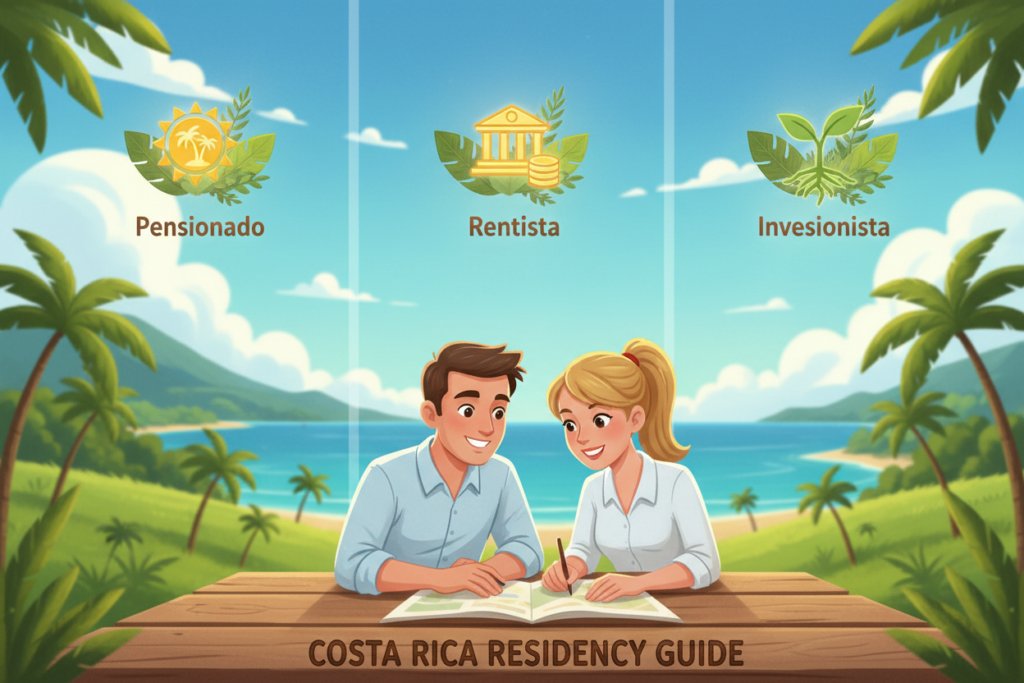
Costa Rica provides clear legal avenues for obtaining long-term residence. These are designed for specific financial situations—whether you’re a retiree, an investor, or have steady passive income.
Overview of Available Options
The Pensionado (Pensionado) category serves retirees. It requires a minimum $1,000 monthly pension from sources like Social Security.
The Rentista (Rentista) visa suits individuals with reliable income. It mandates proof of $2,500 per month for at least two years.
The Inversionista (Inversionista) program is for investors. It requires a $150,000 investment in Costa Rican real estate or a business.
Clarifying the Status of Digital Nomads
Many inquire about the Digital Nomad permit. Launched in 2021, it allows remote work stays but is explicitly not residency.
This visa offers no path to permanent residence or citizenship. If you aim for true residency with consistent foreign income, the Rentista pathway is your practical alternative.
Income Requirements for Costa Rica Residency Explained
Securing residency in Costa Rica hinges on meeting specific financial benchmarks set by immigration authorities. We’ll clarify the exact thresholds for each primary pathway.
Understanding the Financial Thresholds
For retirees, the Pensionado category requires a guaranteed pension of at least $1,000 USD per month. This must come from verifiable sources like Social Security or a company plan.
The Rentista visa serves individuals with stable passive income. You must prove $2,500 USD monthly for two years. Alternatively, a $60,000 deposit in a local bank can satisfy this.
Investors pursue the Inversionista program. It mandates a minimum $150,000 USD investment in Costa Rican real estate or a business. The property must be titled in your name.
These aren’t just numbers you claim. You must provide official documentation like pension letters or bank statements. Authorities also assess the longevity of your income to ensure ongoing compliance.
Step-by-Step Document Preparation for Residency
Before you set foot in Costa Rica, gathering and authenticating your paperwork is a critical step. A complete document package prevents delays and frustration. We guide clients through this essential pre-arrival phase.
Checklist of Required Documents and Apostilles/Translations
Start with a core checklist. You need a valid passport with at least six months remaining. Birth certificates and marriage certificates, if applicable, are mandatory.
These documents require an apostille from your home country. For Hague Convention nations like the U.S., this certification validates them for international use. You cannot complete this step after arriving.
All non-Spanish documents must be translated by an official translator certified in Costa Rica. This is a strict requirement. Notarization by a local notary public may also be needed.
Timelines and Prearrival Preparation
Timing is everything. Police clearance certificates are only valid for six months. Schedule their issuance close to your application date.
Your proof of income documentation should be recent. Bank statements or pension letters typically need to cover the past twelve months. Passport validity must extend well beyond your submission.
The most successful applicants arrive with a fully prepared dossier. Working with an experienced legal professional ensures no detail is overlooked. This proactive approach saves valuable time.
Who Qualifies for Costa Rica Residency?
The question of who can become a resident is answered by specific financial and personal criteria. We see two primary profiles: retirees with pensions and individuals with stable passive income.
Eligibility for Pensionado (Pensionado) with $1,000+ Pension
This pathway is designed for retirees. It requires proof of a guaranteed lifetime pension of at least $1,000 per month.
Qualifying income comes from government or corporate sources. This includes U.S. Social Security, military pensions, and company retirement plans. Critically, general investment or rental income does not qualify, even if it exceeds the threshold.
All applicants must provide a clean criminal record. A valid passport and apostilled birth certificate are also mandatory requirements.
Qualifying as Rentista (Rentista) with $2,500 Monthly Income
The Rentista visa serves younger individuals not yet retired. You must prove stable passive income of $2,500 monthly for two years.
Acceptable sources include investments, rental properties, or annuities. Alternatively, a $60,000 deposit in a Costa Rican bank satisfies this rule.
This residency category allows you to include your spouse and dependent children. Providing thorough proof of your ongoing income stream is essential for approval.
Navigating the Costa Rican Application Process
Submitting your residency application initiates a multi-stage review by Costa Rican authorities. This process requires patience and attention to detail. We guide clients through each official step.
Provisional Visa and Fingerprint Registration
Your first step is often a provisional visa from a Costa Rican consulate. This allows legal entry while your main application processes. Once in the country, you must complete fingerprint registration.
This separate appointment at the Ministry of Public Security is mandatory. It verifies your identity against international databases. Schedule this early to avoid delays in your immigration case.
Consulate Appointments and Tracking Your Application
Next, schedule your main appointment with the DGME immigration office. Use their online system and pay the fee at Banco de Costa Rica. Bring all original documents and copies to this meeting.
Officials will collect your biometric data and give you an expediente file number. Use this number to track your application’s progress online. Current government processing times vary by category.
Pensionado cases often take 8-12 months. Rentista visas typically require 6-10 months. Inversionista applications may conclude in 4-8 months.
You can stay legally in Costa Rica during this wait. If you must leave, obtain an exit permit first. Leaving without this permit cancels your application.
Common Mistakes and Pitfalls to Avoid During Your Application
Learning from the mistakes of others is one of the smartest strategies for navigating the Costa Rican immigration system. We see the same preventable errors causing costly delays.
Incomplete or Inaccurate Documentation
Submitting expired documents is a top error. Criminal background checks are only valid for six months. If they expire during the process, you must start over.
Missing apostilles or official translations will halt your application. Every foreign document needs proper authentication. Name inconsistencies across your paperwork also raise red flags.
Timing and Verification Errors
Poor coordination between gathering documents and submission wastes time. You must manage multiple expiration dates carefully.
Income verification mistakes are common. Providing bank statements without clear proof of the source can lead to denial. For detailed guidance, review this resource on common mistakes in Costa Rica residency.
Planning backward from your submission date helps avoid these pitfalls. A complete, accurate package is your best path forward.
Legal and Compliance Essentials for a Smooth Residency Application
Legal compliance forms the bedrock of any successful residency application in this country. Your paperwork must meet specific Costa Rican legal standards to be valid within their government system.
Importance of Notarized and Translated Documents
Costa Rica’s immigration process operates entirely in Spanish. Every document you submit becomes part of your official government file. For this reason, all non-Spanish documents require translation by a certified Costa Rican translator, known as a traductor oficial.
Translations prepared in your home country lack legal standing here. Certain documents, like financial declarations, also need notarization by a Costa Rican notary public (notario público). This adds a required layer of legal verification for the immigration authorities.
Navigating these requirements can be complex. When uncertain, verify information against official sources like migracion.go.cr. Working with an experienced attorney ensures your documents meet all standards. They help you avoid errors that cause delays. For a complete detailed paperwork guide, professional guidance is a practical investment for future residents.
Documenting Your Income and Proving Passive Revenue
Proving your financial stability is a non-negotiable pillar of any Costa Rica residency application. Immigration officers scrutinize your documentation to verify consistent, sustainable revenue. We help clients prepare bulletproof evidence for each pathway.
Acceptable Proof of Funds and Bank Statements
For Pensionado applicants, you need official letters from pension administrators. Social Security benefit statements or military retirement documents must confirm your $1,000 monthly payment is permanent. Bank deposits alone won’t suffice without this source documentation.
Rentista applicants must provide 12 months of bank statements showing regular $2,500 deposits. You also need proof of the income source—like investment accounts or rental agreements. Alternatively, a $60,000 deposit in a local bank with a withdrawal plan satisfies this requirement.
Inversionista investors submit property appraisals and title documents. Business investments require registration papers and capital transfer records. All funds must move through official banking channels.
Officers evaluate consistency, verifiability, and sustainability. Regular, predictable deposits are more convincing than irregular averages. Your documents must prove income will continue for years.
Key Tips for Successful and Stress-Free Application Submission
To ensure your application process is as smooth as possible, we recommend following a few key practices. A strategic approach from the start saves significant time and reduces stress later on.
Utilizing Professional Assistance and Resources
Working with an experienced legal professional familiar with the Costa Rican immigration system is invaluable. They provide current information and guide you through each step of the process.
This practical knowledge helps you avoid common errors that cause delays. Start gathering all required documents from your home country before you travel.
Proper organization is crucial. Keep digital and physical copies of everything. This preparation keeps your application on track.
Once approved, maintain your status by renewing your DIMEX card on time. Stay current with CAJA healthcare payments. Planning for these renewals is part of a successful long-term strategy.
Ready for expert guidance? Contact CRIE for assistance with your residency journey. Reach us via WhatsApp at +506 8706 3888, email info@crie.cr, or visit www.crie.cr.
Final Considerations & Next Steps on Your Residency Journey
Looking ahead, maintaining your residency status involves understanding both ongoing obligations and future opportunities. Your journey in Costa Rica typically progresses from temporary to permanent residency after three consecutive years.
Permanent status removes many restrictions and requires fewer renewals. After seven years, you may apply for citizenship, though it’s optional for most.
Tax planning is crucial. Costa Rica taxes only local income, but U.S. citizens must file returns. Professional advice ensures compliance in both countries.
Budget for annual costs like CAJA healthcare payments and DIMEX card fees. These are legal requirements for maintaining your status.
Ready to begin? Contact CRIE for expert guidance on your pathway. Reach us via WhatsApp at +506 8706 3888, email info@crie.cr, or visit www.crie.cr.
FAQ
What are the main residency options for moving to Costa Rica?
The primary pathways are the Pensionado, Rentista, and Inversionista visas. The Pensionado visa is for retirees with a guaranteed lifetime pension. The Rentista visa suits individuals with stable passive income. The Inversionista visa requires a significant financial investment in the country, like real estate or a business.
How much monthly income do I need to prove for residency?
For the Pensionado visa, you must prove a minimum lifetime pension of
FAQ
What are the main residency options for moving to Costa Rica?
The primary pathways are the Pensionado, Rentista, and Inversionista visas. The Pensionado visa is for retirees with a guaranteed lifetime pension. The Rentista visa suits individuals with stable passive income. The Inversionista visa requires a significant financial investment in the country, like real estate or a business.
How much monthly income do I need to prove for residency?
For the Pensionado visa, you must prove a minimum lifetime pension of $1,000 per month. For the Rentista visa, you need to demonstrate a stable passive income of at least $2,500 per month, guaranteed for two years. These are the current financial thresholds set by immigration.
Do digital nomads qualify for permanent residency?
No, digital nomads typically enter on a temporary one-year visa designed for remote workers. This visa does not directly lead to permanent resident status. To transition to permanent residency, you would later need to apply under a traditional category like Rentista, meeting its specific income requirements.
What documents are required for the application process?
You’ll need several key documents. These include a valid passport, birth certificate, marriage certificate (if applicable), and police clearance certificates. Crucially, you must provide official proof of your qualifying pension or income. All foreign documents require an apostille and a certified Spanish translation.
How long does the entire residency process take?
The timeline can vary. After submitting a complete application, receiving a provisional visa can take several months. The full approval for temporary residency often takes 6 to 12 months. We always advise starting document collection and apostille processes well before your planned move to avoid delays.
What is the biggest mistake applicants make?
The most common pitfall is submitting incomplete or inaccurate documentation. This includes documents without an apostille, missing translations, or bank statements that don’t clearly show the required monthly deposits. Even small errors can cause significant delays or a rejection, so meticulous preparation is key.
Why are apostilles and translations so important?
An apostille certifies the authenticity of your public documents (like birth certificates) for use in Costa Rica. Without it, your documents are invalid for the immigration process. Since Spanish is the official language, certified translations are legally required for all foreign-language documents. Skipping these steps will halt your application.
What counts as acceptable proof of funds or income?
Immigration accepts official letters from pension funds or Social Security confirming your lifetime monthly benefit. For the Rentista visa, you need bank statements showing regular monthly deposits of at least $2,500. The source must be passive, like investments or rental income. Salary from active employment typically does not qualify.
Should I hire a professional to help with my application?
While not mandatory, we strongly recommend it. A reputable local immigration attorney or facilitator understands the system’s nuances, stays updated on law changes, and can navigate bureaucratic steps efficiently. Their guidance significantly reduces stress and the risk of costly errors that can derail your plans.
,000 per month. For the Rentista visa, you need to demonstrate a stable passive income of at least ,500 per month, guaranteed for two years. These are the current financial thresholds set by immigration.
Do digital nomads qualify for permanent residency?
No, digital nomads typically enter on a temporary one-year visa designed for remote workers. This visa does not directly lead to permanent resident status. To transition to permanent residency, you would later need to apply under a traditional category like Rentista, meeting its specific income requirements.
What documents are required for the application process?
You’ll need several key documents. These include a valid passport, birth certificate, marriage certificate (if applicable), and police clearance certificates. Crucially, you must provide official proof of your qualifying pension or income. All foreign documents require an apostille and a certified Spanish translation.
How long does the entire residency process take?
The timeline can vary. After submitting a complete application, receiving a provisional visa can take several months. The full approval for temporary residency often takes 6 to 12 months. We always advise starting document collection and apostille processes well before your planned move to avoid delays.
What is the biggest mistake applicants make?
The most common pitfall is submitting incomplete or inaccurate documentation. This includes documents without an apostille, missing translations, or bank statements that don’t clearly show the required monthly deposits. Even small errors can cause significant delays or a rejection, so meticulous preparation is key.
Why are apostilles and translations so important?
An apostille certifies the authenticity of your public documents (like birth certificates) for use in Costa Rica. Without it, your documents are invalid for the immigration process. Since Spanish is the official language, certified translations are legally required for all foreign-language documents. Skipping these steps will halt your application.
What counts as acceptable proof of funds or income?
Immigration accepts official letters from pension funds or Social Security confirming your lifetime monthly benefit. For the Rentista visa, you need bank statements showing regular monthly deposits of at least ,500. The source must be passive, like investments or rental income. Salary from active employment typically does not qualify.
Should I hire a professional to help with my application?
While not mandatory, we strongly recommend it. A reputable local immigration attorney or facilitator understands the system’s nuances, stays updated on law changes, and can navigate bureaucratic steps efficiently. Their guidance significantly reduces stress and the risk of costly errors that can derail your plans.
Article by Glenn Tellier (Founder of CRIE and Grupo Gap)
Don't wait, contact us right now!
Call or WhatsApp Costa Rica +506 8373 2085 or +506 8706 3888
Call USA/Canada +1 305-906-6784